A Bend in the River (Easton Press Signed Collector's Edition)
NAIPAUL, V. S. A Bend in the River. Norwalk, Connecticut: The Easton Press, 2000.
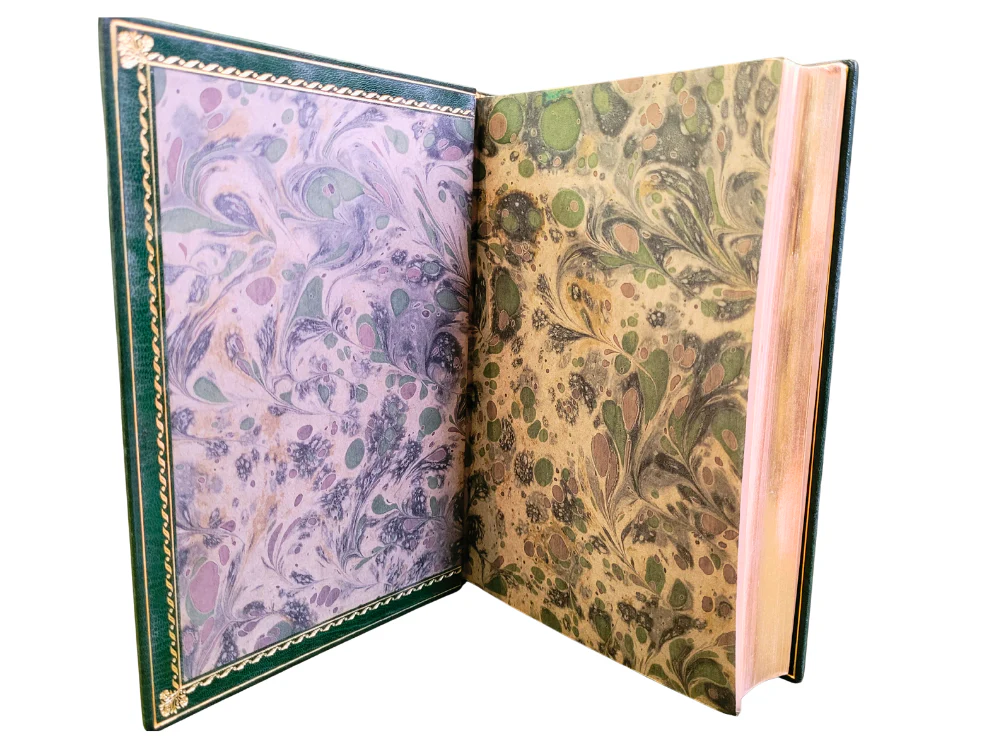
8vo. Full red leather. Spine with four raised bands, 22-carat gilt accents. Gilt design, lettering and fore-edges. All edges gilt. Moiré silk endpapers. Satin ribbon page marker. 278 pp. Signed Collector's Edition. Part of the Easton Press Signed Modern Classics series. Signed by the author on the special limitation page. Includes signed Certificate of Authenticity, edition card, and bookplate adhered to front endpaper. Originally published London: André Deutsch; New York: Alfred A. Knopf, 1979.
Vidiadhar Surajprasad Naipaul (1932–2018) was born in Trinidad to a family of Indian Hindu Brahmin descent whose forebears had come to the island as indentured agricultural labourers. He won a scholarship to Oxford at seventeen, settled in England, and produced over his long career one of the most substantial and contested bodies of work in modern literature in English: novels, travel books, and essays that circled obsessively around the questions of colonial history, postcolonial failure, displacement, and the relationship between culture and civilisation. He was knighted in 1990. In 2001 — the year after this Easton Press edition was produced — he was awarded the Nobel Prize for Literature, the Swedish Academy citing his having united perceptive narrative and incorruptible scrutiny in works that compel us to see the presence of suppressed histories. He died in August 2018.
A Bend in the River was published in 1979, was shortlisted for the Booker Prize, and was ranked by the Modern Library in 1998 among the hundred best English-language novels of the twentieth century. It is set in an unnamed Central African country — widely understood to be Zaire under the dictatorship of Mobutu Sese Seko — and narrated by Salim, a Muslim of Indian-African descent who leaves the turbulent coast of East Africa to set up a trading shop in an isolated town at the bend of a great river in the interior. The country is struggling to construct a modern identity from the ruins of colonial dispossession and the dysfunction of independence, and the town Salim inhabits exists in a permanent state of provisional order — schools and new buildings rising from the bush, a rhetoric of the New Domain and the Big Man issuing from the capital — that is always threatening to revert to something older and darker.
Naipaul's rendering of postcolonial Africa has generated sustained controversy: critics have argued that it reflects a colonial gaze, presenting African political failure from the perspective of an outsider whose sympathy for the project of African self-determination is limited. Others have read it as a precise and unsentimental account of what actually happened in countries that were handed independence without the institutions to sustain it. The argument continues, which is another way of saying the novel has not been safely absorbed into sentiment. John Updike praised Naipaul as "a master of" his particular form, and the opening sentence — "The world is what it is; men who are nothing, who allow themselves to become nothing, have no place in it" — is among the most uncompromising openings in modern fiction.
Fine. Presenting as new.
This book is currently not on display in store. If you would like more information or to arrange a viewing, please contact: [email protected]
Catalogue Number: HH000535
Product Information
Product Information
Shipping & Returns
Shipping & Returns


A Bend in the River (Easton Press Signed Collector's Edition)
A Bend in the River (Easton Press Signed Collector's Edition)
NAIPAUL, V. S. A Bend in the River. Norwalk, Connecticut: The Easton Press, 2000.
8vo. Full red leather. Spine with four raised bands, 22-carat gilt accents. Gilt design, lettering and fore-edges. All edges gilt. Moiré silk endpapers. Satin ribbon page marker. 278 pp. Signed Collector's Edition. Part of the Easton Press Signed Modern Classics series. Signed by the author on the special limitation page. Includes signed Certificate of Authenticity, edition card, and bookplate adhered to front endpaper. Originally published London: André Deutsch; New York: Alfred A. Knopf, 1979.
Vidiadhar Surajprasad Naipaul (1932–2018) was born in Trinidad to a family of Indian Hindu Brahmin descent whose forebears had come to the island as indentured agricultural labourers. He won a scholarship to Oxford at seventeen, settled in England, and produced over his long career one of the most substantial and contested bodies of work in modern literature in English: novels, travel books, and essays that circled obsessively around the questions of colonial history, postcolonial failure, displacement, and the relationship between culture and civilisation. He was knighted in 1990. In 2001 — the year after this Easton Press edition was produced — he was awarded the Nobel Prize for Literature, the Swedish Academy citing his having united perceptive narrative and incorruptible scrutiny in works that compel us to see the presence of suppressed histories. He died in August 2018.
A Bend in the River was published in 1979, was shortlisted for the Booker Prize, and was ranked by the Modern Library in 1998 among the hundred best English-language novels of the twentieth century. It is set in an unnamed Central African country — widely understood to be Zaire under the dictatorship of Mobutu Sese Seko — and narrated by Salim, a Muslim of Indian-African descent who leaves the turbulent coast of East Africa to set up a trading shop in an isolated town at the bend of a great river in the interior. The country is struggling to construct a modern identity from the ruins of colonial dispossession and the dysfunction of independence, and the town Salim inhabits exists in a permanent state of provisional order — schools and new buildings rising from the bush, a rhetoric of the New Domain and the Big Man issuing from the capital — that is always threatening to revert to something older and darker.
Naipaul's rendering of postcolonial Africa has generated sustained controversy: critics have argued that it reflects a colonial gaze, presenting African political failure from the perspective of an outsider whose sympathy for the project of African self-determination is limited. Others have read it as a precise and unsentimental account of what actually happened in countries that were handed independence without the institutions to sustain it. The argument continues, which is another way of saying the novel has not been safely absorbed into sentiment. John Updike praised Naipaul as "a master of" his particular form, and the opening sentence — "The world is what it is; men who are nothing, who allow themselves to become nothing, have no place in it" — is among the most uncompromising openings in modern fiction.
Fine. Presenting as new.
This book is currently not on display in store. If you would like more information or to arrange a viewing, please contact: [email protected]
Catalogue Number: HH000535
Original: $72.85
-65%$72.85
$25.50Product Information
Product Information
Shipping & Returns
Shipping & Returns
Description
NAIPAUL, V. S. A Bend in the River. Norwalk, Connecticut: The Easton Press, 2000.
8vo. Full red leather. Spine with four raised bands, 22-carat gilt accents. Gilt design, lettering and fore-edges. All edges gilt. Moiré silk endpapers. Satin ribbon page marker. 278 pp. Signed Collector's Edition. Part of the Easton Press Signed Modern Classics series. Signed by the author on the special limitation page. Includes signed Certificate of Authenticity, edition card, and bookplate adhered to front endpaper. Originally published London: André Deutsch; New York: Alfred A. Knopf, 1979.
Vidiadhar Surajprasad Naipaul (1932–2018) was born in Trinidad to a family of Indian Hindu Brahmin descent whose forebears had come to the island as indentured agricultural labourers. He won a scholarship to Oxford at seventeen, settled in England, and produced over his long career one of the most substantial and contested bodies of work in modern literature in English: novels, travel books, and essays that circled obsessively around the questions of colonial history, postcolonial failure, displacement, and the relationship between culture and civilisation. He was knighted in 1990. In 2001 — the year after this Easton Press edition was produced — he was awarded the Nobel Prize for Literature, the Swedish Academy citing his having united perceptive narrative and incorruptible scrutiny in works that compel us to see the presence of suppressed histories. He died in August 2018.
A Bend in the River was published in 1979, was shortlisted for the Booker Prize, and was ranked by the Modern Library in 1998 among the hundred best English-language novels of the twentieth century. It is set in an unnamed Central African country — widely understood to be Zaire under the dictatorship of Mobutu Sese Seko — and narrated by Salim, a Muslim of Indian-African descent who leaves the turbulent coast of East Africa to set up a trading shop in an isolated town at the bend of a great river in the interior. The country is struggling to construct a modern identity from the ruins of colonial dispossession and the dysfunction of independence, and the town Salim inhabits exists in a permanent state of provisional order — schools and new buildings rising from the bush, a rhetoric of the New Domain and the Big Man issuing from the capital — that is always threatening to revert to something older and darker.
Naipaul's rendering of postcolonial Africa has generated sustained controversy: critics have argued that it reflects a colonial gaze, presenting African political failure from the perspective of an outsider whose sympathy for the project of African self-determination is limited. Others have read it as a precise and unsentimental account of what actually happened in countries that were handed independence without the institutions to sustain it. The argument continues, which is another way of saying the novel has not been safely absorbed into sentiment. John Updike praised Naipaul as "a master of" his particular form, and the opening sentence — "The world is what it is; men who are nothing, who allow themselves to become nothing, have no place in it" — is among the most uncompromising openings in modern fiction.
Fine. Presenting as new.
This book is currently not on display in store. If you would like more information or to arrange a viewing, please contact: [email protected]
Catalogue Number: HH000535