Banker to the Poor (Easton Press Signed Collector's Edition)
YUNUS, Muhammad. Banker to the Poor: Micro-Lending and the Battle Against World Poverty. Norwalk, Connecticut: The Easton Press, 2010.
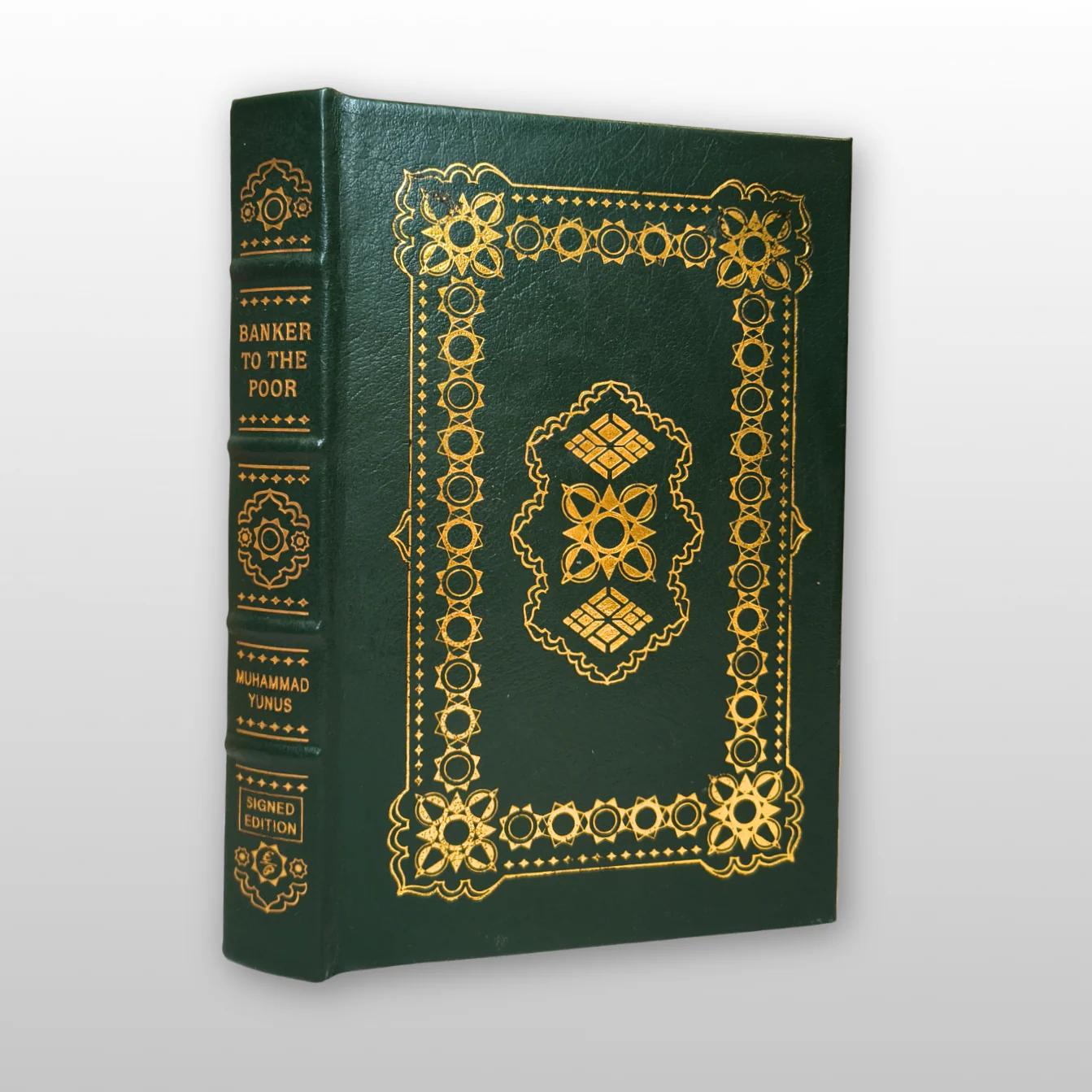
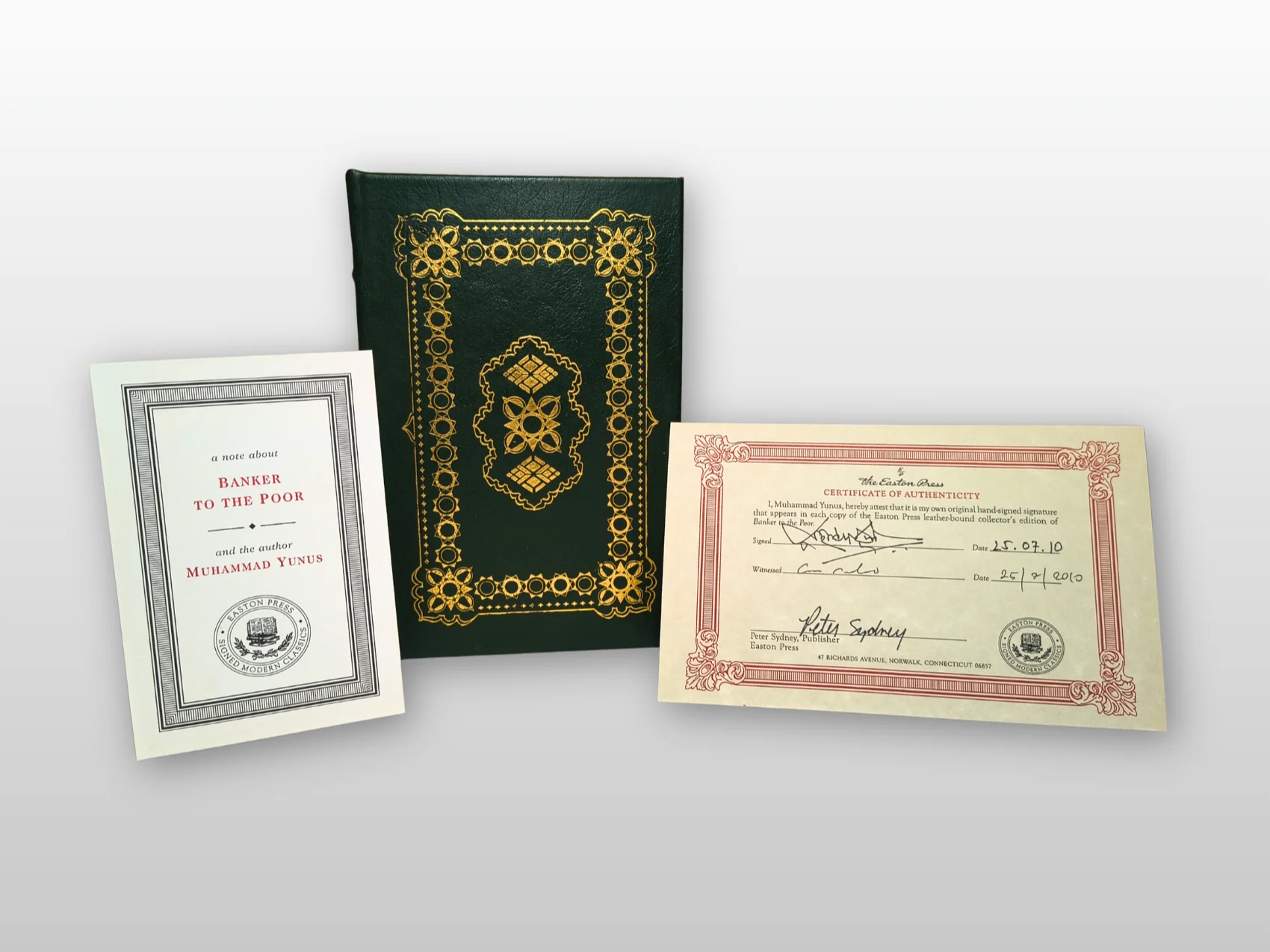
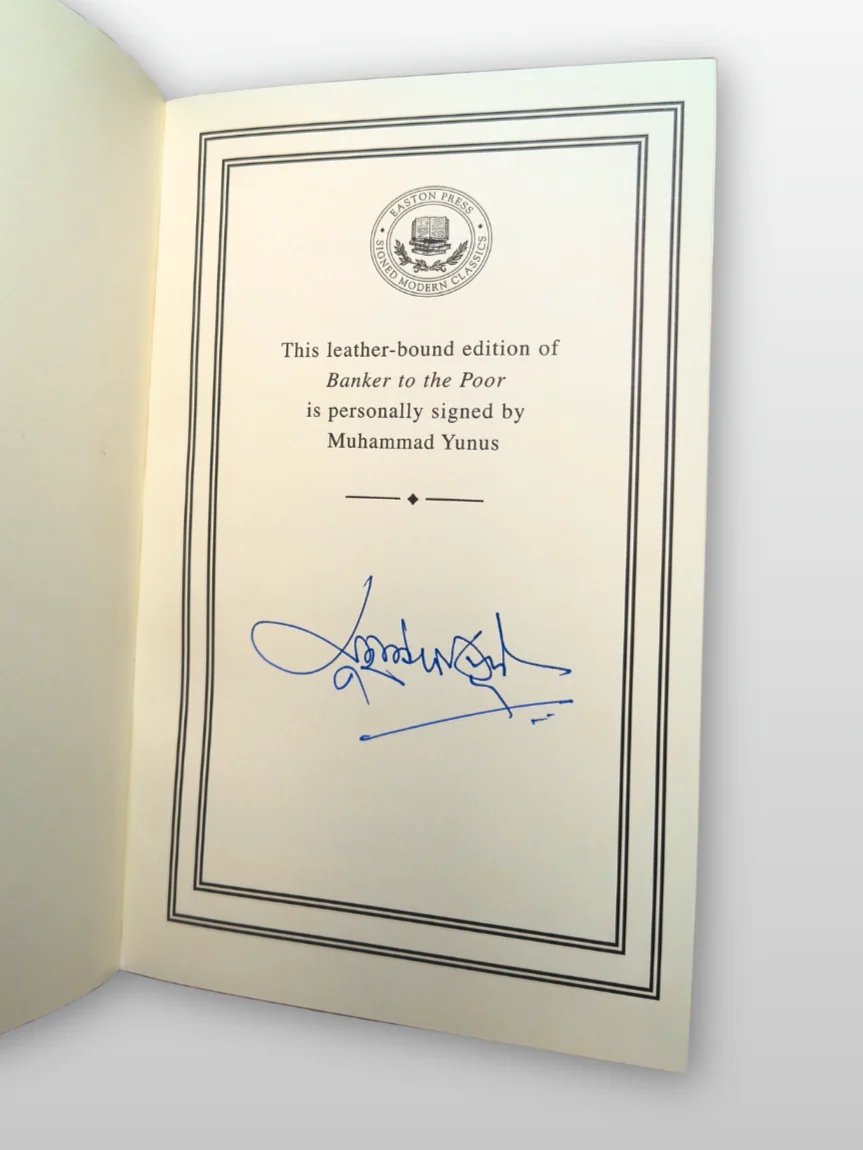
Octavo. Full green leather. Spine with four raised bands, 22-carat gilt accents. Gilt design, lettering and fore-edges. All edges gilt. Moiré silk endpapers. Satin ribbon page marker. 289 pp. Signed Collector's Edition. Part of the Easton Press Signed Modern Classics series. Signed by the author on the special signature page. Includes signed Certificate of Authenticity, edition card, and bookplate adhered to front endpaper. Originally published New York: PublicAffairs, 1999.
Muhammad Yunus (b. 1940) was born in Chittagong, then part of British India, studied economics at Dhaka University, and came to the United States on a Fulbright scholarship, completing his doctorate at Vanderbilt University in 1969. He returned to Bangladesh and in 1972 became head of the economics department at Chittagong University. In 1974, during a catastrophic famine that killed hundreds of thousands, he found himself teaching elegant economic theories to students in a country where people were dying of hunger outside the classroom window. The collision between his academic training and this reality redirected the rest of his life.
In 1976, Yunus visited the village of Jobra near Chittagong and met a woman who made bamboo stools for a living. She needed the equivalent of twenty-two cents to buy the bamboo she required for a day's work; without it she was forced to borrow from a trader at rates that ensured she would never escape debt. Yunus lent twenty-seven dollars of his own money to forty-two villagers in similar situations. Every loan was repaid. The experiment became a pilot project, the pilot project became Grameen Bank, and Grameen Bank — formally established in 1983 against the advice of every financial and governmental authority Yunus approached — became one of the most significant institutional innovations in the history of economic development. It now provides billions of dollars in micro-loans to millions of families in Bangladesh, 94 per cent of them women, with repayment rates approaching 100 per cent.
Banker to the Poor is Yunus's own account of how he arrived at the idea of micro-credit and how he built the institution that proved it could work. It is simultaneously a memoir, an economic argument, and a meditation on the relationship between poverty and the systemic failures of conventional banking — which proceeds, as Yunus observed, on the assumption that poor people are not creditworthy, an assumption that Grameen Bank has spent four decades disproving. The Los Angeles Times described it as "well-reasoned yet passionate"; the Washington Post called it "stirring." In 2006, Muhammad Yunus and Grameen Bank were jointly awarded the Nobel Peace Prize for their efforts to create economic and social development from below.
Fine. Presenting as new.
This book is currently not on display in store. If you would like more information or to arrange a viewing, please contact: [email protected]
Catalogue Number: HH000526
Product Information
Product Information
Shipping & Returns
Shipping & Returns
Banker to the Poor (Easton Press Signed Collector's Edition)
Banker to the Poor (Easton Press Signed Collector's Edition)
YUNUS, Muhammad. Banker to the Poor: Micro-Lending and the Battle Against World Poverty. Norwalk, Connecticut: The Easton Press, 2010.
Octavo. Full green leather. Spine with four raised bands, 22-carat gilt accents. Gilt design, lettering and fore-edges. All edges gilt. Moiré silk endpapers. Satin ribbon page marker. 289 pp. Signed Collector's Edition. Part of the Easton Press Signed Modern Classics series. Signed by the author on the special signature page. Includes signed Certificate of Authenticity, edition card, and bookplate adhered to front endpaper. Originally published New York: PublicAffairs, 1999.
Muhammad Yunus (b. 1940) was born in Chittagong, then part of British India, studied economics at Dhaka University, and came to the United States on a Fulbright scholarship, completing his doctorate at Vanderbilt University in 1969. He returned to Bangladesh and in 1972 became head of the economics department at Chittagong University. In 1974, during a catastrophic famine that killed hundreds of thousands, he found himself teaching elegant economic theories to students in a country where people were dying of hunger outside the classroom window. The collision between his academic training and this reality redirected the rest of his life.
In 1976, Yunus visited the village of Jobra near Chittagong and met a woman who made bamboo stools for a living. She needed the equivalent of twenty-two cents to buy the bamboo she required for a day's work; without it she was forced to borrow from a trader at rates that ensured she would never escape debt. Yunus lent twenty-seven dollars of his own money to forty-two villagers in similar situations. Every loan was repaid. The experiment became a pilot project, the pilot project became Grameen Bank, and Grameen Bank — formally established in 1983 against the advice of every financial and governmental authority Yunus approached — became one of the most significant institutional innovations in the history of economic development. It now provides billions of dollars in micro-loans to millions of families in Bangladesh, 94 per cent of them women, with repayment rates approaching 100 per cent.
Banker to the Poor is Yunus's own account of how he arrived at the idea of micro-credit and how he built the institution that proved it could work. It is simultaneously a memoir, an economic argument, and a meditation on the relationship between poverty and the systemic failures of conventional banking — which proceeds, as Yunus observed, on the assumption that poor people are not creditworthy, an assumption that Grameen Bank has spent four decades disproving. The Los Angeles Times described it as "well-reasoned yet passionate"; the Washington Post called it "stirring." In 2006, Muhammad Yunus and Grameen Bank were jointly awarded the Nobel Peace Prize for their efforts to create economic and social development from below.
Fine. Presenting as new.
This book is currently not on display in store. If you would like more information or to arrange a viewing, please contact: [email protected]
Catalogue Number: HH000526
Original: $62.85
-65%$62.85
$22.00Product Information
Product Information
Shipping & Returns
Shipping & Returns
Description
YUNUS, Muhammad. Banker to the Poor: Micro-Lending and the Battle Against World Poverty. Norwalk, Connecticut: The Easton Press, 2010.
Octavo. Full green leather. Spine with four raised bands, 22-carat gilt accents. Gilt design, lettering and fore-edges. All edges gilt. Moiré silk endpapers. Satin ribbon page marker. 289 pp. Signed Collector's Edition. Part of the Easton Press Signed Modern Classics series. Signed by the author on the special signature page. Includes signed Certificate of Authenticity, edition card, and bookplate adhered to front endpaper. Originally published New York: PublicAffairs, 1999.
Muhammad Yunus (b. 1940) was born in Chittagong, then part of British India, studied economics at Dhaka University, and came to the United States on a Fulbright scholarship, completing his doctorate at Vanderbilt University in 1969. He returned to Bangladesh and in 1972 became head of the economics department at Chittagong University. In 1974, during a catastrophic famine that killed hundreds of thousands, he found himself teaching elegant economic theories to students in a country where people were dying of hunger outside the classroom window. The collision between his academic training and this reality redirected the rest of his life.
In 1976, Yunus visited the village of Jobra near Chittagong and met a woman who made bamboo stools for a living. She needed the equivalent of twenty-two cents to buy the bamboo she required for a day's work; without it she was forced to borrow from a trader at rates that ensured she would never escape debt. Yunus lent twenty-seven dollars of his own money to forty-two villagers in similar situations. Every loan was repaid. The experiment became a pilot project, the pilot project became Grameen Bank, and Grameen Bank — formally established in 1983 against the advice of every financial and governmental authority Yunus approached — became one of the most significant institutional innovations in the history of economic development. It now provides billions of dollars in micro-loans to millions of families in Bangladesh, 94 per cent of them women, with repayment rates approaching 100 per cent.
Banker to the Poor is Yunus's own account of how he arrived at the idea of micro-credit and how he built the institution that proved it could work. It is simultaneously a memoir, an economic argument, and a meditation on the relationship between poverty and the systemic failures of conventional banking — which proceeds, as Yunus observed, on the assumption that poor people are not creditworthy, an assumption that Grameen Bank has spent four decades disproving. The Los Angeles Times described it as "well-reasoned yet passionate"; the Washington Post called it "stirring." In 2006, Muhammad Yunus and Grameen Bank were jointly awarded the Nobel Peace Prize for their efforts to create economic and social development from below.
Fine. Presenting as new.
This book is currently not on display in store. If you would like more information or to arrange a viewing, please contact: [email protected]
Catalogue Number: HH000526