Burr (Easton Press Signed Collector's Edition)
VIDAL, Gore. Burr: A Novel. Norwalk, Connecticut: The Easton Press, 2000.
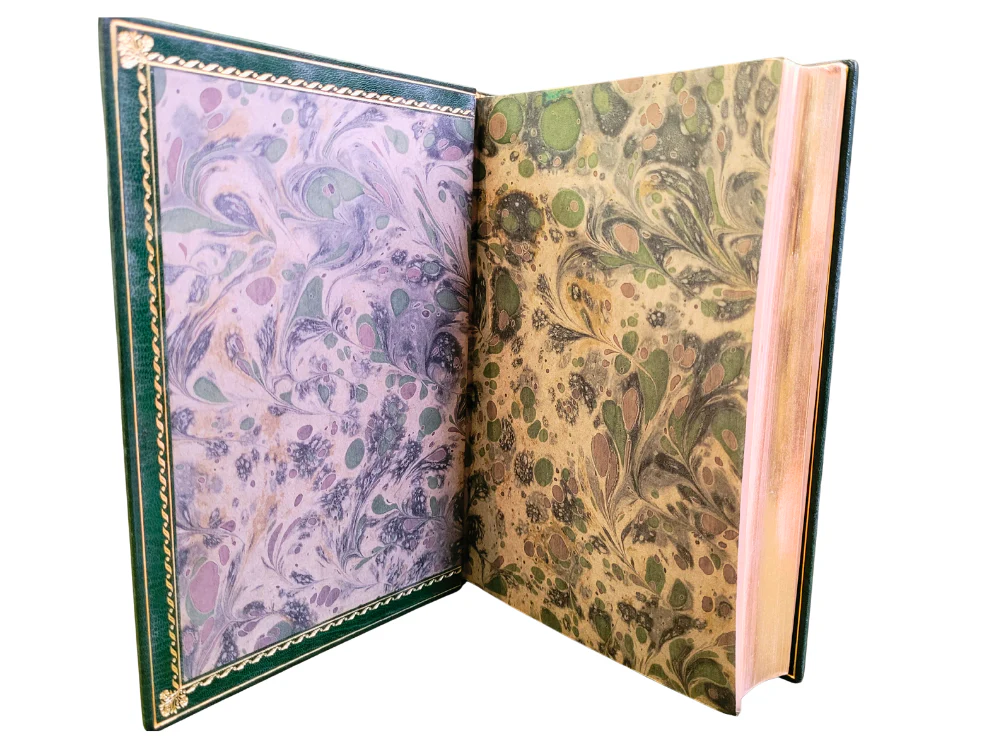
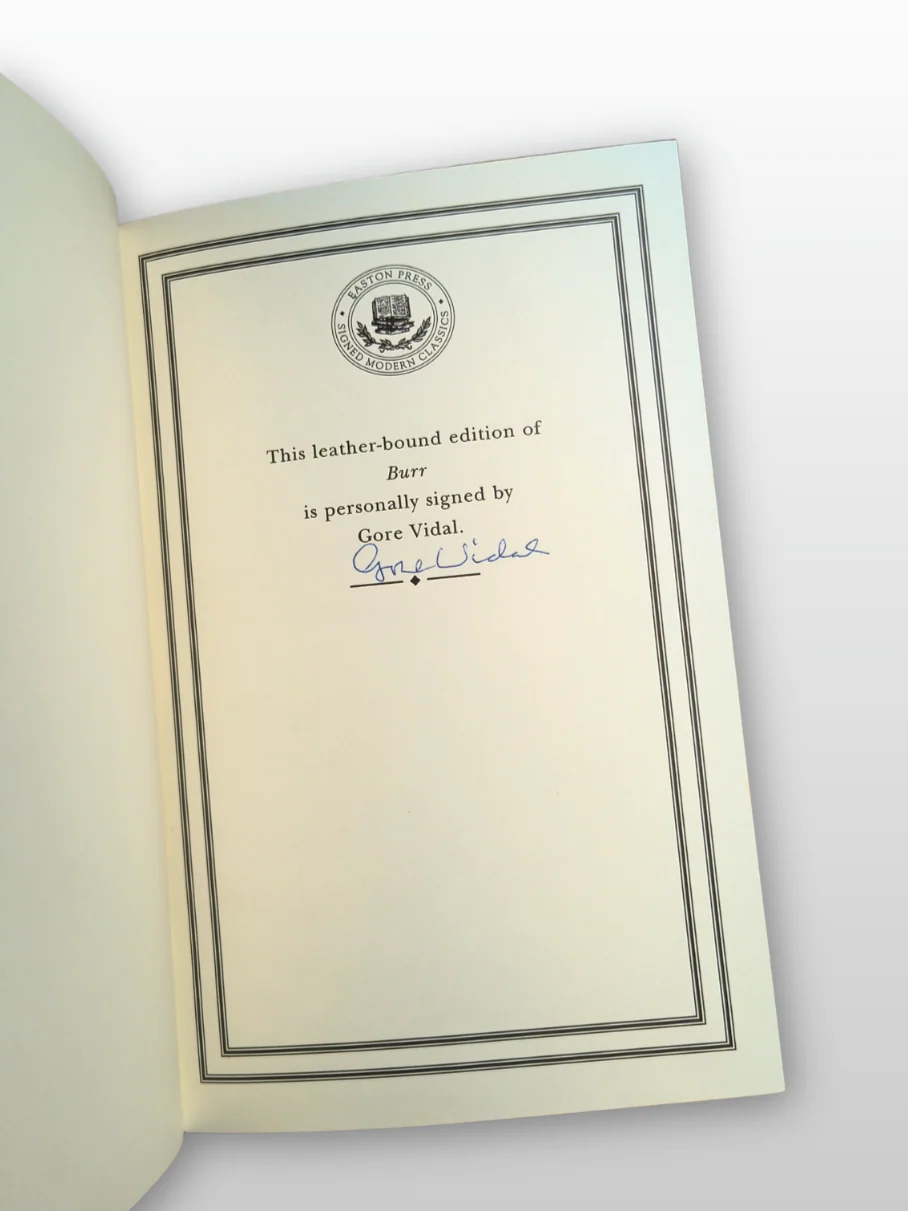
Octavo. Full black leather. Spine with five raised bands, 22-carat gilt accents. Gilt decorations to spine and covers. All edges gilt. Peach silk moiré endpapers. Satin ribbon page marker. [viii], 430 pp. Signed Collector's Edition. Signed by the author on the signature page. Includes signed Certificate of Authenticity and edition card. Originally published New York: Random House, 1973.
Gore Vidal (1925–2012) — born Eugene Luther Gore Vidal Jr. at the United States Military Academy at West Point, the grandson of a blind Oklahoma senator whose papers he read aloud as a child and whose political world he absorbed before he had a name for it — produced over the course of his career one of the most sustained and ambitious projects in American historical fiction: seven novels, collectively titled Narratives of Empire, tracing the history of the United States from the Revolution through the Second World War. Burr, published in 1973 and the first in the sequence chronologically though not in order of composition, was a finalist for the National Book Award and remains the most widely read of the seven.
Aaron Burr (1756–1836) was the third Vice President of the United States, the man who shot and killed Alexander Hamilton in a duel at Weehawken, New Jersey, on 11 July 1804, and was subsequently tried for treason — acquitted, but politically destroyed — before spending years in European exile and finally returning to New York to live out a long, impoverished old age practising law. He was, depending on who was asked, a brilliant man wronged by his enemies, or the most dangerous person ever to hold high office in the United States. Hamilton held the second view; Jefferson, who despised Hamilton, held a version of the first; history has generally followed Hamilton.
Vidal's novel holds neither view and both. The outer narrative is supplied by Charlie Schuyler, a young journalist in New York in 1833 who becomes Burr's law clerk and, at Burr's direction, begins secretly transcribing the old man's recollections of his life. What Burr recalls — Washington, Hamilton, Jefferson, Adams, the Revolution, the duel, the treason trial, the years in Europe — is rendered with Vidal's characteristic combination of exhaustive historical research and gleeful irreverence. The Founding Fathers as Burr remembers them are vain, scheming, sexually complicated, financially precarious men who happened to be present at the creation of something larger than themselves. The irony is never merely satirical: Vidal's Burr genuinely loved his country and was destroyed by it, and the novel's comedy and its melancholy are inseparable.
Burr is the first volume of the Narratives of Empire series, which continues with 1876 (1976), Lincoln (1984), Empire (1987), Hollywood (1990), Washington D.C. (1967), and The Golden Age (2000). Signed copies of Vidal's work carry additional significance following his death in 2012.
Near fine. Some very minor loss to cover gilt; otherwise fine throughout.
This book is currently not on display in store. If you would like more information or to arrange a viewing, please contact: [email protected]
Catalogue Number: HH000503
Product Information
Product Information
Shipping & Returns
Shipping & Returns


Burr (Easton Press Signed Collector's Edition)
Burr (Easton Press Signed Collector's Edition)
VIDAL, Gore. Burr: A Novel. Norwalk, Connecticut: The Easton Press, 2000.
Octavo. Full black leather. Spine with five raised bands, 22-carat gilt accents. Gilt decorations to spine and covers. All edges gilt. Peach silk moiré endpapers. Satin ribbon page marker. [viii], 430 pp. Signed Collector's Edition. Signed by the author on the signature page. Includes signed Certificate of Authenticity and edition card. Originally published New York: Random House, 1973.
Gore Vidal (1925–2012) — born Eugene Luther Gore Vidal Jr. at the United States Military Academy at West Point, the grandson of a blind Oklahoma senator whose papers he read aloud as a child and whose political world he absorbed before he had a name for it — produced over the course of his career one of the most sustained and ambitious projects in American historical fiction: seven novels, collectively titled Narratives of Empire, tracing the history of the United States from the Revolution through the Second World War. Burr, published in 1973 and the first in the sequence chronologically though not in order of composition, was a finalist for the National Book Award and remains the most widely read of the seven.
Aaron Burr (1756–1836) was the third Vice President of the United States, the man who shot and killed Alexander Hamilton in a duel at Weehawken, New Jersey, on 11 July 1804, and was subsequently tried for treason — acquitted, but politically destroyed — before spending years in European exile and finally returning to New York to live out a long, impoverished old age practising law. He was, depending on who was asked, a brilliant man wronged by his enemies, or the most dangerous person ever to hold high office in the United States. Hamilton held the second view; Jefferson, who despised Hamilton, held a version of the first; history has generally followed Hamilton.
Vidal's novel holds neither view and both. The outer narrative is supplied by Charlie Schuyler, a young journalist in New York in 1833 who becomes Burr's law clerk and, at Burr's direction, begins secretly transcribing the old man's recollections of his life. What Burr recalls — Washington, Hamilton, Jefferson, Adams, the Revolution, the duel, the treason trial, the years in Europe — is rendered with Vidal's characteristic combination of exhaustive historical research and gleeful irreverence. The Founding Fathers as Burr remembers them are vain, scheming, sexually complicated, financially precarious men who happened to be present at the creation of something larger than themselves. The irony is never merely satirical: Vidal's Burr genuinely loved his country and was destroyed by it, and the novel's comedy and its melancholy are inseparable.
Burr is the first volume of the Narratives of Empire series, which continues with 1876 (1976), Lincoln (1984), Empire (1987), Hollywood (1990), Washington D.C. (1967), and The Golden Age (2000). Signed copies of Vidal's work carry additional significance following his death in 2012.
Near fine. Some very minor loss to cover gilt; otherwise fine throughout.
This book is currently not on display in store. If you would like more information or to arrange a viewing, please contact: [email protected]
Catalogue Number: HH000503
Original: $52.14
-65%$52.14
$18.25Product Information
Product Information
Shipping & Returns
Shipping & Returns
Description
VIDAL, Gore. Burr: A Novel. Norwalk, Connecticut: The Easton Press, 2000.
Octavo. Full black leather. Spine with five raised bands, 22-carat gilt accents. Gilt decorations to spine and covers. All edges gilt. Peach silk moiré endpapers. Satin ribbon page marker. [viii], 430 pp. Signed Collector's Edition. Signed by the author on the signature page. Includes signed Certificate of Authenticity and edition card. Originally published New York: Random House, 1973.
Gore Vidal (1925–2012) — born Eugene Luther Gore Vidal Jr. at the United States Military Academy at West Point, the grandson of a blind Oklahoma senator whose papers he read aloud as a child and whose political world he absorbed before he had a name for it — produced over the course of his career one of the most sustained and ambitious projects in American historical fiction: seven novels, collectively titled Narratives of Empire, tracing the history of the United States from the Revolution through the Second World War. Burr, published in 1973 and the first in the sequence chronologically though not in order of composition, was a finalist for the National Book Award and remains the most widely read of the seven.
Aaron Burr (1756–1836) was the third Vice President of the United States, the man who shot and killed Alexander Hamilton in a duel at Weehawken, New Jersey, on 11 July 1804, and was subsequently tried for treason — acquitted, but politically destroyed — before spending years in European exile and finally returning to New York to live out a long, impoverished old age practising law. He was, depending on who was asked, a brilliant man wronged by his enemies, or the most dangerous person ever to hold high office in the United States. Hamilton held the second view; Jefferson, who despised Hamilton, held a version of the first; history has generally followed Hamilton.
Vidal's novel holds neither view and both. The outer narrative is supplied by Charlie Schuyler, a young journalist in New York in 1833 who becomes Burr's law clerk and, at Burr's direction, begins secretly transcribing the old man's recollections of his life. What Burr recalls — Washington, Hamilton, Jefferson, Adams, the Revolution, the duel, the treason trial, the years in Europe — is rendered with Vidal's characteristic combination of exhaustive historical research and gleeful irreverence. The Founding Fathers as Burr remembers them are vain, scheming, sexually complicated, financially precarious men who happened to be present at the creation of something larger than themselves. The irony is never merely satirical: Vidal's Burr genuinely loved his country and was destroyed by it, and the novel's comedy and its melancholy are inseparable.
Burr is the first volume of the Narratives of Empire series, which continues with 1876 (1976), Lincoln (1984), Empire (1987), Hollywood (1990), Washington D.C. (1967), and The Golden Age (2000). Signed copies of Vidal's work carry additional significance following his death in 2012.
Near fine. Some very minor loss to cover gilt; otherwise fine throughout.
This book is currently not on display in store. If you would like more information or to arrange a viewing, please contact: [email protected]
Catalogue Number: HH000503