Coma (Easton Press Signed Collector's Edition)
COOK, Robin. Coma. Norwalk, Connecticut: The Easton Press, 2016.
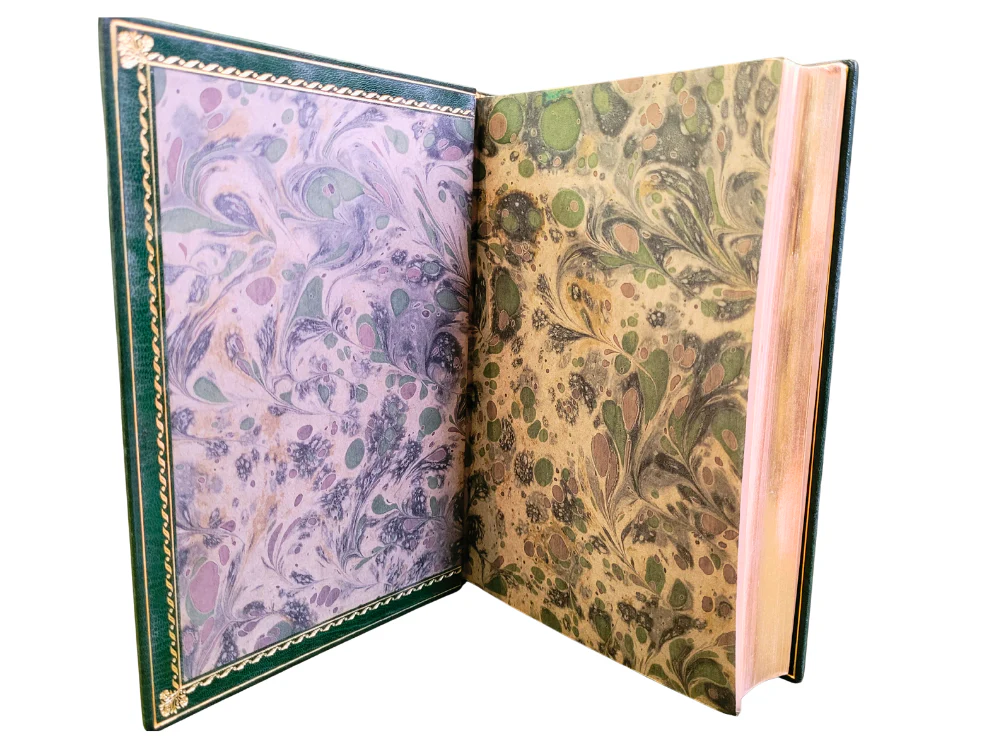
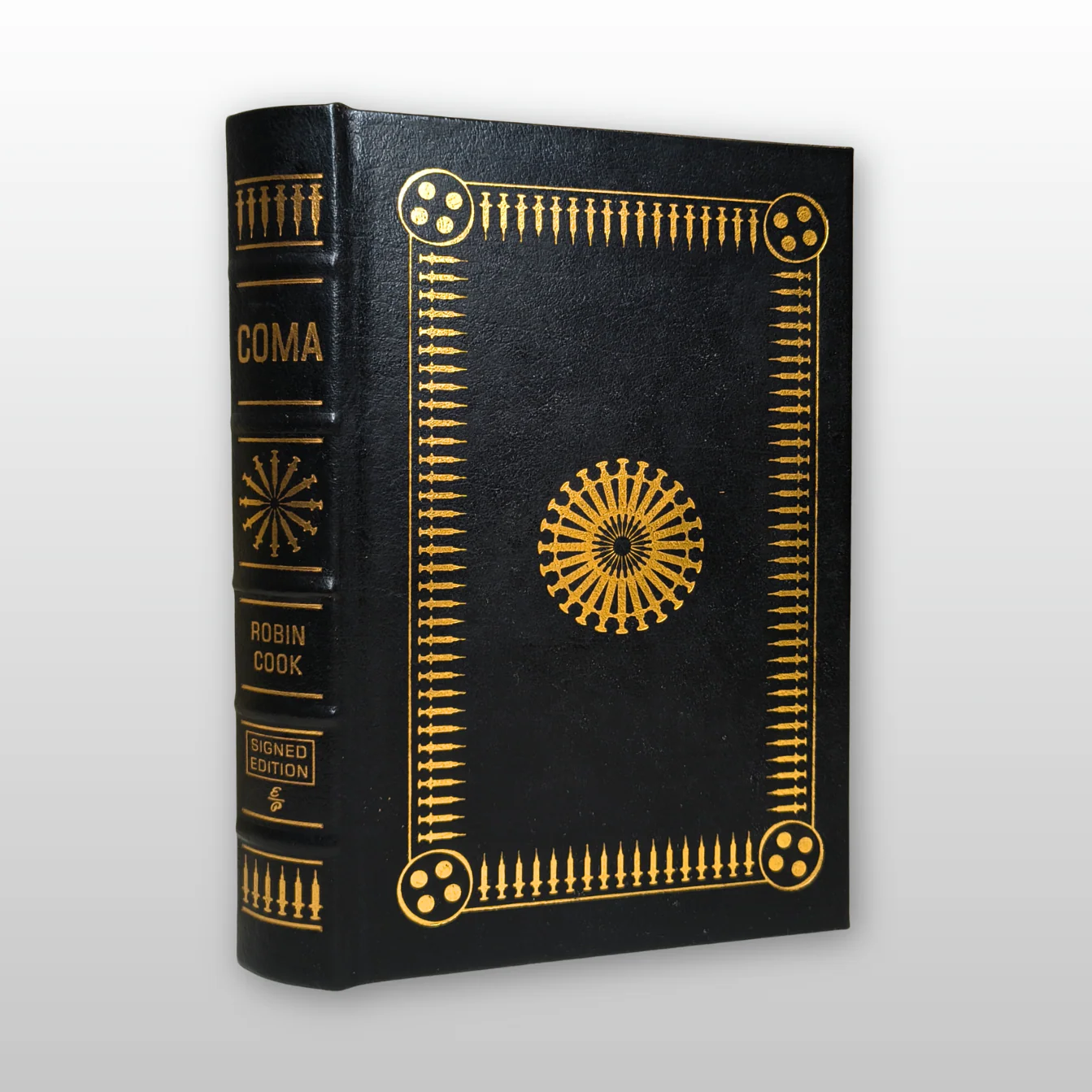
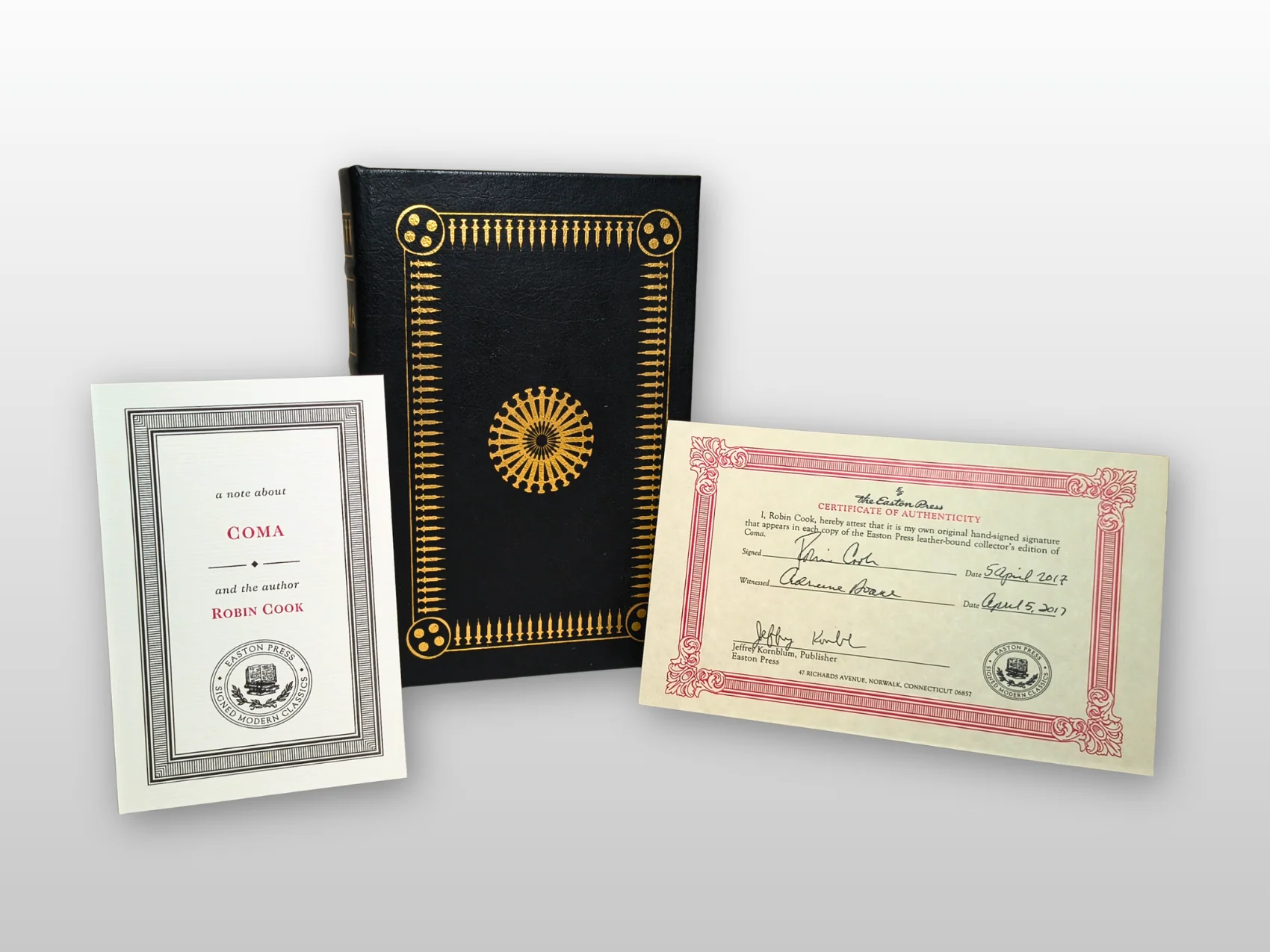
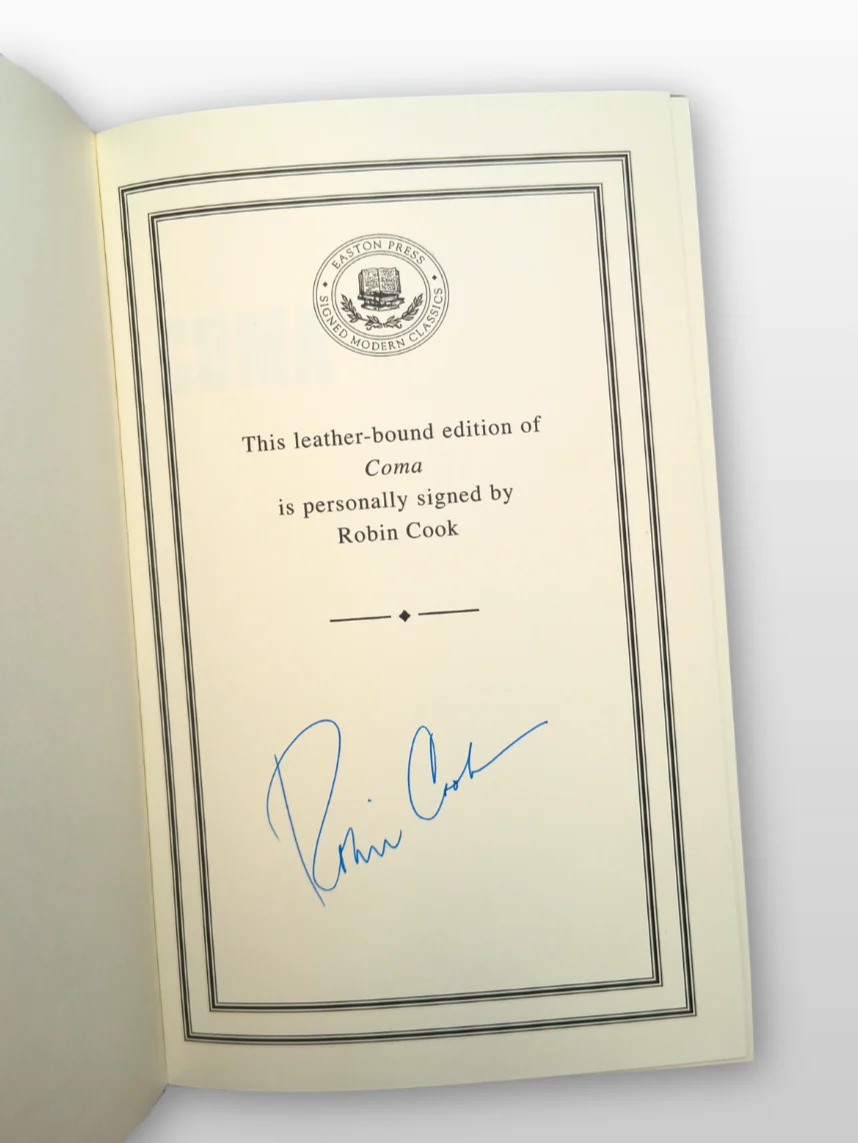
Octavo. Full black leather. Covers and spine with gold foil-stamped designs. Spine with raised bands, 22-carat gilt accents. All edges gilt. Moiré silk endpapers. Satin ribbon page marker. Signed Collector's Edition. Signed by the author on the tipped-in signature page. Includes signed Certificate of Authenticity, edition card, and bookplate adhered to front endpaper. Originally published Boston: Little, Brown and Company, 1977.
Robin Cook (b. 1940) trained as an ophthalmologist at Columbia University College of Physicians and Surgeons, completed a fellowship at the Massachusetts Eye and Ear Infirmary, and began writing fiction as a way of exploring the ethical and institutional dimensions of medicine that his clinical work made visible. His first novel was published in 1972; his breakthrough came with Coma in 1977, when the paperback rights sold for $800,000 before publication — a figure that signalled both the commercial appetite for medically grounded thriller fiction and the particular anxiety about hospital systems and institutional power that Coma had tapped. He has since published more than thirty-five medical thrillers, establishing the genre he effectively created.
Coma is set at the fictional Boston Memorial Hospital. Susan Wheeler is a third-year medical student who begins to notice a pattern: a statistically improbable number of patients at Boston Memorial are entering comas after routine surgical procedures, emerging alive but vegetative and subsequently transferred to a facility called the Jefferson Institute. Susan's investigation — conducted against the indifference of the hospital administration, the active hostility of senior physicians, and considerable personal danger — leads her toward a conspiracy whose dimensions the novel reveals with sustained and mounting dread. The ethical core of Coma is the commodification of the human body as a source of transplant organs for wealthy clients — a scenario that in 1977 was science fiction and has since become a matter of documented criminal practice in various parts of the world.
Cook has said that he deliberately studied the mechanisms of the commercial thriller before writing Coma, identifying the structural techniques by which popular novels maintain reader engagement and applying them systematically. The result is a novel that is simultaneously a highly effective thriller and a serious critique of the power dynamics within hospital medicine, the vulnerability of patients, and the capacity of institutions to function as systems for the concealment of wrongdoing. Michael Crichton's 1978 film adaptation, starring Genevieve Bujold as Susan and Michael Douglas, brought the story to a still larger audience and remains one of the most effective medical thrillers in the history of cinema.
Fine. Presenting as new.
This book is currently not on display in store. If you would like more information or to arrange a viewing, please contact: [email protected]
Catalogue Number: HH000548
Product Information
Product Information
Shipping & Returns
Shipping & Returns
Coma (Easton Press Signed Collector's Edition)
Coma (Easton Press Signed Collector's Edition)
COOK, Robin. Coma. Norwalk, Connecticut: The Easton Press, 2016.
Octavo. Full black leather. Covers and spine with gold foil-stamped designs. Spine with raised bands, 22-carat gilt accents. All edges gilt. Moiré silk endpapers. Satin ribbon page marker. Signed Collector's Edition. Signed by the author on the tipped-in signature page. Includes signed Certificate of Authenticity, edition card, and bookplate adhered to front endpaper. Originally published Boston: Little, Brown and Company, 1977.
Robin Cook (b. 1940) trained as an ophthalmologist at Columbia University College of Physicians and Surgeons, completed a fellowship at the Massachusetts Eye and Ear Infirmary, and began writing fiction as a way of exploring the ethical and institutional dimensions of medicine that his clinical work made visible. His first novel was published in 1972; his breakthrough came with Coma in 1977, when the paperback rights sold for $800,000 before publication — a figure that signalled both the commercial appetite for medically grounded thriller fiction and the particular anxiety about hospital systems and institutional power that Coma had tapped. He has since published more than thirty-five medical thrillers, establishing the genre he effectively created.
Coma is set at the fictional Boston Memorial Hospital. Susan Wheeler is a third-year medical student who begins to notice a pattern: a statistically improbable number of patients at Boston Memorial are entering comas after routine surgical procedures, emerging alive but vegetative and subsequently transferred to a facility called the Jefferson Institute. Susan's investigation — conducted against the indifference of the hospital administration, the active hostility of senior physicians, and considerable personal danger — leads her toward a conspiracy whose dimensions the novel reveals with sustained and mounting dread. The ethical core of Coma is the commodification of the human body as a source of transplant organs for wealthy clients — a scenario that in 1977 was science fiction and has since become a matter of documented criminal practice in various parts of the world.
Cook has said that he deliberately studied the mechanisms of the commercial thriller before writing Coma, identifying the structural techniques by which popular novels maintain reader engagement and applying them systematically. The result is a novel that is simultaneously a highly effective thriller and a serious critique of the power dynamics within hospital medicine, the vulnerability of patients, and the capacity of institutions to function as systems for the concealment of wrongdoing. Michael Crichton's 1978 film adaptation, starring Genevieve Bujold as Susan and Michael Douglas, brought the story to a still larger audience and remains one of the most effective medical thrillers in the history of cinema.
Fine. Presenting as new.
This book is currently not on display in store. If you would like more information or to arrange a viewing, please contact: [email protected]
Catalogue Number: HH000548
Original: $52.14
-65%$52.14
$18.25Product Information
Product Information
Shipping & Returns
Shipping & Returns
Description
COOK, Robin. Coma. Norwalk, Connecticut: The Easton Press, 2016.
Octavo. Full black leather. Covers and spine with gold foil-stamped designs. Spine with raised bands, 22-carat gilt accents. All edges gilt. Moiré silk endpapers. Satin ribbon page marker. Signed Collector's Edition. Signed by the author on the tipped-in signature page. Includes signed Certificate of Authenticity, edition card, and bookplate adhered to front endpaper. Originally published Boston: Little, Brown and Company, 1977.
Robin Cook (b. 1940) trained as an ophthalmologist at Columbia University College of Physicians and Surgeons, completed a fellowship at the Massachusetts Eye and Ear Infirmary, and began writing fiction as a way of exploring the ethical and institutional dimensions of medicine that his clinical work made visible. His first novel was published in 1972; his breakthrough came with Coma in 1977, when the paperback rights sold for $800,000 before publication — a figure that signalled both the commercial appetite for medically grounded thriller fiction and the particular anxiety about hospital systems and institutional power that Coma had tapped. He has since published more than thirty-five medical thrillers, establishing the genre he effectively created.
Coma is set at the fictional Boston Memorial Hospital. Susan Wheeler is a third-year medical student who begins to notice a pattern: a statistically improbable number of patients at Boston Memorial are entering comas after routine surgical procedures, emerging alive but vegetative and subsequently transferred to a facility called the Jefferson Institute. Susan's investigation — conducted against the indifference of the hospital administration, the active hostility of senior physicians, and considerable personal danger — leads her toward a conspiracy whose dimensions the novel reveals with sustained and mounting dread. The ethical core of Coma is the commodification of the human body as a source of transplant organs for wealthy clients — a scenario that in 1977 was science fiction and has since become a matter of documented criminal practice in various parts of the world.
Cook has said that he deliberately studied the mechanisms of the commercial thriller before writing Coma, identifying the structural techniques by which popular novels maintain reader engagement and applying them systematically. The result is a novel that is simultaneously a highly effective thriller and a serious critique of the power dynamics within hospital medicine, the vulnerability of patients, and the capacity of institutions to function as systems for the concealment of wrongdoing. Michael Crichton's 1978 film adaptation, starring Genevieve Bujold as Susan and Michael Douglas, brought the story to a still larger audience and remains one of the most effective medical thrillers in the history of cinema.
Fine. Presenting as new.
This book is currently not on display in store. If you would like more information or to arrange a viewing, please contact: [email protected]
Catalogue Number: HH000548