Ender's Game (Easton Press Signed Collector's Edition)
CARD, Orson Scott (intro. George Slusser; illus. Walter Velez). Ender's Game. Norwalk, Connecticut: The Easton Press, 2005 [1993].
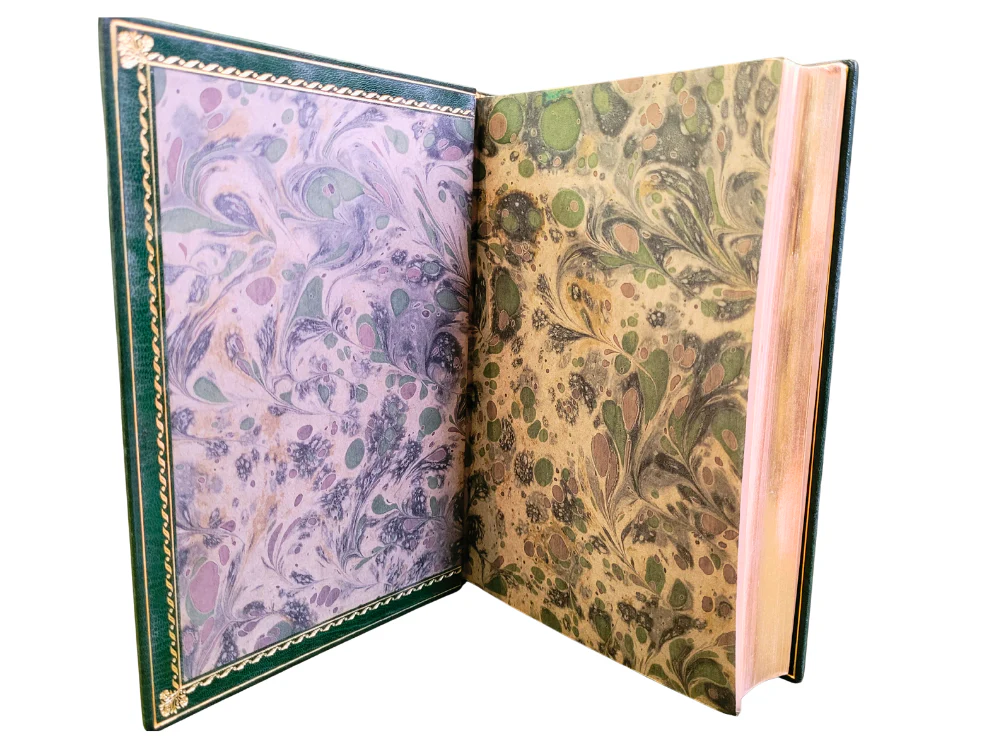
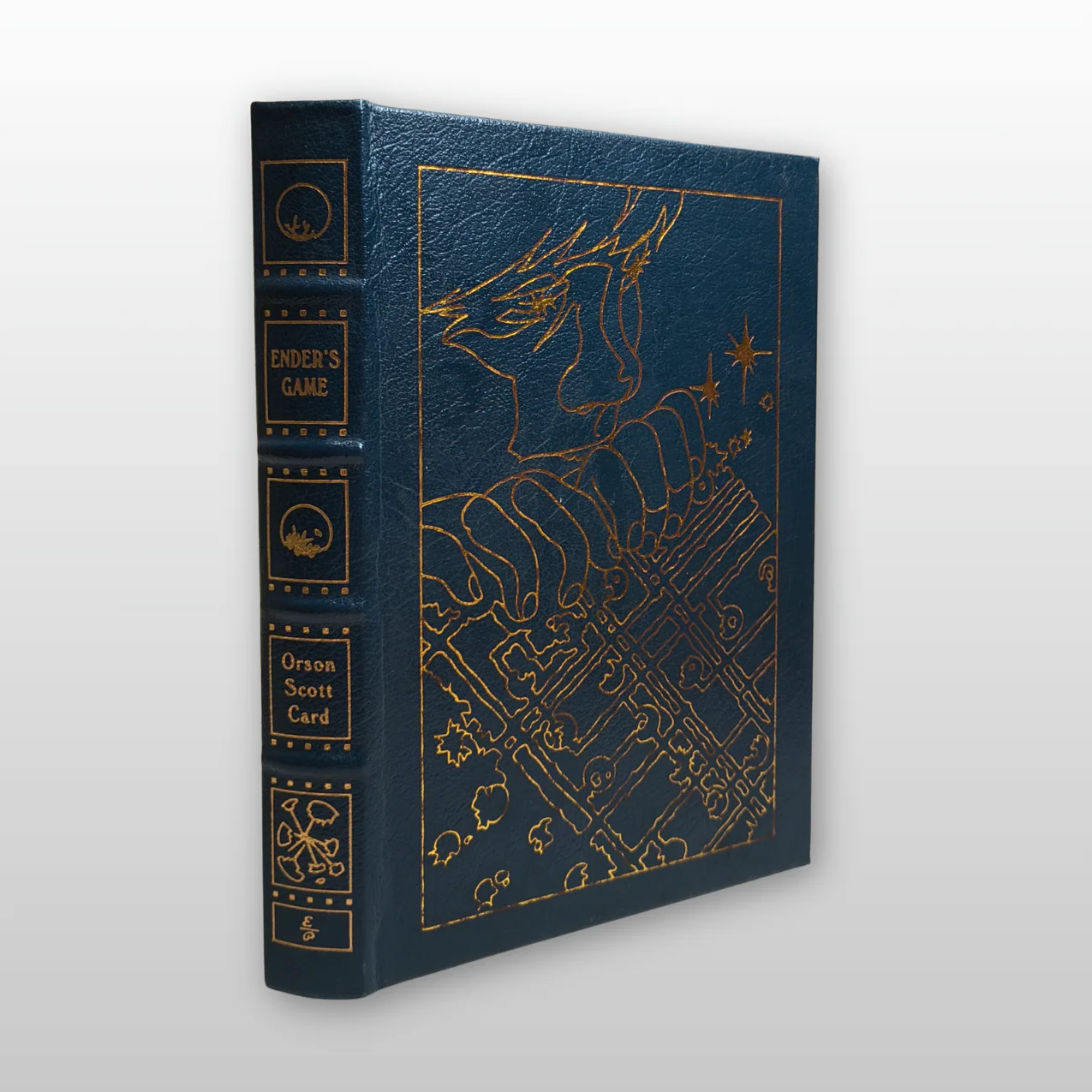
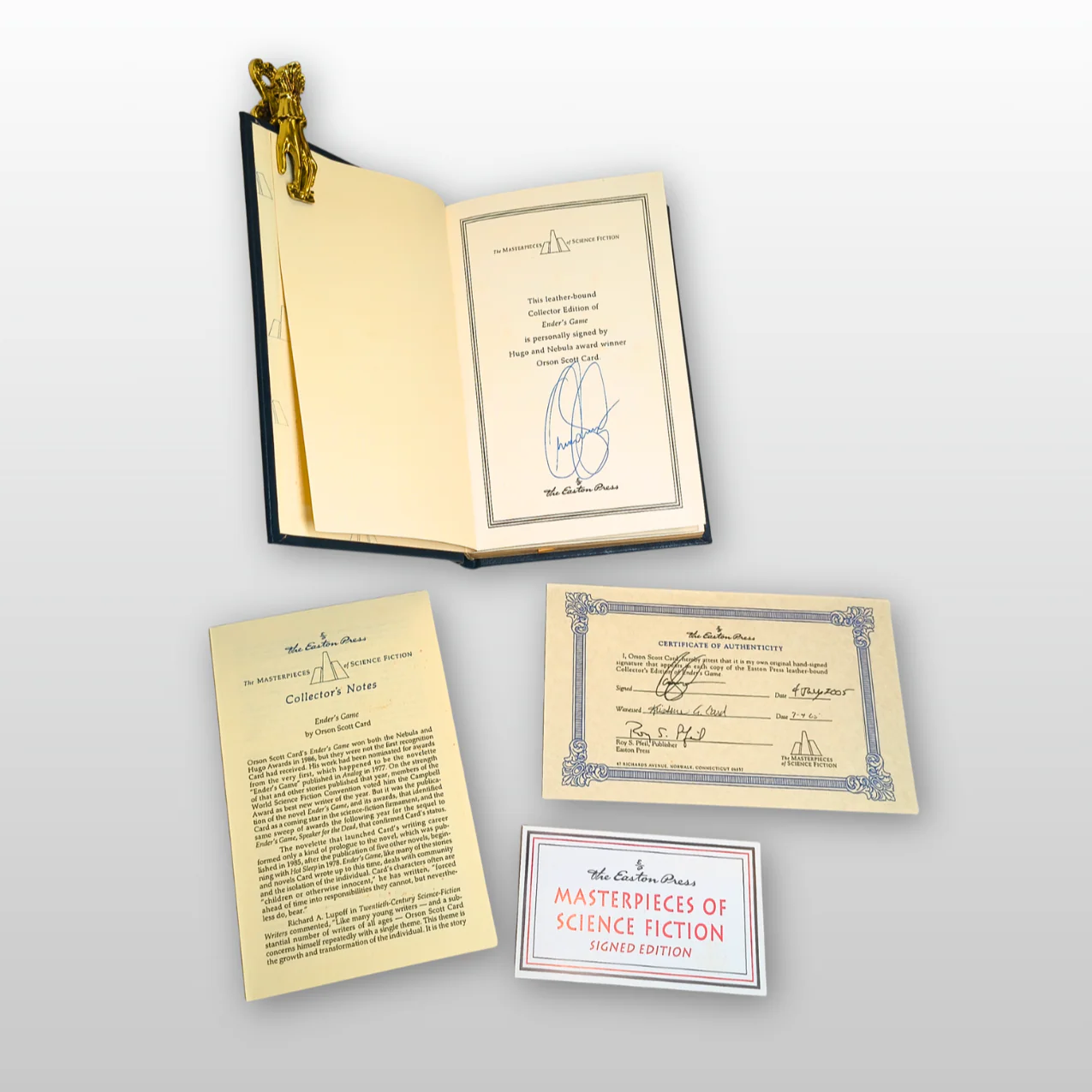
8vo. Full blue leather. Spine with raised bands, 22-carat gilt accents. All edges gilt. Moiré silk endpapers. Satin ribbon page marker. 226 pp. Frontispiece illustration by Walter Velez. Signed Collector's Edition. Part of the Easton Press Masterpieces of Science Fiction series. Signed by the author on the special title page in 2005. Includes signed Certificate of Authenticity (dated 2005), Collector's Notes, edition card, and bookplate. Originally published New York: Tor Books, 1985.
Ender's Game began as a short story in Analog Science Fiction in 1977, written to provide context for the novel that became Speaker for the Dead. When Orson Scott Card (b. 1951) expanded it into a novel and published it in 1985, both it and its sequel won the Hugo and Nebula Awards in consecutive years — a feat that has never been matched in the history of science fiction. The novel has since sold tens of millions of copies, been translated into thirty-seven languages, and entered the curriculum of the United States Marine Corps as recommended reading on military leadership.
The premise is spare and efficient. Earth has survived two invasions by an alien species known as the Formics — insectoid beings whose incomprehensibility to human minds has generated a century of war and enormous loss of life. To prepare for the anticipated third invasion, the International Fleet has established a Battle School in Earth's orbit, where children identified as potential military geniuses are recruited, trained, and competed against each other in elaborate war games. Andrew "Ender" Wiggin is six years old at the novel's opening. He is the third child in a future where government population controls are absolute, born only because his older siblings — Peter, who is brilliant and cruel, and Valentine, who is brilliant and kind — each failed to meet the programme's specific requirements. Ender contains both of them, and the International Fleet wants him.
What follows is a novel about the education of a warrior — and about the ethics of using children as instruments of war without their knowledge or consent. Ender excels at Battle School and is moved through its ranks with a speed that isolates him from every relationship he forms. He is manipulated, pressured, and deliberately put into situations of impossible difficulty in order to determine how he responds to stress. The novel tracks his development with a psychological precision that earns the reader's complete investment in his fate, and the conclusion — which turns on a deception that has been concealed from Ender throughout — is one of the most genuinely shattering endings in popular fiction. Card's exploration of leadership, the ethics of violence, the relationship between empathy and destruction, and the cost of extraordinary ability on the individual who possesses it has given the novel a durability well beyond its genre origins.
Near fine. Some loss to cover gilt; otherwise fine throughout.
This book is currently not on display in store. If you would like more information or to arrange a viewing, please contact: [email protected]
Catalogue Number: HH000510
Product Information
Product Information
Shipping & Returns
Shipping & Returns
Ender's Game (Easton Press Signed Collector's Edition)
Ender's Game (Easton Press Signed Collector's Edition)
CARD, Orson Scott (intro. George Slusser; illus. Walter Velez). Ender's Game. Norwalk, Connecticut: The Easton Press, 2005 [1993].
8vo. Full blue leather. Spine with raised bands, 22-carat gilt accents. All edges gilt. Moiré silk endpapers. Satin ribbon page marker. 226 pp. Frontispiece illustration by Walter Velez. Signed Collector's Edition. Part of the Easton Press Masterpieces of Science Fiction series. Signed by the author on the special title page in 2005. Includes signed Certificate of Authenticity (dated 2005), Collector's Notes, edition card, and bookplate. Originally published New York: Tor Books, 1985.
Ender's Game began as a short story in Analog Science Fiction in 1977, written to provide context for the novel that became Speaker for the Dead. When Orson Scott Card (b. 1951) expanded it into a novel and published it in 1985, both it and its sequel won the Hugo and Nebula Awards in consecutive years — a feat that has never been matched in the history of science fiction. The novel has since sold tens of millions of copies, been translated into thirty-seven languages, and entered the curriculum of the United States Marine Corps as recommended reading on military leadership.
The premise is spare and efficient. Earth has survived two invasions by an alien species known as the Formics — insectoid beings whose incomprehensibility to human minds has generated a century of war and enormous loss of life. To prepare for the anticipated third invasion, the International Fleet has established a Battle School in Earth's orbit, where children identified as potential military geniuses are recruited, trained, and competed against each other in elaborate war games. Andrew "Ender" Wiggin is six years old at the novel's opening. He is the third child in a future where government population controls are absolute, born only because his older siblings — Peter, who is brilliant and cruel, and Valentine, who is brilliant and kind — each failed to meet the programme's specific requirements. Ender contains both of them, and the International Fleet wants him.
What follows is a novel about the education of a warrior — and about the ethics of using children as instruments of war without their knowledge or consent. Ender excels at Battle School and is moved through its ranks with a speed that isolates him from every relationship he forms. He is manipulated, pressured, and deliberately put into situations of impossible difficulty in order to determine how he responds to stress. The novel tracks his development with a psychological precision that earns the reader's complete investment in his fate, and the conclusion — which turns on a deception that has been concealed from Ender throughout — is one of the most genuinely shattering endings in popular fiction. Card's exploration of leadership, the ethics of violence, the relationship between empathy and destruction, and the cost of extraordinary ability on the individual who possesses it has given the novel a durability well beyond its genre origins.
Near fine. Some loss to cover gilt; otherwise fine throughout.
This book is currently not on display in store. If you would like more information or to arrange a viewing, please contact: [email protected]
Catalogue Number: HH000510
Original: $62.85
-65%$62.85
$22.00Product Information
Product Information
Shipping & Returns
Shipping & Returns
Description
CARD, Orson Scott (intro. George Slusser; illus. Walter Velez). Ender's Game. Norwalk, Connecticut: The Easton Press, 2005 [1993].
8vo. Full blue leather. Spine with raised bands, 22-carat gilt accents. All edges gilt. Moiré silk endpapers. Satin ribbon page marker. 226 pp. Frontispiece illustration by Walter Velez. Signed Collector's Edition. Part of the Easton Press Masterpieces of Science Fiction series. Signed by the author on the special title page in 2005. Includes signed Certificate of Authenticity (dated 2005), Collector's Notes, edition card, and bookplate. Originally published New York: Tor Books, 1985.
Ender's Game began as a short story in Analog Science Fiction in 1977, written to provide context for the novel that became Speaker for the Dead. When Orson Scott Card (b. 1951) expanded it into a novel and published it in 1985, both it and its sequel won the Hugo and Nebula Awards in consecutive years — a feat that has never been matched in the history of science fiction. The novel has since sold tens of millions of copies, been translated into thirty-seven languages, and entered the curriculum of the United States Marine Corps as recommended reading on military leadership.
The premise is spare and efficient. Earth has survived two invasions by an alien species known as the Formics — insectoid beings whose incomprehensibility to human minds has generated a century of war and enormous loss of life. To prepare for the anticipated third invasion, the International Fleet has established a Battle School in Earth's orbit, where children identified as potential military geniuses are recruited, trained, and competed against each other in elaborate war games. Andrew "Ender" Wiggin is six years old at the novel's opening. He is the third child in a future where government population controls are absolute, born only because his older siblings — Peter, who is brilliant and cruel, and Valentine, who is brilliant and kind — each failed to meet the programme's specific requirements. Ender contains both of them, and the International Fleet wants him.
What follows is a novel about the education of a warrior — and about the ethics of using children as instruments of war without their knowledge or consent. Ender excels at Battle School and is moved through its ranks with a speed that isolates him from every relationship he forms. He is manipulated, pressured, and deliberately put into situations of impossible difficulty in order to determine how he responds to stress. The novel tracks his development with a psychological precision that earns the reader's complete investment in his fate, and the conclusion — which turns on a deception that has been concealed from Ender throughout — is one of the most genuinely shattering endings in popular fiction. Card's exploration of leadership, the ethics of violence, the relationship between empathy and destruction, and the cost of extraordinary ability on the individual who possesses it has given the novel a durability well beyond its genre origins.
Near fine. Some loss to cover gilt; otherwise fine throughout.
This book is currently not on display in store. If you would like more information or to arrange a viewing, please contact: [email protected]
Catalogue Number: HH000510