Hortus Eystettensis, 4 volumes (Limited Facsimile Edition)
BESLER, Basilius. Hortus Eystettensis, sive Diligens et accurata omnium plantarum, florum, stirpium... [The Garden of Eichstätt.] Facsimile of the 1613 edition. Sansepolcro: Aboca Museum, 2006. 4 vols.
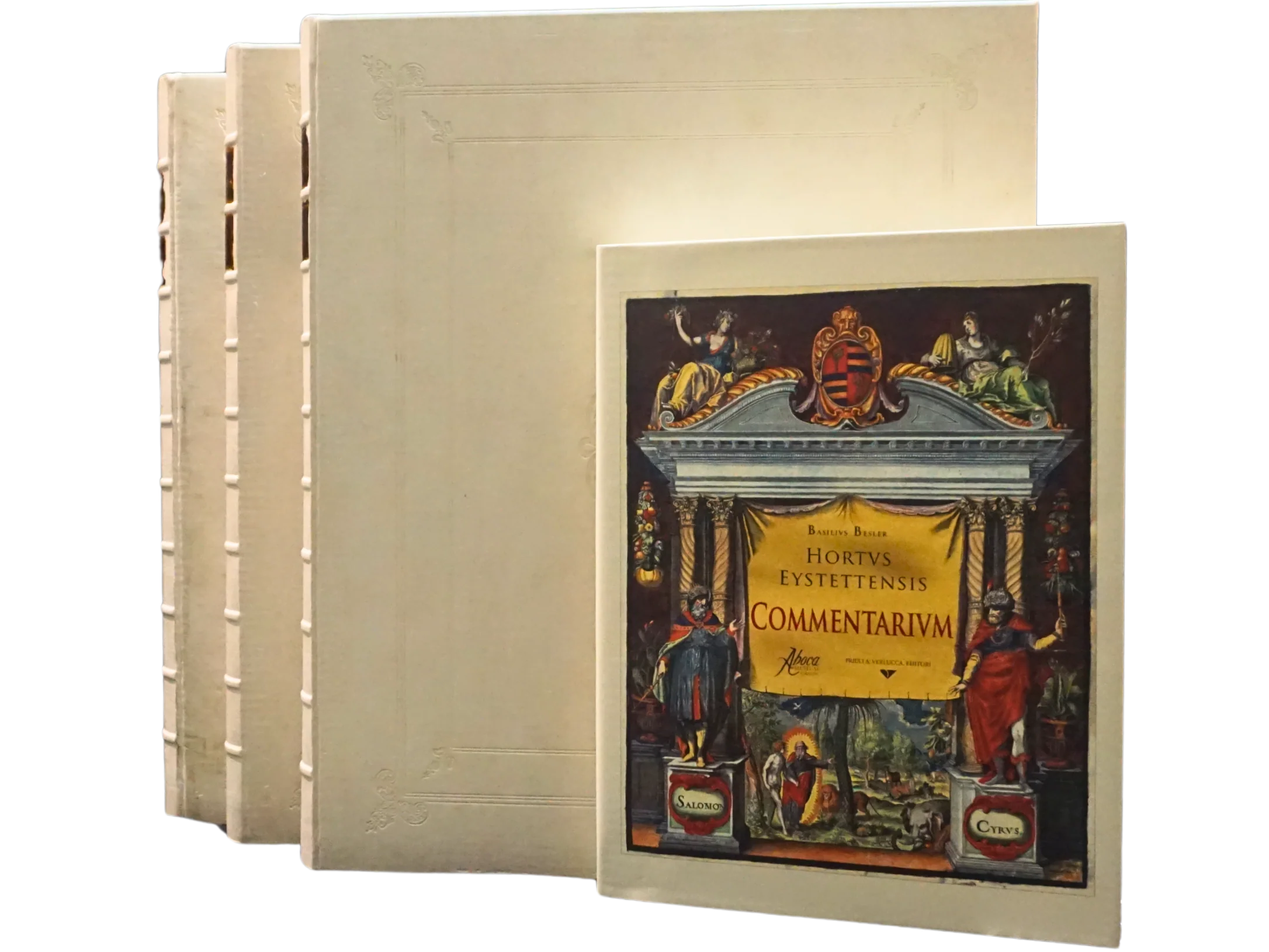
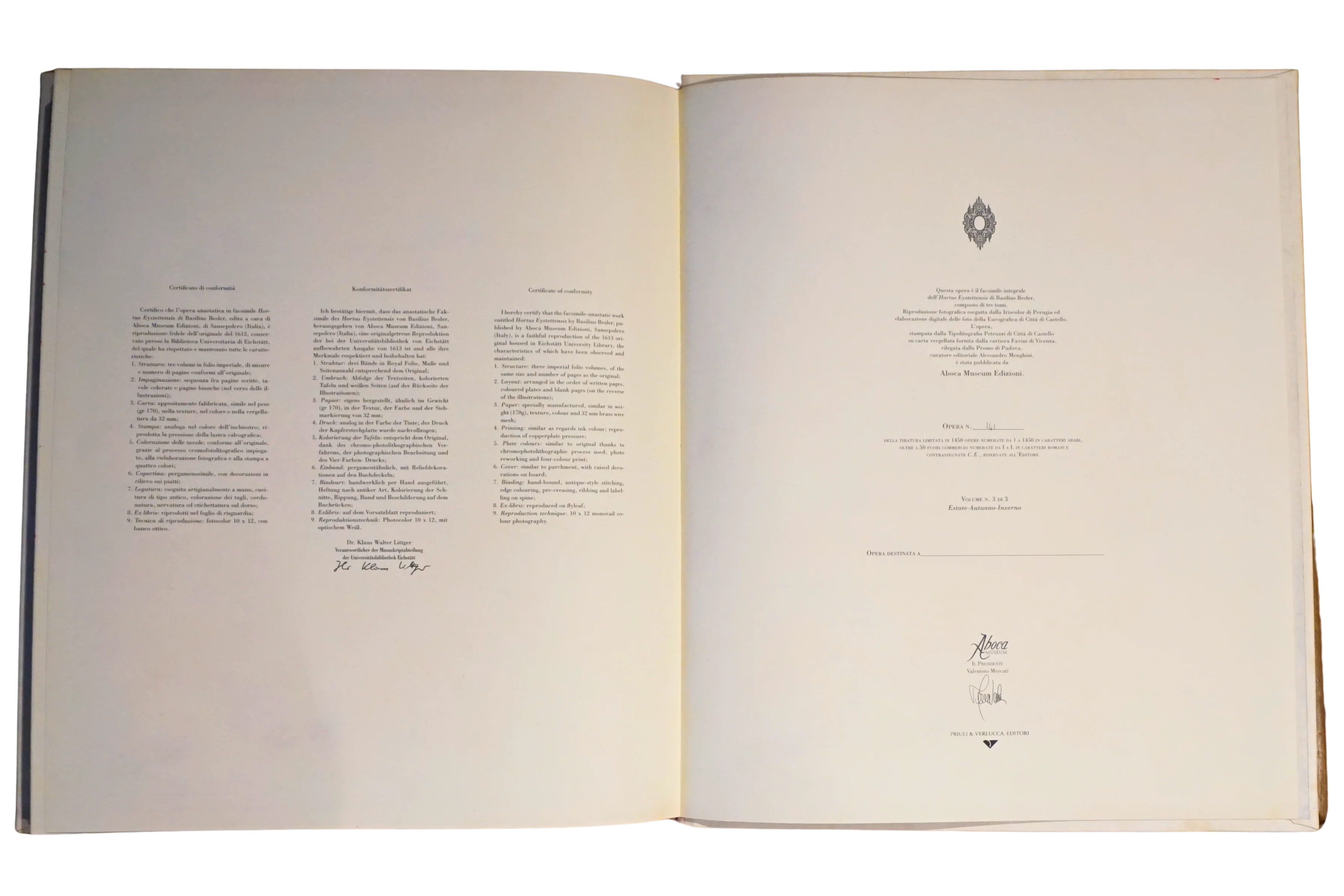
Elephant folio (3 main vols.) and large 4to (1 commentary vol.). Three main volumes bound in full white vellum, intricately blind-stamped. Spines with ten raised bands and gilt titling on brown morocco panels. [Pagination to be confirmed.] 367 full-page colour plates depicting over 1,000 plants. Signed by Dr. Klaus Walter Littger to rear certificate of conformity page of each volume. Facsimile reproduced from the 1613 original held at the Eichstätt University Library. Limited edition facsimile. Numbered 141 of 1,450 at rear colophon of each volume.
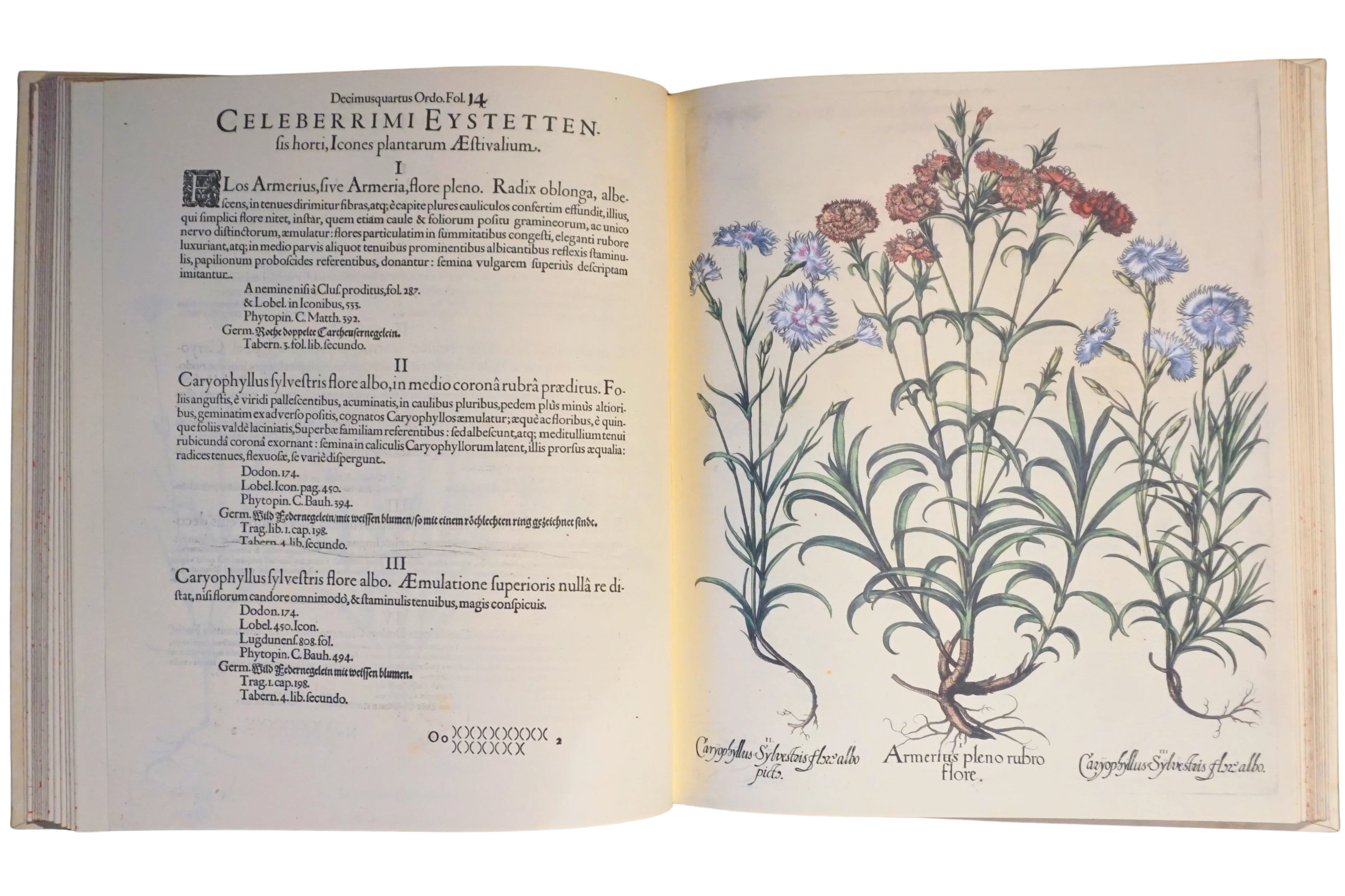
Basilius Besler was a Nuremberg apothecary who spent sixteen years overseeing the creation of the most ambitious florilegium of the seventeenth century. The garden he documented — that of Johann Conrad von Gemmingen, Prince-Bishop of Eichstätt, in Bavaria — was the greatest private garden in German-speaking Europe at the time, and Gemmingen's ambition was to document it permanently in print. The task Besler undertook was extraordinary in its scope: to commission artists to draw every plant in cultivation at the garden, then to have those drawings engraved at full scale, printed, and hand-coloured with botanical accuracy. The result, published in 1613 in a folio of such dimensions that individual plates could be produced at something approaching actual size, contained 367 plates depicting more than a thousand species arranged by the four seasons of their flowering. Nothing of comparable scale or ambition had been attempted in botanical illustration, and nothing quite like it would be attempted again.
The plates established the visual language of botanical illustration for generations of subsequent artists and publishers. The composition of each plate (multiple specimens arranged with an eye to both scientific accuracy and decorative effect, set against a neutral ground that gives maximum emphasis to the plant itself) became the template from which the great eighteenth-century florilegia of Ehret, the Bauer brothers, and Redouté would eventually descend. The Hortus Eystettensis is, in the deepest sense, the origin of the tradition.
The Aboca Museum facsimile of 2006, produced in a limited edition of 1,450 numbered copies under the scholarly editorship of Dr. Klaus Walter Littger of the Eichstätt University Library reproduces the 1613 text at full scale from the original held in that collection. Internal markings visible in the plates, including ex-libris bookplates and manuscript annotations, are reproduced as issued: they are scans of the original volume, not additions to this copy. The damage visible to the titling plates on the volume spines is likewise reproduced from the original and not a condition fault of this set.
Very good/Near Fine. Set complete save for the shipping box of Volume I. Some rubbing to the vellum of each volume from previous handling; most pronounced on Volume I, which shows signs of display use. Contents of all volumes fine, impeccably preserved. Commentary volume fine and free of markings.
This book is currently not on display in store. If you would like more information or to arrange a viewing, please contact: [email protected]
Catalogue Number: HH000222
Please note: This item is very large and heavy (over 25kg). Within Australia it will likely require additional postage costs. For international shipping please contact us for a quote.
Product Information
Product Information
Shipping & Returns
Shipping & Returns



Hortus Eystettensis, 4 volumes (Limited Facsimile Edition)
Hortus Eystettensis, 4 volumes (Limited Facsimile Edition)
BESLER, Basilius. Hortus Eystettensis, sive Diligens et accurata omnium plantarum, florum, stirpium... [The Garden of Eichstätt.] Facsimile of the 1613 edition. Sansepolcro: Aboca Museum, 2006. 4 vols.
Elephant folio (3 main vols.) and large 4to (1 commentary vol.). Three main volumes bound in full white vellum, intricately blind-stamped. Spines with ten raised bands and gilt titling on brown morocco panels. [Pagination to be confirmed.] 367 full-page colour plates depicting over 1,000 plants. Signed by Dr. Klaus Walter Littger to rear certificate of conformity page of each volume. Facsimile reproduced from the 1613 original held at the Eichstätt University Library. Limited edition facsimile. Numbered 141 of 1,450 at rear colophon of each volume.
Basilius Besler was a Nuremberg apothecary who spent sixteen years overseeing the creation of the most ambitious florilegium of the seventeenth century. The garden he documented — that of Johann Conrad von Gemmingen, Prince-Bishop of Eichstätt, in Bavaria — was the greatest private garden in German-speaking Europe at the time, and Gemmingen's ambition was to document it permanently in print. The task Besler undertook was extraordinary in its scope: to commission artists to draw every plant in cultivation at the garden, then to have those drawings engraved at full scale, printed, and hand-coloured with botanical accuracy. The result, published in 1613 in a folio of such dimensions that individual plates could be produced at something approaching actual size, contained 367 plates depicting more than a thousand species arranged by the four seasons of their flowering. Nothing of comparable scale or ambition had been attempted in botanical illustration, and nothing quite like it would be attempted again.
The plates established the visual language of botanical illustration for generations of subsequent artists and publishers. The composition of each plate (multiple specimens arranged with an eye to both scientific accuracy and decorative effect, set against a neutral ground that gives maximum emphasis to the plant itself) became the template from which the great eighteenth-century florilegia of Ehret, the Bauer brothers, and Redouté would eventually descend. The Hortus Eystettensis is, in the deepest sense, the origin of the tradition.
The Aboca Museum facsimile of 2006, produced in a limited edition of 1,450 numbered copies under the scholarly editorship of Dr. Klaus Walter Littger of the Eichstätt University Library reproduces the 1613 text at full scale from the original held in that collection. Internal markings visible in the plates, including ex-libris bookplates and manuscript annotations, are reproduced as issued: they are scans of the original volume, not additions to this copy. The damage visible to the titling plates on the volume spines is likewise reproduced from the original and not a condition fault of this set.
Very good/Near Fine. Set complete save for the shipping box of Volume I. Some rubbing to the vellum of each volume from previous handling; most pronounced on Volume I, which shows signs of display use. Contents of all volumes fine, impeccably preserved. Commentary volume fine and free of markings.
This book is currently not on display in store. If you would like more information or to arrange a viewing, please contact: [email protected]
Catalogue Number: HH000222
Please note: This item is very large and heavy (over 25kg). Within Australia it will likely require additional postage costs. For international shipping please contact us for a quote.
Product Information
Product Information
Shipping & Returns
Shipping & Returns
Description
BESLER, Basilius. Hortus Eystettensis, sive Diligens et accurata omnium plantarum, florum, stirpium... [The Garden of Eichstätt.] Facsimile of the 1613 edition. Sansepolcro: Aboca Museum, 2006. 4 vols.
Elephant folio (3 main vols.) and large 4to (1 commentary vol.). Three main volumes bound in full white vellum, intricately blind-stamped. Spines with ten raised bands and gilt titling on brown morocco panels. [Pagination to be confirmed.] 367 full-page colour plates depicting over 1,000 plants. Signed by Dr. Klaus Walter Littger to rear certificate of conformity page of each volume. Facsimile reproduced from the 1613 original held at the Eichstätt University Library. Limited edition facsimile. Numbered 141 of 1,450 at rear colophon of each volume.
Basilius Besler was a Nuremberg apothecary who spent sixteen years overseeing the creation of the most ambitious florilegium of the seventeenth century. The garden he documented — that of Johann Conrad von Gemmingen, Prince-Bishop of Eichstätt, in Bavaria — was the greatest private garden in German-speaking Europe at the time, and Gemmingen's ambition was to document it permanently in print. The task Besler undertook was extraordinary in its scope: to commission artists to draw every plant in cultivation at the garden, then to have those drawings engraved at full scale, printed, and hand-coloured with botanical accuracy. The result, published in 1613 in a folio of such dimensions that individual plates could be produced at something approaching actual size, contained 367 plates depicting more than a thousand species arranged by the four seasons of their flowering. Nothing of comparable scale or ambition had been attempted in botanical illustration, and nothing quite like it would be attempted again.
The plates established the visual language of botanical illustration for generations of subsequent artists and publishers. The composition of each plate (multiple specimens arranged with an eye to both scientific accuracy and decorative effect, set against a neutral ground that gives maximum emphasis to the plant itself) became the template from which the great eighteenth-century florilegia of Ehret, the Bauer brothers, and Redouté would eventually descend. The Hortus Eystettensis is, in the deepest sense, the origin of the tradition.
The Aboca Museum facsimile of 2006, produced in a limited edition of 1,450 numbered copies under the scholarly editorship of Dr. Klaus Walter Littger of the Eichstätt University Library reproduces the 1613 text at full scale from the original held in that collection. Internal markings visible in the plates, including ex-libris bookplates and manuscript annotations, are reproduced as issued: they are scans of the original volume, not additions to this copy. The damage visible to the titling plates on the volume spines is likewise reproduced from the original and not a condition fault of this set.
Very good/Near Fine. Set complete save for the shipping box of Volume I. Some rubbing to the vellum of each volume from previous handling; most pronounced on Volume I, which shows signs of display use. Contents of all volumes fine, impeccably preserved. Commentary volume fine and free of markings.
This book is currently not on display in store. If you would like more information or to arrange a viewing, please contact: [email protected]
Catalogue Number: HH000222
Please note: This item is very large and heavy (over 25kg). Within Australia it will likely require additional postage costs. For international shipping please contact us for a quote.