Lord Byron: Selected Poems (First Folio Edition)
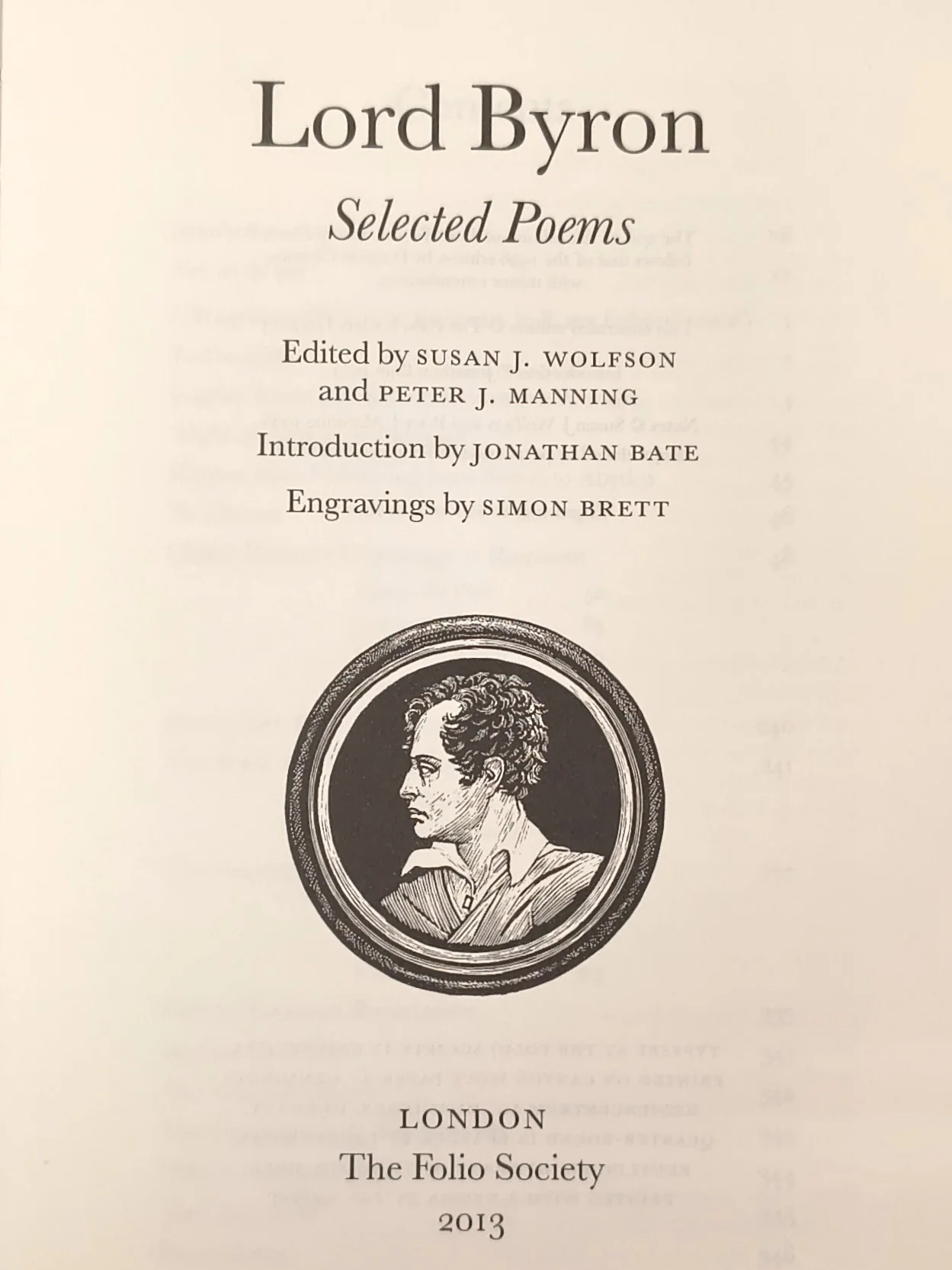
BYRON, George Gordon, Lord (ed. Susan J. Wolfson & Peter J. Manning; intro. Jonathan Bate; engravings Simon Brett). Selected Poems. London: The Folio Society, 2013.
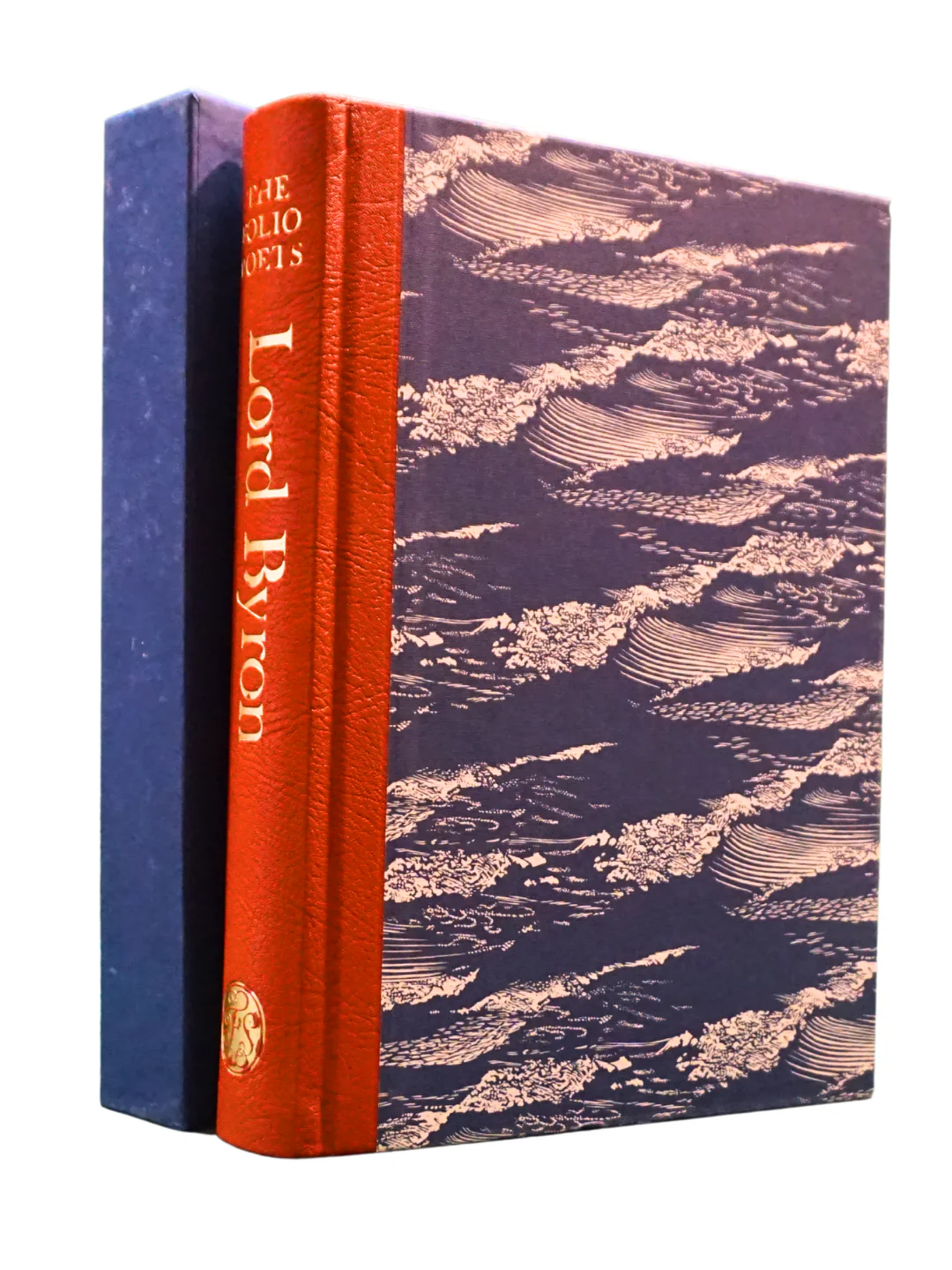
Large 8vo. Quarter ochre Morocco and blue cloth boards, boards decorated with wave design in white. Spine lettered in gilt. Upper edge sprayed ochre. Deep blue endpapers. Illustrated slipcase. xv, 400 pp. First Folio Society edition.
George Gordon, Lord Byron (1788–1824) was the most famous writer in Europe in his own lifetime — more famous, by some measures, than Napoleon, and considerably more scandalous. The celebrity was inseparable from the work: when Childe Harold's Pilgrimage appeared in 1812 Byron woke to find himself, as he put it, famous, and the brooding, self-exiled protagonist of that poem — the original Byronic hero — was immediately and not entirely inaccurately identified with his creator. He spent the rest of his short life living up to the identification, which meant exile from England following the collapse of his marriage in 1816, an affair with Mary Godwin's stepsister Claire Clairmont, the famous summer at the Villa Diodati on Lake Geneva where Frankenstein was conceived, and a succession of Italian entanglements before his death at Missolonghi in 1824, where he had gone to support the Greek war of independence.
The poetry sustains the legend rather than being obscured by it. Byron's range was extraordinary: the oceanic melancholy of Childe Harold, the compressed lyric intensity of the Hebrew Melodies, the ferocious satirical intelligence of Don Juan, and the dramatic power of the verse dramas represent not variations on a theme but genuinely different modes, differently achieved. Don Juan in particular — left unfinished at his death with sixteen cantos complete — is one of the great comic poems in English, its narrator's voice perpetually deflating its own romantic tendencies and his reader's expectations with equal cheerfulness. It is also a serious poem about freedom, war, and the relationship between private appetite and public virtue; the satirical surfaces conceal a sustained argument.
The selection edited by Susan J. Wolfson and Peter J. Manning draws on their deep scholarship in Romantic poetry; both are distinguished academics whose previous Byron editions have been widely used. Simon Brett's engravings throughout are characteristic of his ability to find a visual equivalent for the scale and drama of the verse without illustrating it literally.
Near fine in like slipcase. Some rubbing to spine gilt; contents near fine with faint spotting to fore-edge only. Slipcase shows minor shelf wear.
This book is currently on display in the rare book section of our Bondi store. If you would like more information or to arrange a viewing, please contact: [email protected]
Catalogue Number: HH000306
Product Information
Product Information
Shipping & Returns
Shipping & Returns
Lord Byron: Selected Poems (First Folio Edition)
Lord Byron: Selected Poems (First Folio Edition)
BYRON, George Gordon, Lord (ed. Susan J. Wolfson & Peter J. Manning; intro. Jonathan Bate; engravings Simon Brett). Selected Poems. London: The Folio Society, 2013.
Large 8vo. Quarter ochre Morocco and blue cloth boards, boards decorated with wave design in white. Spine lettered in gilt. Upper edge sprayed ochre. Deep blue endpapers. Illustrated slipcase. xv, 400 pp. First Folio Society edition.
George Gordon, Lord Byron (1788–1824) was the most famous writer in Europe in his own lifetime — more famous, by some measures, than Napoleon, and considerably more scandalous. The celebrity was inseparable from the work: when Childe Harold's Pilgrimage appeared in 1812 Byron woke to find himself, as he put it, famous, and the brooding, self-exiled protagonist of that poem — the original Byronic hero — was immediately and not entirely inaccurately identified with his creator. He spent the rest of his short life living up to the identification, which meant exile from England following the collapse of his marriage in 1816, an affair with Mary Godwin's stepsister Claire Clairmont, the famous summer at the Villa Diodati on Lake Geneva where Frankenstein was conceived, and a succession of Italian entanglements before his death at Missolonghi in 1824, where he had gone to support the Greek war of independence.
The poetry sustains the legend rather than being obscured by it. Byron's range was extraordinary: the oceanic melancholy of Childe Harold, the compressed lyric intensity of the Hebrew Melodies, the ferocious satirical intelligence of Don Juan, and the dramatic power of the verse dramas represent not variations on a theme but genuinely different modes, differently achieved. Don Juan in particular — left unfinished at his death with sixteen cantos complete — is one of the great comic poems in English, its narrator's voice perpetually deflating its own romantic tendencies and his reader's expectations with equal cheerfulness. It is also a serious poem about freedom, war, and the relationship between private appetite and public virtue; the satirical surfaces conceal a sustained argument.
The selection edited by Susan J. Wolfson and Peter J. Manning draws on their deep scholarship in Romantic poetry; both are distinguished academics whose previous Byron editions have been widely used. Simon Brett's engravings throughout are characteristic of his ability to find a visual equivalent for the scale and drama of the verse without illustrating it literally.
Near fine in like slipcase. Some rubbing to spine gilt; contents near fine with faint spotting to fore-edge only. Slipcase shows minor shelf wear.
This book is currently on display in the rare book section of our Bondi store. If you would like more information or to arrange a viewing, please contact: [email protected]
Catalogue Number: HH000306
Original: $104.28
-65%$104.28
$36.50Product Information
Product Information
Shipping & Returns
Shipping & Returns
Description
BYRON, George Gordon, Lord (ed. Susan J. Wolfson & Peter J. Manning; intro. Jonathan Bate; engravings Simon Brett). Selected Poems. London: The Folio Society, 2013.
Large 8vo. Quarter ochre Morocco and blue cloth boards, boards decorated with wave design in white. Spine lettered in gilt. Upper edge sprayed ochre. Deep blue endpapers. Illustrated slipcase. xv, 400 pp. First Folio Society edition.
George Gordon, Lord Byron (1788–1824) was the most famous writer in Europe in his own lifetime — more famous, by some measures, than Napoleon, and considerably more scandalous. The celebrity was inseparable from the work: when Childe Harold's Pilgrimage appeared in 1812 Byron woke to find himself, as he put it, famous, and the brooding, self-exiled protagonist of that poem — the original Byronic hero — was immediately and not entirely inaccurately identified with his creator. He spent the rest of his short life living up to the identification, which meant exile from England following the collapse of his marriage in 1816, an affair with Mary Godwin's stepsister Claire Clairmont, the famous summer at the Villa Diodati on Lake Geneva where Frankenstein was conceived, and a succession of Italian entanglements before his death at Missolonghi in 1824, where he had gone to support the Greek war of independence.
The poetry sustains the legend rather than being obscured by it. Byron's range was extraordinary: the oceanic melancholy of Childe Harold, the compressed lyric intensity of the Hebrew Melodies, the ferocious satirical intelligence of Don Juan, and the dramatic power of the verse dramas represent not variations on a theme but genuinely different modes, differently achieved. Don Juan in particular — left unfinished at his death with sixteen cantos complete — is one of the great comic poems in English, its narrator's voice perpetually deflating its own romantic tendencies and his reader's expectations with equal cheerfulness. It is also a serious poem about freedom, war, and the relationship between private appetite and public virtue; the satirical surfaces conceal a sustained argument.
The selection edited by Susan J. Wolfson and Peter J. Manning draws on their deep scholarship in Romantic poetry; both are distinguished academics whose previous Byron editions have been widely used. Simon Brett's engravings throughout are characteristic of his ability to find a visual equivalent for the scale and drama of the verse without illustrating it literally.
Near fine in like slipcase. Some rubbing to spine gilt; contents near fine with faint spotting to fore-edge only. Slipcase shows minor shelf wear.
This book is currently on display in the rare book section of our Bondi store. If you would like more information or to arrange a viewing, please contact: [email protected]
Catalogue Number: HH000306