Orphan Train (Easton Press Signed Collector's Edition)
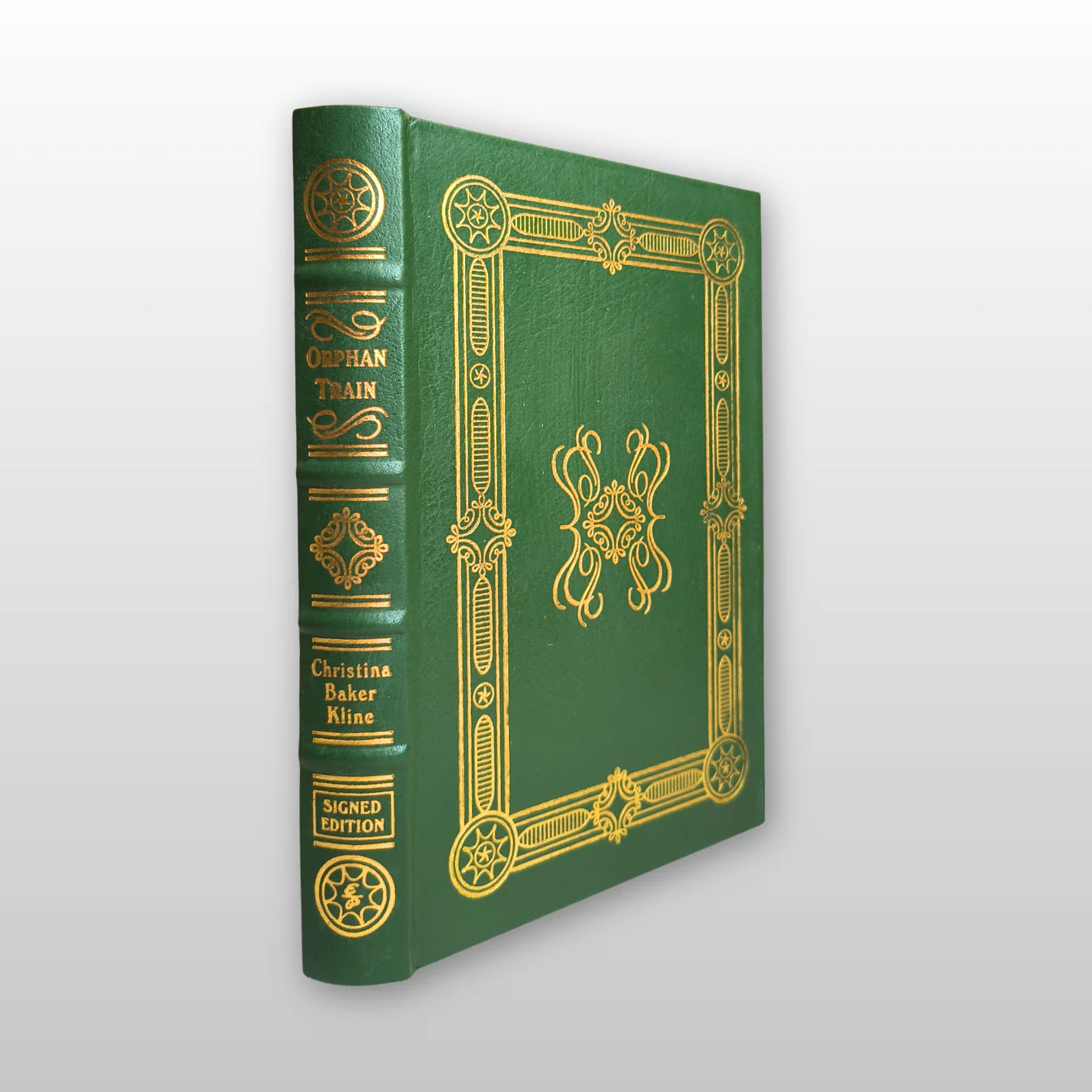
KLINE, Christina Baker. Orphan Train. Norwalk, Connecticut: The Easton Press, 2015.
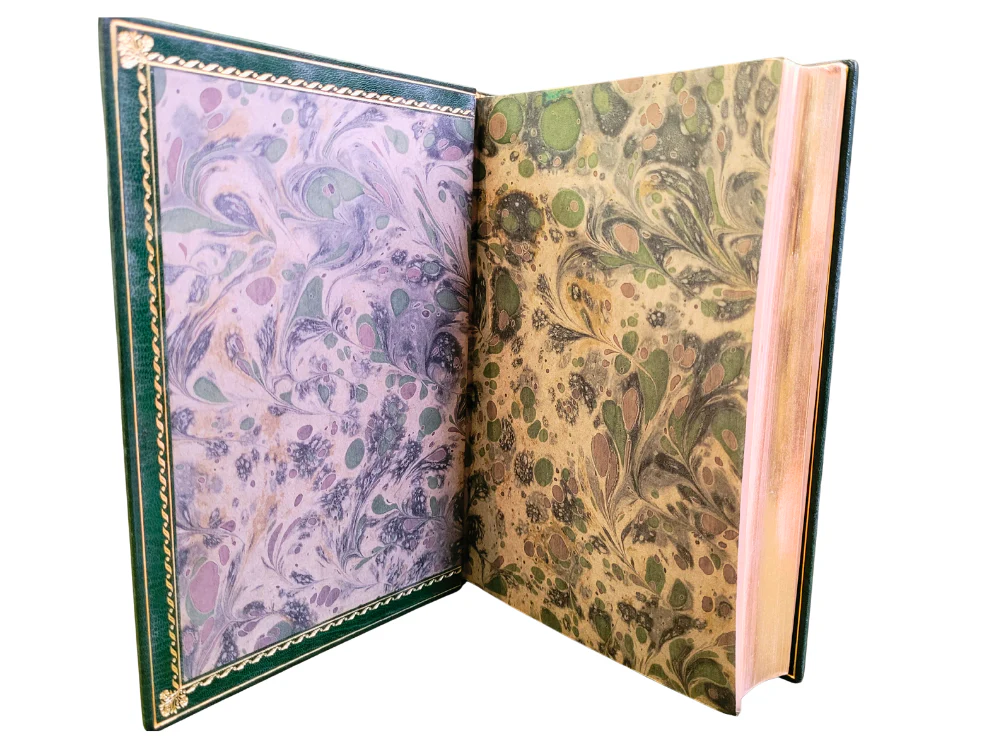
Octavo. Full green leather. Spine with four raised bands, 22-carat gilt accents. Gilt design to covers. All edges gilt. Moiré silk endpapers. Satin ribbon page marker. 278 pp. Signed Collector's Edition. Part of the Easton Press Signed Modern Classics series. Signed by the author on the special title page. Includes signed Certificate of Authenticity, edition card, and bookplate adhered to front endpaper. Originally published New York: William Morrow, 2013.
Between 1854 and 1929, approximately 200,000 children — orphaned, abandoned, or simply too poor to be kept — were transported by train from New York and other eastern cities to rural communities across the Midwest and beyond, where they were placed with farm families who took them in for reasons ranging from genuine compassion to the need for cheap labour. The programme was organised by the Children's Aid Society, founded by the social reformer Charles Loring Brace, who believed that removing children from the corrupting environment of the city and placing them in the moral clarity of agricultural life was the most effective form of social intervention available. For many of the children — known thereafter as orphan train riders — the reality was more complicated and more brutal than that proposition suggests. The programme ran for seventy-five years and constitutes one of the largest organised movements of children in American history, and one of the least remembered.
Christina Baker Kline (b. in England; raised in the American South and Maine) began researching the orphan trains after discovering that a relative had been among the riders. Orphan Train, published in 2013, illuminates this largely forgotten chapter of American history through two parallel narratives. Vivian Daly, ninety-one years old, lives quietly on the coast of Maine with the memories of her Irish immigrant childhood and her years as an orphan train rider locked in trunks in her attic. Seventeen-year-old Molly Ayer, a Penobscot Indian who has spent her life in the foster care system, is sentenced to community service — cleaning out Vivian's attic — as an alternative to juvenile detention. As the two women work through the contents of those trunks, the novel moves between the Depression-era Midwest of Vivian's youth and the contemporary Maine of Molly's present, finding in both the same fundamental experience: the loss of family, the search for belonging, and the contingency of the identity we construct from what survives.
The novel became a number one New York Times bestseller and has since been chosen by hundreds of communities, universities, and schools as a "One Book, One Read" selection across the United States. Richard Russo described Kline as "a relentless storyteller" whose "narrative line is too taut" to resist. Kline holds degrees from Yale, Cambridge, and the University of Virginia.
Near fine. A few very minor imperfections; otherwise fine throughout.
This book is currently not on display in store. If you would like more information or to arrange a viewing, please contact: [email protected]
Catalogue Number: HH000511
Product Information
Product Information
Shipping & Returns
Shipping & Returns

Orphan Train (Easton Press Signed Collector's Edition)
Orphan Train (Easton Press Signed Collector's Edition)
KLINE, Christina Baker. Orphan Train. Norwalk, Connecticut: The Easton Press, 2015.
Octavo. Full green leather. Spine with four raised bands, 22-carat gilt accents. Gilt design to covers. All edges gilt. Moiré silk endpapers. Satin ribbon page marker. 278 pp. Signed Collector's Edition. Part of the Easton Press Signed Modern Classics series. Signed by the author on the special title page. Includes signed Certificate of Authenticity, edition card, and bookplate adhered to front endpaper. Originally published New York: William Morrow, 2013.
Between 1854 and 1929, approximately 200,000 children — orphaned, abandoned, or simply too poor to be kept — were transported by train from New York and other eastern cities to rural communities across the Midwest and beyond, where they were placed with farm families who took them in for reasons ranging from genuine compassion to the need for cheap labour. The programme was organised by the Children's Aid Society, founded by the social reformer Charles Loring Brace, who believed that removing children from the corrupting environment of the city and placing them in the moral clarity of agricultural life was the most effective form of social intervention available. For many of the children — known thereafter as orphan train riders — the reality was more complicated and more brutal than that proposition suggests. The programme ran for seventy-five years and constitutes one of the largest organised movements of children in American history, and one of the least remembered.
Christina Baker Kline (b. in England; raised in the American South and Maine) began researching the orphan trains after discovering that a relative had been among the riders. Orphan Train, published in 2013, illuminates this largely forgotten chapter of American history through two parallel narratives. Vivian Daly, ninety-one years old, lives quietly on the coast of Maine with the memories of her Irish immigrant childhood and her years as an orphan train rider locked in trunks in her attic. Seventeen-year-old Molly Ayer, a Penobscot Indian who has spent her life in the foster care system, is sentenced to community service — cleaning out Vivian's attic — as an alternative to juvenile detention. As the two women work through the contents of those trunks, the novel moves between the Depression-era Midwest of Vivian's youth and the contemporary Maine of Molly's present, finding in both the same fundamental experience: the loss of family, the search for belonging, and the contingency of the identity we construct from what survives.
The novel became a number one New York Times bestseller and has since been chosen by hundreds of communities, universities, and schools as a "One Book, One Read" selection across the United States. Richard Russo described Kline as "a relentless storyteller" whose "narrative line is too taut" to resist. Kline holds degrees from Yale, Cambridge, and the University of Virginia.
Near fine. A few very minor imperfections; otherwise fine throughout.
This book is currently not on display in store. If you would like more information or to arrange a viewing, please contact: [email protected]
Catalogue Number: HH000511
Original: $52.14
-65%$52.14
$18.25Product Information
Product Information
Shipping & Returns
Shipping & Returns
Description
KLINE, Christina Baker. Orphan Train. Norwalk, Connecticut: The Easton Press, 2015.
Octavo. Full green leather. Spine with four raised bands, 22-carat gilt accents. Gilt design to covers. All edges gilt. Moiré silk endpapers. Satin ribbon page marker. 278 pp. Signed Collector's Edition. Part of the Easton Press Signed Modern Classics series. Signed by the author on the special title page. Includes signed Certificate of Authenticity, edition card, and bookplate adhered to front endpaper. Originally published New York: William Morrow, 2013.
Between 1854 and 1929, approximately 200,000 children — orphaned, abandoned, or simply too poor to be kept — were transported by train from New York and other eastern cities to rural communities across the Midwest and beyond, where they were placed with farm families who took them in for reasons ranging from genuine compassion to the need for cheap labour. The programme was organised by the Children's Aid Society, founded by the social reformer Charles Loring Brace, who believed that removing children from the corrupting environment of the city and placing them in the moral clarity of agricultural life was the most effective form of social intervention available. For many of the children — known thereafter as orphan train riders — the reality was more complicated and more brutal than that proposition suggests. The programme ran for seventy-five years and constitutes one of the largest organised movements of children in American history, and one of the least remembered.
Christina Baker Kline (b. in England; raised in the American South and Maine) began researching the orphan trains after discovering that a relative had been among the riders. Orphan Train, published in 2013, illuminates this largely forgotten chapter of American history through two parallel narratives. Vivian Daly, ninety-one years old, lives quietly on the coast of Maine with the memories of her Irish immigrant childhood and her years as an orphan train rider locked in trunks in her attic. Seventeen-year-old Molly Ayer, a Penobscot Indian who has spent her life in the foster care system, is sentenced to community service — cleaning out Vivian's attic — as an alternative to juvenile detention. As the two women work through the contents of those trunks, the novel moves between the Depression-era Midwest of Vivian's youth and the contemporary Maine of Molly's present, finding in both the same fundamental experience: the loss of family, the search for belonging, and the contingency of the identity we construct from what survives.
The novel became a number one New York Times bestseller and has since been chosen by hundreds of communities, universities, and schools as a "One Book, One Read" selection across the United States. Richard Russo described Kline as "a relentless storyteller" whose "narrative line is too taut" to resist. Kline holds degrees from Yale, Cambridge, and the University of Virginia.
Near fine. A few very minor imperfections; otherwise fine throughout.
This book is currently not on display in store. If you would like more information or to arrange a viewing, please contact: [email protected]
Catalogue Number: HH000511