Paddy Clarke Ha Ha Ha (Easton Press Signed Collector's Edition)
DOYLE, Roddy. Paddy Clarke Ha Ha Ha. Norwalk, Connecticut: The Easton Press, 2011.
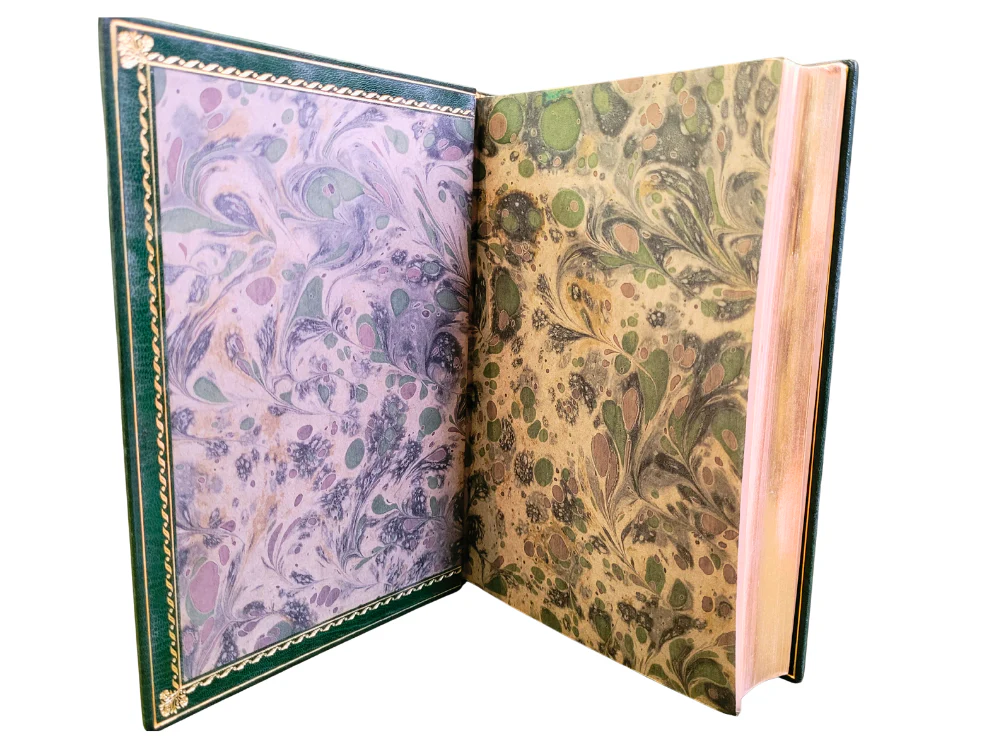
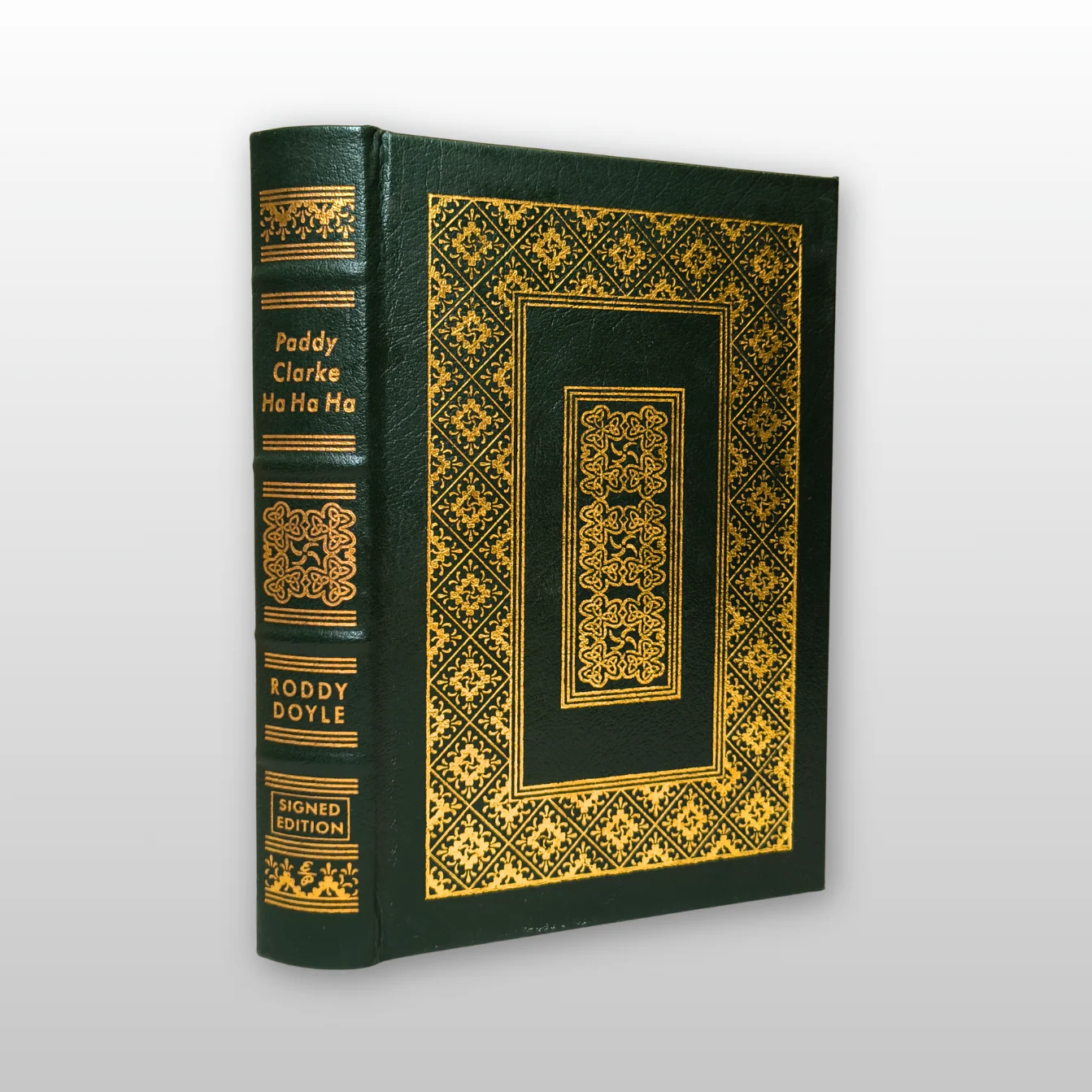
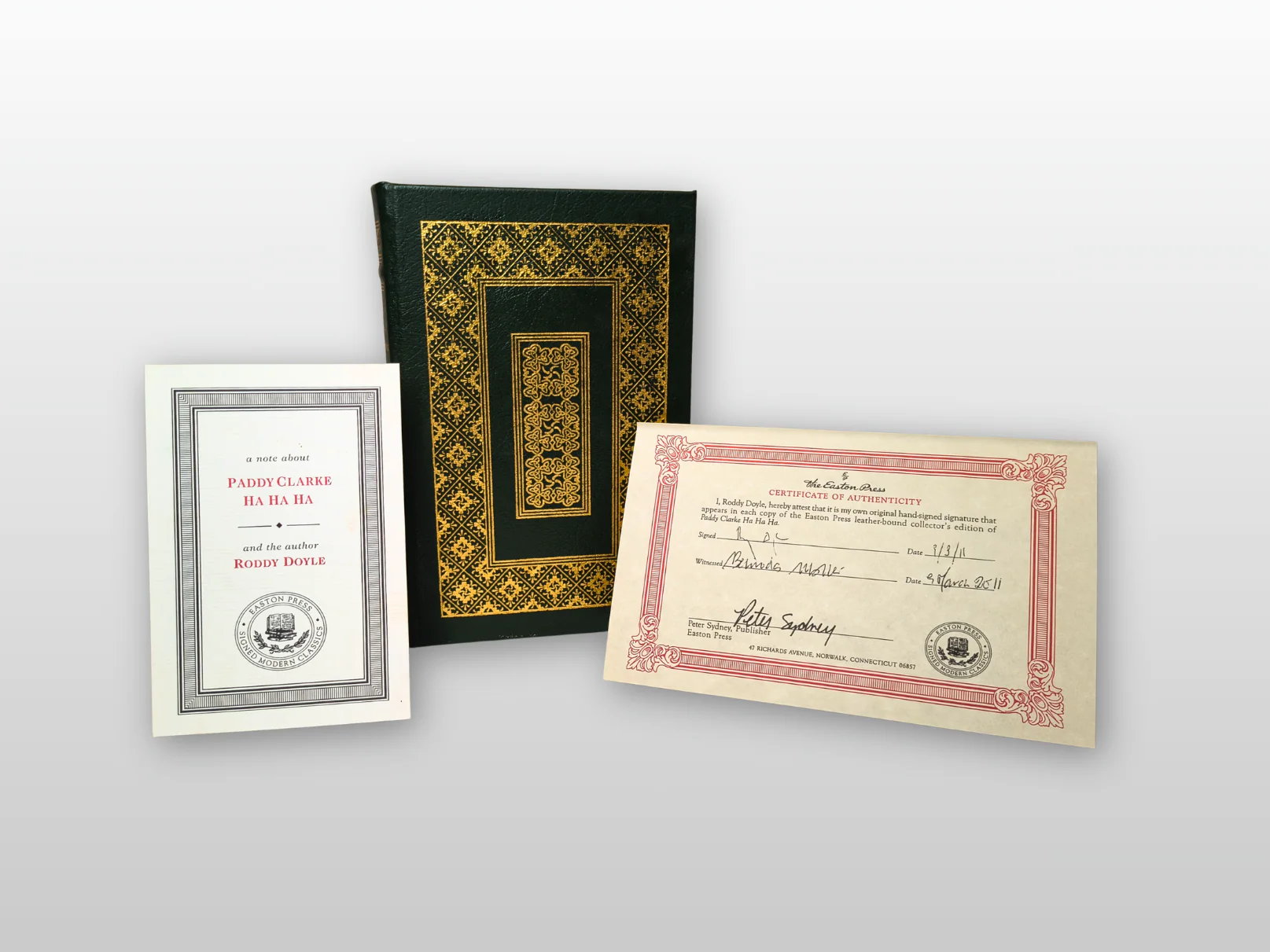
Octavo. Full green leather. Spine with raised bands, 22-carat gilt accents. All edges gilt. Moiré silk endpapers. Satin ribbon page marker. 282 pp. Signed Collector's Edition. Signed by the author on the special title page. Includes signed Certificate of Authenticity and edition card. Originally published London: Secker & Warburg, 1993.
Roddy Doyle (b. 1958) grew up in Kilbarrack, a working-class suburb of north Dublin that became, fictionalised as Barrytown, the setting for everything he wrote in the first decade of his career. He was a schoolteacher when The Commitments was published in 1987, and he remained one through the Barrytown Trilogy — The Snapper (1990) and The Van (1991, shortlisted for the Booker Prize) followed — before Paddy Clarke Ha Ha Ha won the Booker Prize in 1993 and made the question of continuing to teach a moot one. He has lived and worked in Dublin ever since.
Paddy Clarke Ha Ha Ha is set in Barrytown in 1968. Patrick Clarke is ten years old. He and his best friend Kevin and their gang of boys write their names in wet cement, set fires in abandoned buildings, play football and lepers and jumping to the bottom of the sea. They tease younger children and challenge each other to feats of daring with the particular cruelty and elation that exists only in the social world of boys of that age and that era. Paddy loves Geronimo and the Three Stooges and the smell of his hot water bottle. He cannot stand his little brother Sinbad. He is observant and funny and alive to everything around him, and he is beginning to notice that his parents argue more than they used to, and that the arguments have started to sound different from before.
The novel is narrated entirely in Paddy's voice — not the retrospective voice of an adult recalling childhood, but the immediate, present-tense voice of the child himself, with its gaps in understanding, its leaps of association, its sudden swerves between comedy and alarm. Doyle's control of that voice is the central technical achievement of the book, and it is complete: the register never slips, and the effect is of a consciousness that is registering everything and comprehending less and less as the situation at home deteriorates. The Independent praised it as "one of the truest and funniest presentations of juvenile experience in any recent literature." The title's meaning becomes clear only toward the end, when Paddy's father has left and the other boys at school have found the cruelest possible way to acknowledge what has happened.
Fine. Presenting as new.
This book is currently not on display in store. If you would like more information or to arrange a viewing, please contact: [email protected]
Catalogue Number: HH000502
Product Information
Product Information
Shipping & Returns
Shipping & Returns

Paddy Clarke Ha Ha Ha (Easton Press Signed Collector's Edition)
Paddy Clarke Ha Ha Ha (Easton Press Signed Collector's Edition)
DOYLE, Roddy. Paddy Clarke Ha Ha Ha. Norwalk, Connecticut: The Easton Press, 2011.
Octavo. Full green leather. Spine with raised bands, 22-carat gilt accents. All edges gilt. Moiré silk endpapers. Satin ribbon page marker. 282 pp. Signed Collector's Edition. Signed by the author on the special title page. Includes signed Certificate of Authenticity and edition card. Originally published London: Secker & Warburg, 1993.
Roddy Doyle (b. 1958) grew up in Kilbarrack, a working-class suburb of north Dublin that became, fictionalised as Barrytown, the setting for everything he wrote in the first decade of his career. He was a schoolteacher when The Commitments was published in 1987, and he remained one through the Barrytown Trilogy — The Snapper (1990) and The Van (1991, shortlisted for the Booker Prize) followed — before Paddy Clarke Ha Ha Ha won the Booker Prize in 1993 and made the question of continuing to teach a moot one. He has lived and worked in Dublin ever since.
Paddy Clarke Ha Ha Ha is set in Barrytown in 1968. Patrick Clarke is ten years old. He and his best friend Kevin and their gang of boys write their names in wet cement, set fires in abandoned buildings, play football and lepers and jumping to the bottom of the sea. They tease younger children and challenge each other to feats of daring with the particular cruelty and elation that exists only in the social world of boys of that age and that era. Paddy loves Geronimo and the Three Stooges and the smell of his hot water bottle. He cannot stand his little brother Sinbad. He is observant and funny and alive to everything around him, and he is beginning to notice that his parents argue more than they used to, and that the arguments have started to sound different from before.
The novel is narrated entirely in Paddy's voice — not the retrospective voice of an adult recalling childhood, but the immediate, present-tense voice of the child himself, with its gaps in understanding, its leaps of association, its sudden swerves between comedy and alarm. Doyle's control of that voice is the central technical achievement of the book, and it is complete: the register never slips, and the effect is of a consciousness that is registering everything and comprehending less and less as the situation at home deteriorates. The Independent praised it as "one of the truest and funniest presentations of juvenile experience in any recent literature." The title's meaning becomes clear only toward the end, when Paddy's father has left and the other boys at school have found the cruelest possible way to acknowledge what has happened.
Fine. Presenting as new.
This book is currently not on display in store. If you would like more information or to arrange a viewing, please contact: [email protected]
Catalogue Number: HH000502
Original: $62.85
-65%$62.85
$22.00Product Information
Product Information
Shipping & Returns
Shipping & Returns
Description
DOYLE, Roddy. Paddy Clarke Ha Ha Ha. Norwalk, Connecticut: The Easton Press, 2011.
Octavo. Full green leather. Spine with raised bands, 22-carat gilt accents. All edges gilt. Moiré silk endpapers. Satin ribbon page marker. 282 pp. Signed Collector's Edition. Signed by the author on the special title page. Includes signed Certificate of Authenticity and edition card. Originally published London: Secker & Warburg, 1993.
Roddy Doyle (b. 1958) grew up in Kilbarrack, a working-class suburb of north Dublin that became, fictionalised as Barrytown, the setting for everything he wrote in the first decade of his career. He was a schoolteacher when The Commitments was published in 1987, and he remained one through the Barrytown Trilogy — The Snapper (1990) and The Van (1991, shortlisted for the Booker Prize) followed — before Paddy Clarke Ha Ha Ha won the Booker Prize in 1993 and made the question of continuing to teach a moot one. He has lived and worked in Dublin ever since.
Paddy Clarke Ha Ha Ha is set in Barrytown in 1968. Patrick Clarke is ten years old. He and his best friend Kevin and their gang of boys write their names in wet cement, set fires in abandoned buildings, play football and lepers and jumping to the bottom of the sea. They tease younger children and challenge each other to feats of daring with the particular cruelty and elation that exists only in the social world of boys of that age and that era. Paddy loves Geronimo and the Three Stooges and the smell of his hot water bottle. He cannot stand his little brother Sinbad. He is observant and funny and alive to everything around him, and he is beginning to notice that his parents argue more than they used to, and that the arguments have started to sound different from before.
The novel is narrated entirely in Paddy's voice — not the retrospective voice of an adult recalling childhood, but the immediate, present-tense voice of the child himself, with its gaps in understanding, its leaps of association, its sudden swerves between comedy and alarm. Doyle's control of that voice is the central technical achievement of the book, and it is complete: the register never slips, and the effect is of a consciousness that is registering everything and comprehending less and less as the situation at home deteriorates. The Independent praised it as "one of the truest and funniest presentations of juvenile experience in any recent literature." The title's meaning becomes clear only toward the end, when Paddy's father has left and the other boys at school have found the cruelest possible way to acknowledge what has happened.
Fine. Presenting as new.
This book is currently not on display in store. If you would like more information or to arrange a viewing, please contact: [email protected]
Catalogue Number: HH000502