Pilgrim at Tinker Creek (Easton Press Signed Collector's Edition)
DILLARD, Annie. Pilgrim at Tinker Creek. Norwalk, Connecticut: The Easton Press, 2000.
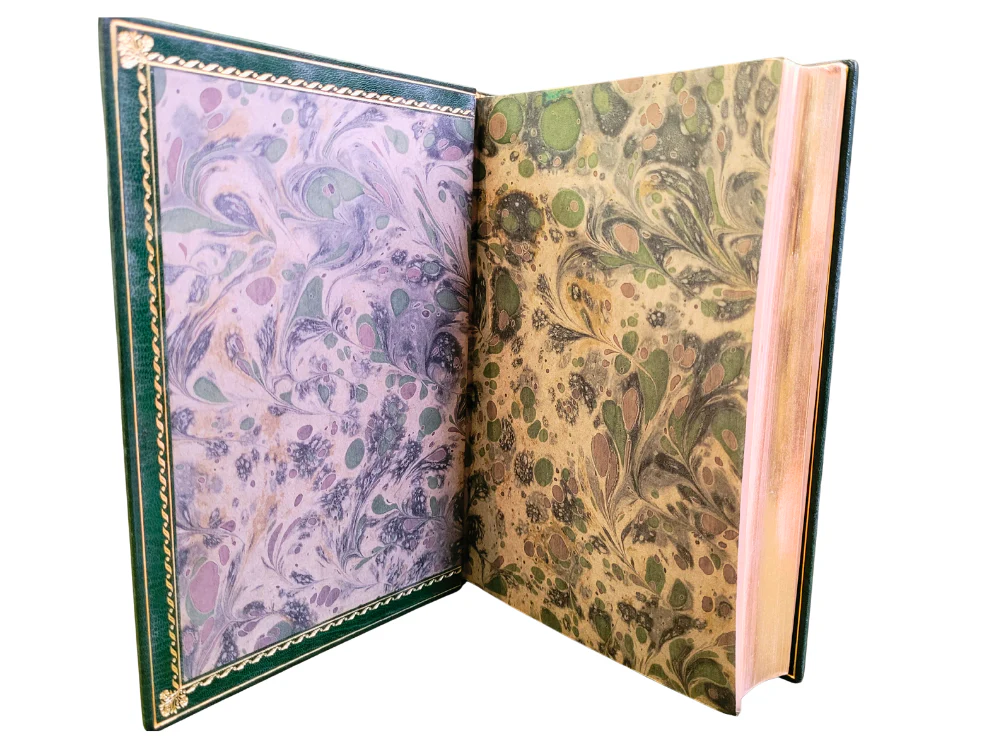
Octavo. Full dark green leather. Spine with four raised bands, 22-carat gilt accents. Gilt design, lettering and fore-edges. All edges gilt. Moiré silk endpapers. Satin ribbon page marker. 271 pp. Signed Collector's Edition. Limited to 1,100 numbered copies. Signed by the author on the special tipped-in publisher's page. Includes signed Certificate of Authenticity, Collector's Notes, and bookplate adhered to front endpaper. Originally published New York: Harper's Magazine Press, 1974.
Annie Dillard (b. 1945) grew up in Pittsburgh, took her BA and MA at Hollins University in Virginia, and in 1971 began keeping the journal of daily observation that became Pilgrim at Tinker Creek. She spent a year watching the creek and its surrounding Virginia Blue Ridge landscape with the combined attentiveness of a naturalist, a philosopher, and a poet, and wrote the resulting essays in a four-month burst the following winter. She was twenty-eight years old when the book was published in 1974. It won the Pulitzer Prize for General Nonfiction in 1975, establishing her immediately as one of the most original voices in American letters.
The obvious comparison is to Thoreau — a writer observing a small piece of the natural world with minute attention, using that observation as a vehicle for the largest possible questions about consciousness, time, beauty, and death. Dillard acknowledged the debt and worked within it, but Pilgrim at Tinker Creek is its own book: rawer than Walden, more willing to dwell in horror as well as wonder, more explicitly structured around the tension between what can be seen and what cannot be known. The natural world as Dillard observes it is not pastoral. It is violent, prodigal, indifferent, and occasionally and inexplicably beautiful, and her attention to it never flinches from what that combination means.
The book is organised by season across a single year, and moves between modes of writing that Dillard herself describes as "the literature of natural history, for the most part, and the literature of contemplation." The result belongs wholly to neither genre: it is something more like a meditation on perception itself, conducted through the specific textures of a creek, a field, a moth, a frog, a tree. The New York Times described it as a book whose "ambition is to feel." Annie Dillard's subsequent works include An American Childhood (1987), The Writing Life (1989), and For the Time Being (1999), all of which extend the project begun here, but Pilgrim at Tinker Creek remains her best-known and most influential work.
Near fine. Some mild markings along gilt edges; otherwise fine throughout.
This book is currently not on display in store. If you would like more information or to arrange a viewing, please contact: [email protected]
Catalogue Number: HH000561
Product Information
Product Information
Shipping & Returns
Shipping & Returns

Pilgrim at Tinker Creek (Easton Press Signed Collector's Edition)
Pilgrim at Tinker Creek (Easton Press Signed Collector's Edition)
DILLARD, Annie. Pilgrim at Tinker Creek. Norwalk, Connecticut: The Easton Press, 2000.
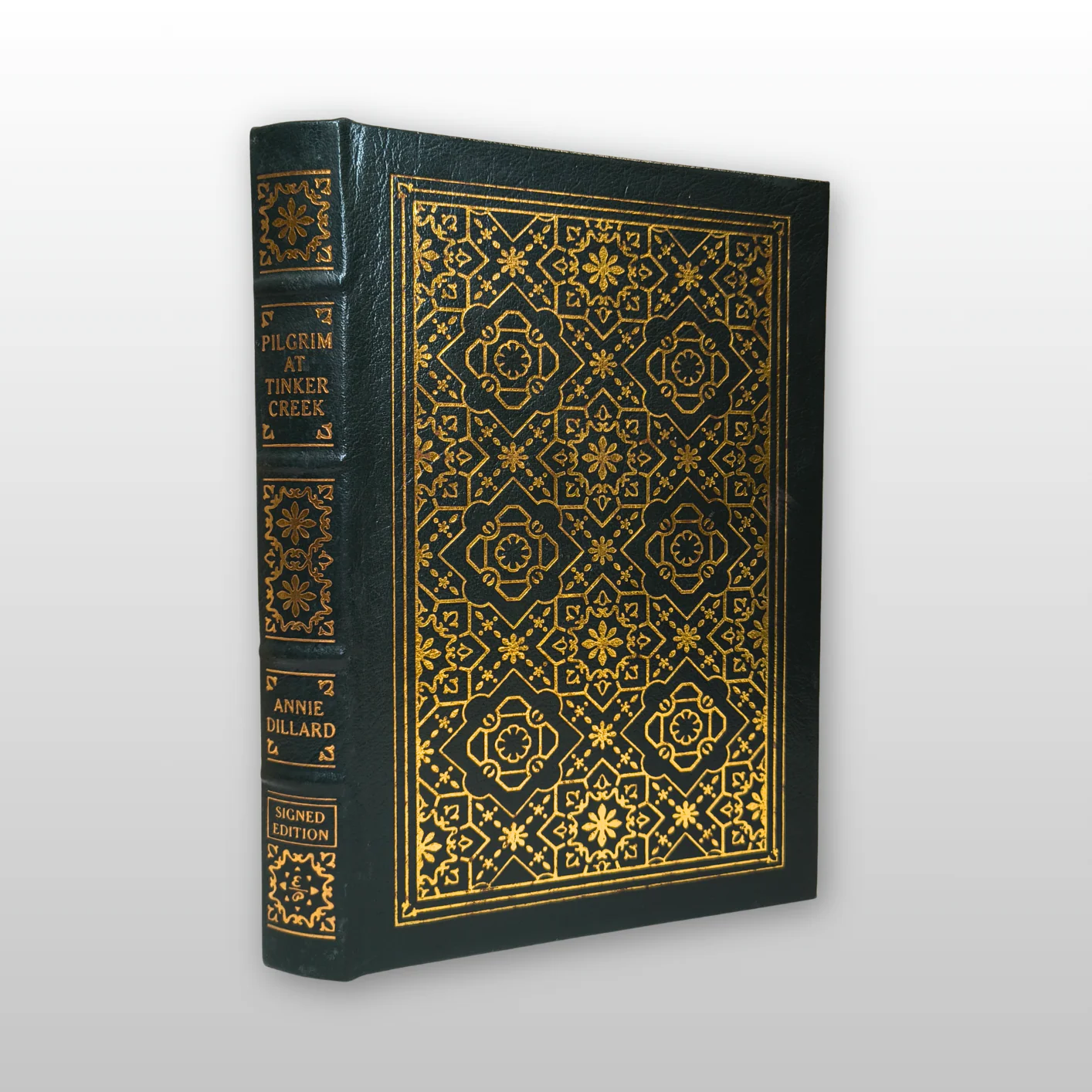
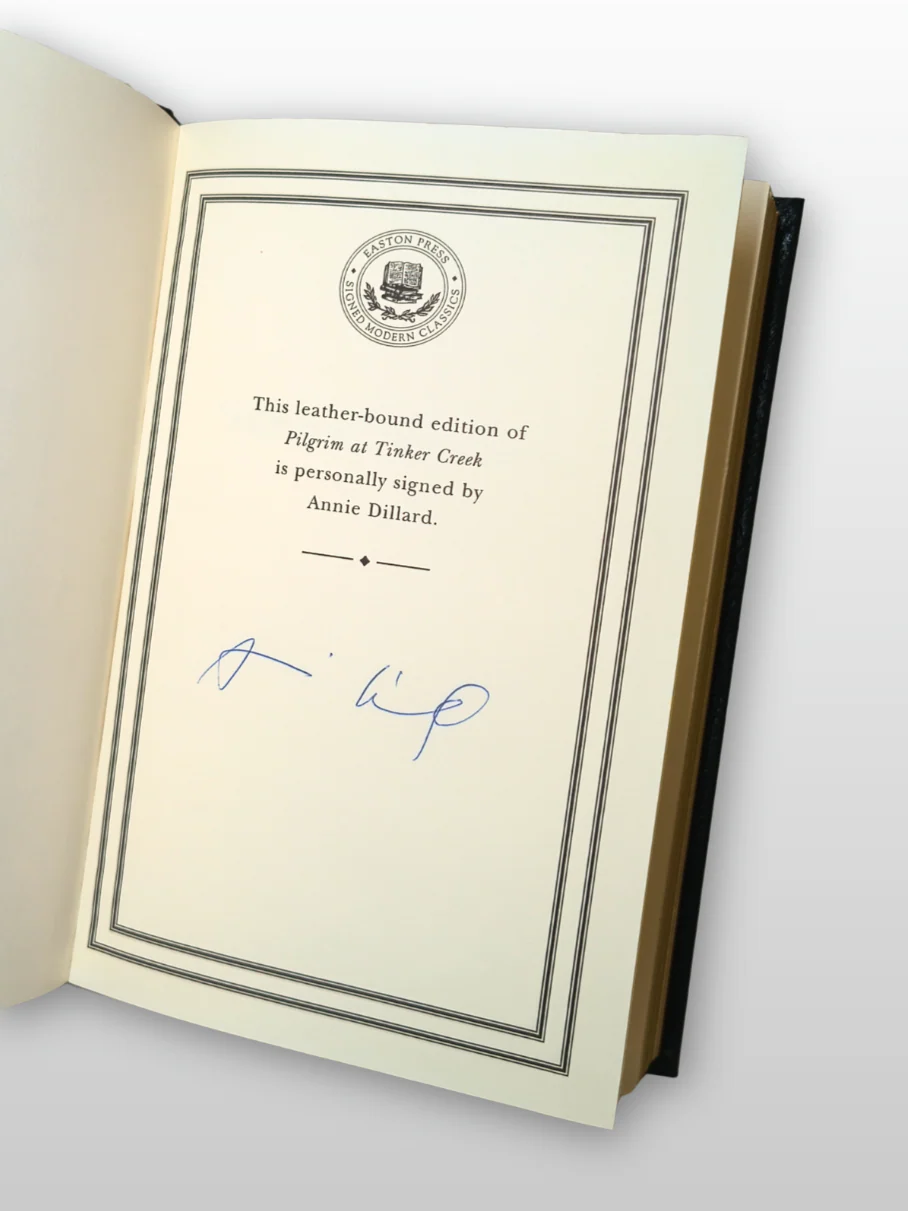
Octavo. Full dark green leather. Spine with four raised bands, 22-carat gilt accents. Gilt design, lettering and fore-edges. All edges gilt. Moiré silk endpapers. Satin ribbon page marker. 271 pp. Signed Collector's Edition. Limited to 1,100 numbered copies. Signed by the author on the special tipped-in publisher's page. Includes signed Certificate of Authenticity, Collector's Notes, and bookplate adhered to front endpaper. Originally published New York: Harper's Magazine Press, 1974.
Annie Dillard (b. 1945) grew up in Pittsburgh, took her BA and MA at Hollins University in Virginia, and in 1971 began keeping the journal of daily observation that became Pilgrim at Tinker Creek. She spent a year watching the creek and its surrounding Virginia Blue Ridge landscape with the combined attentiveness of a naturalist, a philosopher, and a poet, and wrote the resulting essays in a four-month burst the following winter. She was twenty-eight years old when the book was published in 1974. It won the Pulitzer Prize for General Nonfiction in 1975, establishing her immediately as one of the most original voices in American letters.
The obvious comparison is to Thoreau — a writer observing a small piece of the natural world with minute attention, using that observation as a vehicle for the largest possible questions about consciousness, time, beauty, and death. Dillard acknowledged the debt and worked within it, but Pilgrim at Tinker Creek is its own book: rawer than Walden, more willing to dwell in horror as well as wonder, more explicitly structured around the tension between what can be seen and what cannot be known. The natural world as Dillard observes it is not pastoral. It is violent, prodigal, indifferent, and occasionally and inexplicably beautiful, and her attention to it never flinches from what that combination means.
The book is organised by season across a single year, and moves between modes of writing that Dillard herself describes as "the literature of natural history, for the most part, and the literature of contemplation." The result belongs wholly to neither genre: it is something more like a meditation on perception itself, conducted through the specific textures of a creek, a field, a moth, a frog, a tree. The New York Times described it as a book whose "ambition is to feel." Annie Dillard's subsequent works include An American Childhood (1987), The Writing Life (1989), and For the Time Being (1999), all of which extend the project begun here, but Pilgrim at Tinker Creek remains her best-known and most influential work.
Near fine. Some mild markings along gilt edges; otherwise fine throughout.
This book is currently not on display in store. If you would like more information or to arrange a viewing, please contact: [email protected]
Catalogue Number: HH000561
Original: $52.14
-65%$52.14
$18.25Product Information
Product Information
Shipping & Returns
Shipping & Returns
Description
DILLARD, Annie. Pilgrim at Tinker Creek. Norwalk, Connecticut: The Easton Press, 2000.
Octavo. Full dark green leather. Spine with four raised bands, 22-carat gilt accents. Gilt design, lettering and fore-edges. All edges gilt. Moiré silk endpapers. Satin ribbon page marker. 271 pp. Signed Collector's Edition. Limited to 1,100 numbered copies. Signed by the author on the special tipped-in publisher's page. Includes signed Certificate of Authenticity, Collector's Notes, and bookplate adhered to front endpaper. Originally published New York: Harper's Magazine Press, 1974.
Annie Dillard (b. 1945) grew up in Pittsburgh, took her BA and MA at Hollins University in Virginia, and in 1971 began keeping the journal of daily observation that became Pilgrim at Tinker Creek. She spent a year watching the creek and its surrounding Virginia Blue Ridge landscape with the combined attentiveness of a naturalist, a philosopher, and a poet, and wrote the resulting essays in a four-month burst the following winter. She was twenty-eight years old when the book was published in 1974. It won the Pulitzer Prize for General Nonfiction in 1975, establishing her immediately as one of the most original voices in American letters.
The obvious comparison is to Thoreau — a writer observing a small piece of the natural world with minute attention, using that observation as a vehicle for the largest possible questions about consciousness, time, beauty, and death. Dillard acknowledged the debt and worked within it, but Pilgrim at Tinker Creek is its own book: rawer than Walden, more willing to dwell in horror as well as wonder, more explicitly structured around the tension between what can be seen and what cannot be known. The natural world as Dillard observes it is not pastoral. It is violent, prodigal, indifferent, and occasionally and inexplicably beautiful, and her attention to it never flinches from what that combination means.
The book is organised by season across a single year, and moves between modes of writing that Dillard herself describes as "the literature of natural history, for the most part, and the literature of contemplation." The result belongs wholly to neither genre: it is something more like a meditation on perception itself, conducted through the specific textures of a creek, a field, a moth, a frog, a tree. The New York Times described it as a book whose "ambition is to feel." Annie Dillard's subsequent works include An American Childhood (1987), The Writing Life (1989), and For the Time Being (1999), all of which extend the project begun here, but Pilgrim at Tinker Creek remains her best-known and most influential work.
Near fine. Some mild markings along gilt edges; otherwise fine throughout.
This book is currently not on display in store. If you would like more information or to arrange a viewing, please contact: [email protected]
Catalogue Number: HH000561