Rabbit, Run (Easton Press Collector's Edition)
UPDIKE, John. Rabbit, Run. Norwalk, Connecticut: The Easton Press, 1993.
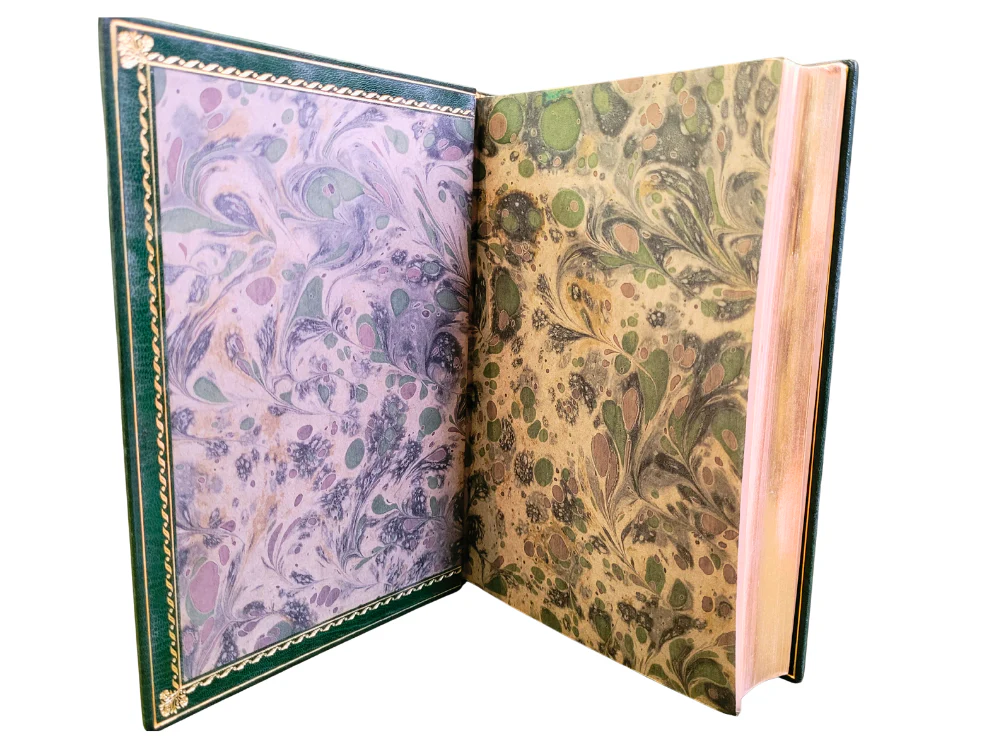
Octavo. Full Burgundy leather. Spine with raised bands, 22-carat gilt accents. Gilt design and lettering to covers. All edges gilt. Moiré silk endpapers. Satin ribbon page marker. 307 pp. Collector's Notes laid in. Collector's Edition. Originally published New York: Alfred A. Knopf, 1960.
John Updike (1932–2009) published Rabbit, Run in 1960, at twenty-eight, and it established him immediately as one of the central novelists of American life in the second half of the twentieth century. He had been writing for The New Yorker since graduating from Harvard summa cum laude in 1954, and the prose style he brought to his first major novel — lyrical, exact, attentive to the surfaces of the physical world in a way that was simultaneously celebratory and melancholy — was unlike anything else in American fiction of the period. Over the following five decades he published more than twenty novels, numerous collections of short stories, poetry, essays, and criticism, and won virtually every honour American letters had to offer, including two Pulitzer Prizes for Fiction — for Rabbit Is Rich (1982) and Rabbit at Rest (1991).
Harry "Rabbit" Angstrom is twenty-six years old. He was, in high school, a basketball player of real ability — the kind of player a small Pennsylvania town remembers — and that period of physical grace and social centrality is the best thing that has ever happened to him. Now he works a dead-end sales job, is trapped in a failing marriage to the pregnant Janice, and cannot explain, even to himself, why the life he is living feels like the wrong life. One evening he gets in his car to drive south and simply keeps driving. He cannot get free. He comes back. He goes again. The novel follows three months of this circular flight, and it is as honest an account of a man trying to escape an existence that does not fit him as American fiction has produced.
The Rabbit series that followed — Rabbit Redux (1971), Rabbit Is Rich (1981), Rabbit at Rest (1990), and the novella Rabbit Remembered (2001) — traced Harry Angstrom across the decades of American life from Eisenhower to the Clinton era, making him one of the most sustained character studies in modern fiction. The Modern Library ranked Rabbit, Run fourth on its list of the hundred best English-language novels of the twentieth century. The Easton Press Collector's Edition of 1993 presents the complete text as new.
As new. Removed from publisher's shrinkwrap to verify contents and condition.
This book is currently not on display in store. If you would like more information or to arrange a viewing, please contact: [email protected]
Catalogue Number: HH000565
Product Information
Product Information
Shipping & Returns
Shipping & Returns

Rabbit, Run (Easton Press Collector's Edition)
Rabbit, Run (Easton Press Collector's Edition)
UPDIKE, John. Rabbit, Run. Norwalk, Connecticut: The Easton Press, 1993.
Octavo. Full Burgundy leather. Spine with raised bands, 22-carat gilt accents. Gilt design and lettering to covers. All edges gilt. Moiré silk endpapers. Satin ribbon page marker. 307 pp. Collector's Notes laid in. Collector's Edition. Originally published New York: Alfred A. Knopf, 1960.
John Updike (1932–2009) published Rabbit, Run in 1960, at twenty-eight, and it established him immediately as one of the central novelists of American life in the second half of the twentieth century. He had been writing for The New Yorker since graduating from Harvard summa cum laude in 1954, and the prose style he brought to his first major novel — lyrical, exact, attentive to the surfaces of the physical world in a way that was simultaneously celebratory and melancholy — was unlike anything else in American fiction of the period. Over the following five decades he published more than twenty novels, numerous collections of short stories, poetry, essays, and criticism, and won virtually every honour American letters had to offer, including two Pulitzer Prizes for Fiction — for Rabbit Is Rich (1982) and Rabbit at Rest (1991).
Harry "Rabbit" Angstrom is twenty-six years old. He was, in high school, a basketball player of real ability — the kind of player a small Pennsylvania town remembers — and that period of physical grace and social centrality is the best thing that has ever happened to him. Now he works a dead-end sales job, is trapped in a failing marriage to the pregnant Janice, and cannot explain, even to himself, why the life he is living feels like the wrong life. One evening he gets in his car to drive south and simply keeps driving. He cannot get free. He comes back. He goes again. The novel follows three months of this circular flight, and it is as honest an account of a man trying to escape an existence that does not fit him as American fiction has produced.
The Rabbit series that followed — Rabbit Redux (1971), Rabbit Is Rich (1981), Rabbit at Rest (1990), and the novella Rabbit Remembered (2001) — traced Harry Angstrom across the decades of American life from Eisenhower to the Clinton era, making him one of the most sustained character studies in modern fiction. The Modern Library ranked Rabbit, Run fourth on its list of the hundred best English-language novels of the twentieth century. The Easton Press Collector's Edition of 1993 presents the complete text as new.
As new. Removed from publisher's shrinkwrap to verify contents and condition.
This book is currently not on display in store. If you would like more information or to arrange a viewing, please contact: [email protected]
Catalogue Number: HH000565
Original: $62.85
-65%$62.85
$22.00Product Information
Product Information
Shipping & Returns
Shipping & Returns
Description
UPDIKE, John. Rabbit, Run. Norwalk, Connecticut: The Easton Press, 1993.
Octavo. Full Burgundy leather. Spine with raised bands, 22-carat gilt accents. Gilt design and lettering to covers. All edges gilt. Moiré silk endpapers. Satin ribbon page marker. 307 pp. Collector's Notes laid in. Collector's Edition. Originally published New York: Alfred A. Knopf, 1960.
John Updike (1932–2009) published Rabbit, Run in 1960, at twenty-eight, and it established him immediately as one of the central novelists of American life in the second half of the twentieth century. He had been writing for The New Yorker since graduating from Harvard summa cum laude in 1954, and the prose style he brought to his first major novel — lyrical, exact, attentive to the surfaces of the physical world in a way that was simultaneously celebratory and melancholy — was unlike anything else in American fiction of the period. Over the following five decades he published more than twenty novels, numerous collections of short stories, poetry, essays, and criticism, and won virtually every honour American letters had to offer, including two Pulitzer Prizes for Fiction — for Rabbit Is Rich (1982) and Rabbit at Rest (1991).
Harry "Rabbit" Angstrom is twenty-six years old. He was, in high school, a basketball player of real ability — the kind of player a small Pennsylvania town remembers — and that period of physical grace and social centrality is the best thing that has ever happened to him. Now he works a dead-end sales job, is trapped in a failing marriage to the pregnant Janice, and cannot explain, even to himself, why the life he is living feels like the wrong life. One evening he gets in his car to drive south and simply keeps driving. He cannot get free. He comes back. He goes again. The novel follows three months of this circular flight, and it is as honest an account of a man trying to escape an existence that does not fit him as American fiction has produced.
The Rabbit series that followed — Rabbit Redux (1971), Rabbit Is Rich (1981), Rabbit at Rest (1990), and the novella Rabbit Remembered (2001) — traced Harry Angstrom across the decades of American life from Eisenhower to the Clinton era, making him one of the most sustained character studies in modern fiction. The Modern Library ranked Rabbit, Run fourth on its list of the hundred best English-language novels of the twentieth century. The Easton Press Collector's Edition of 1993 presents the complete text as new.
As new. Removed from publisher's shrinkwrap to verify contents and condition.
This book is currently not on display in store. If you would like more information or to arrange a viewing, please contact: [email protected]
Catalogue Number: HH000565