Soul Mountain (Easton Press Signed Collector's Edition)
GAO, Xingjian (trans. Mabel Lee). Soul Mountain. Norwalk, Connecticut: The Easton Press, 2006.
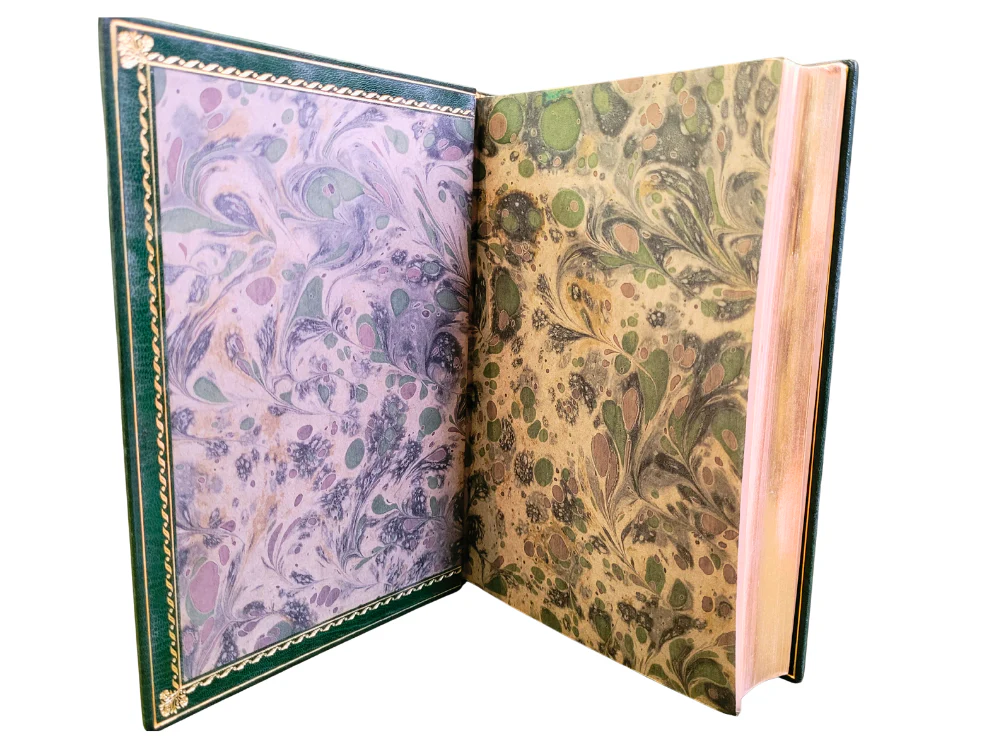
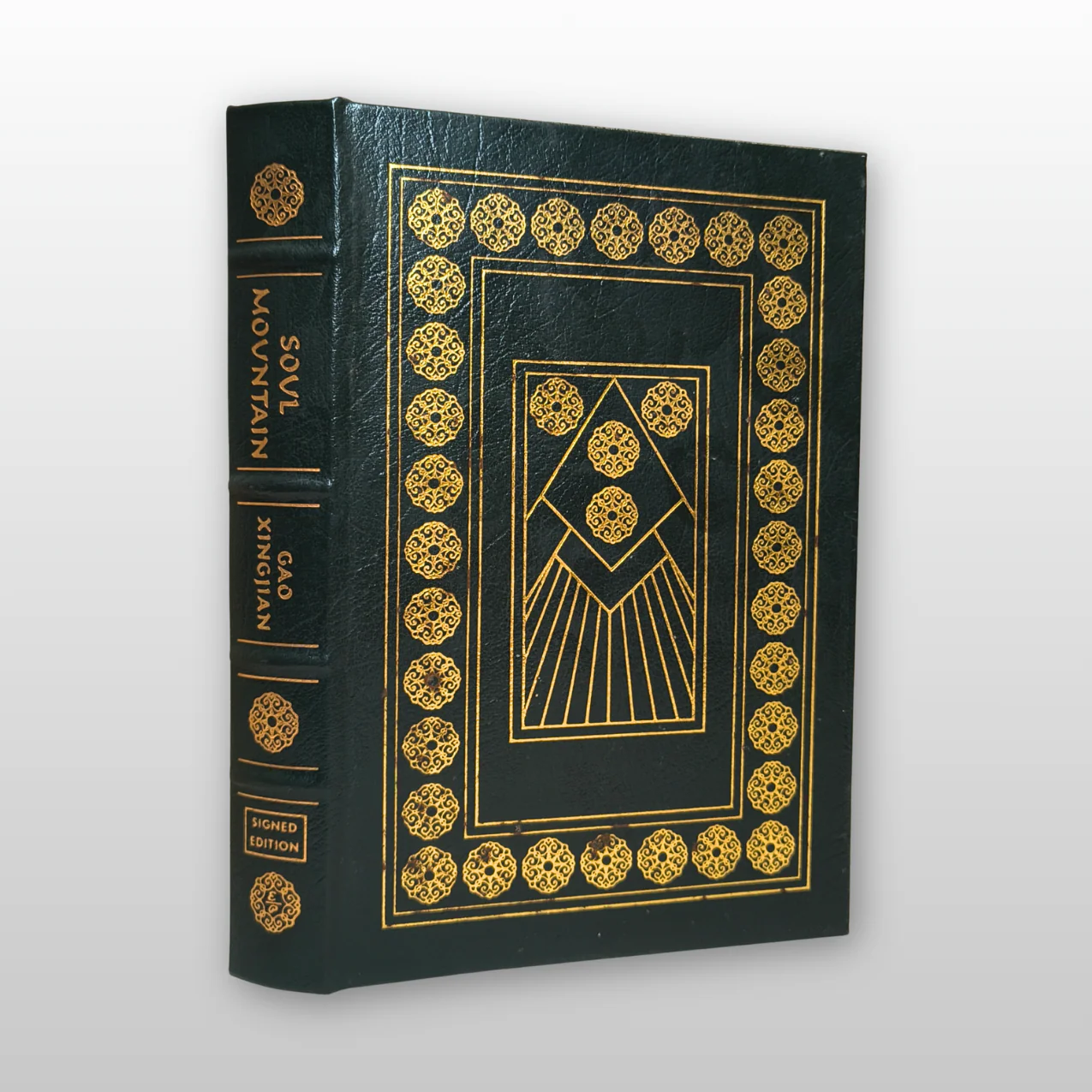
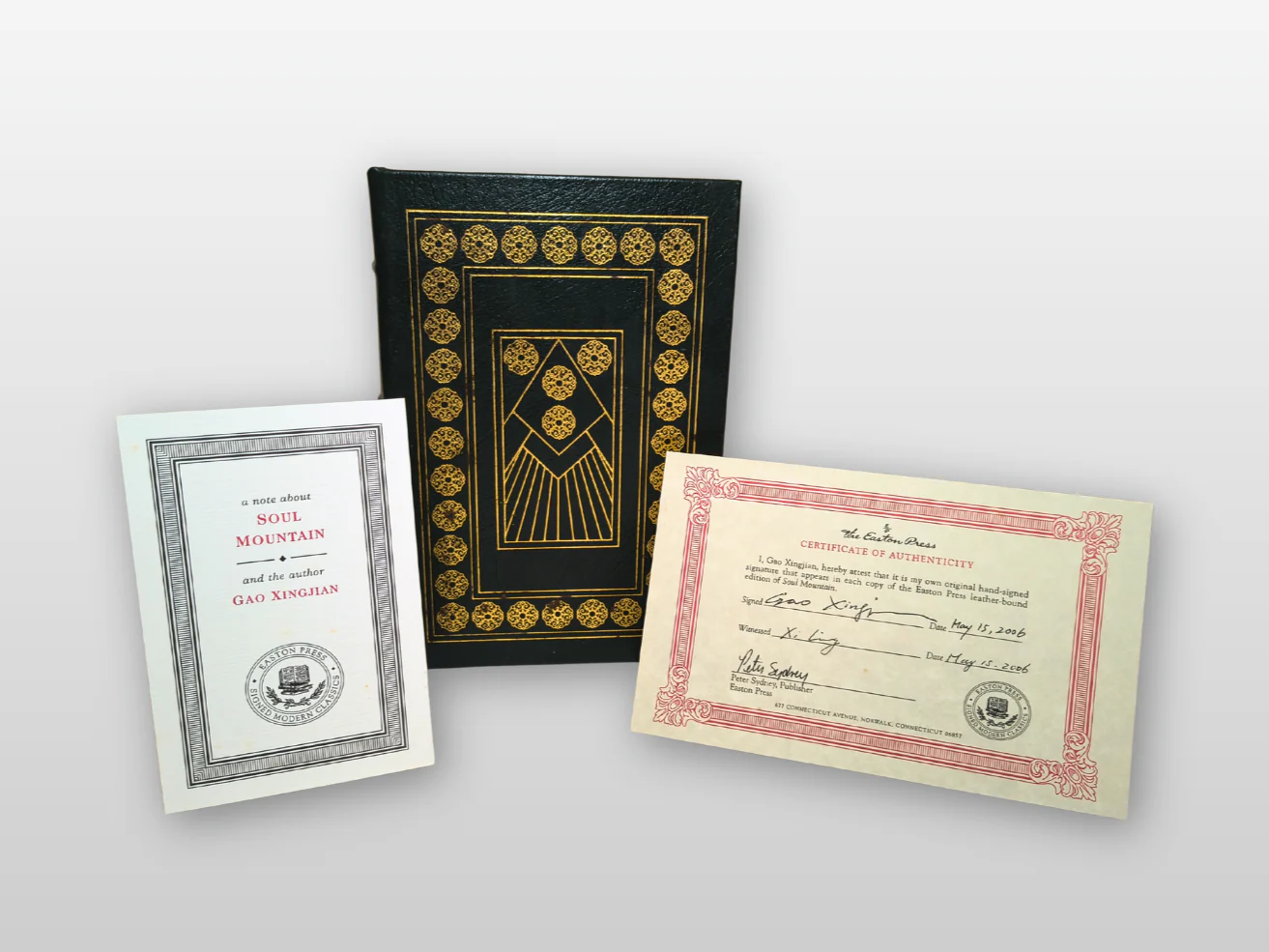
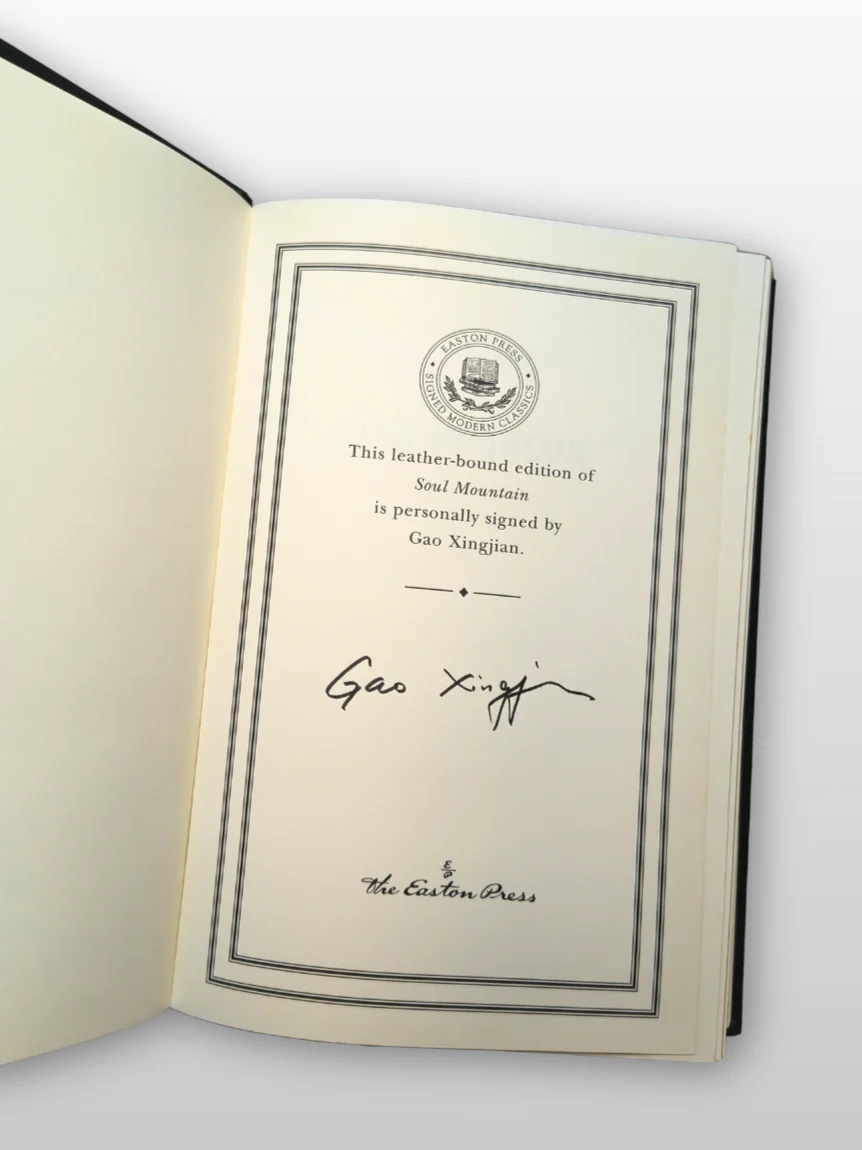
Octavo. Full deep green leather. Spine with four raised bands, 22-carat gilt accents. Gilt design, lettering and fore-edges. All edges gilt. Moiré silk endpapers. Satin ribbon page marker. 510 pp. Signed Collector's Edition. Signed by the author on the special preliminary page. Includes signed Certificate of Authenticity, Collector's Notes, and bookplate adhered to front endpaper. Originally published in Chinese as 靈山 (Lingshan), Taipei: Lianjing Publishing Company, 1990. First English translation by Mabel Lee, Sydney: HarperCollins Australia, 2000.
Gao Xingjian (b. 1940) is a novelist, playwright, and painter who was born in Ganzhou in Jiangxi Province and educated in Beijing. During the Cultural Revolution he was sent to a re-education camp for six years and spent time burning his own manuscripts to avoid persecution. He emerged as one of the leading playwrights of the post-Mao liberalisation and achieved international recognition with his play Bus Stop (1983) — which was subsequently banned as "spiritual pollution" by Chinese authorities — before a combination of political pressure and a misdiagnosis of lung cancer prompted him to flee Beijing in 1983 for a five-month journey through remote regions of Sichuan, Guizhou, and Yunnan. The journey provided the material for Soul Mountain. Gao left China permanently in 1987, settled in Paris, and became a French citizen in 1998. After the Tiananmen Square massacre of 1989, his works were banned in China. In 2000 he was awarded the Nobel Prize for Literature — the first Chinese author to receive it.
Soul Mountain, written during the decade following Gao's journey and first published in Taiwan in 1990, is the novel the Nobel Committee had in mind. It defies straightforward description, which is part of the point. The narrator — a writer who has also been misdiagnosed with lung cancer and has also fled Beijing into the wilderness — travels through the remote mountains and forests of southwestern China in search of a place called Lingshan, Soul Mountain, whose existence he cannot verify and whose location no one can agree on. The journey is simultaneously physical and metaphysical, a traversal of China's pre-revolutionary folk traditions, shamanism, Taoism, and Buddhism alongside its landscapes. The novel's narrative is distributed across shifting pronouns — sections addressed to "you" alternate with "I" and "he/she" — enacting the fragmentation of identity that is both the novel's subject and its formal method.
The first English translation was produced by Mabel Lee, an Australian scholar of Chinese literature at the University of Sydney, whose championing of the novel brought it to HarperCollins Australia — making Sydney the site of the work's first appearance in English in 2000, weeks before Gao's Nobel Prize transformed it into an international phenomenon. The Nobel Committee described Soul Mountain as "a work of unique scope, a kind of modern Odyssey in China."
Near fine. Some very minor loss to cover gilt; faint markings along edges. Otherwise fine throughout.
This book is currently not on display in store. If you would like more information or to arrange a viewing, please contact: [email protected]
Catalogue Number: HH000569
Product Information
Product Information
Shipping & Returns
Shipping & Returns
Soul Mountain (Easton Press Signed Collector's Edition)
Soul Mountain (Easton Press Signed Collector's Edition)
GAO, Xingjian (trans. Mabel Lee). Soul Mountain. Norwalk, Connecticut: The Easton Press, 2006.
Octavo. Full deep green leather. Spine with four raised bands, 22-carat gilt accents. Gilt design, lettering and fore-edges. All edges gilt. Moiré silk endpapers. Satin ribbon page marker. 510 pp. Signed Collector's Edition. Signed by the author on the special preliminary page. Includes signed Certificate of Authenticity, Collector's Notes, and bookplate adhered to front endpaper. Originally published in Chinese as 靈山 (Lingshan), Taipei: Lianjing Publishing Company, 1990. First English translation by Mabel Lee, Sydney: HarperCollins Australia, 2000.
Gao Xingjian (b. 1940) is a novelist, playwright, and painter who was born in Ganzhou in Jiangxi Province and educated in Beijing. During the Cultural Revolution he was sent to a re-education camp for six years and spent time burning his own manuscripts to avoid persecution. He emerged as one of the leading playwrights of the post-Mao liberalisation and achieved international recognition with his play Bus Stop (1983) — which was subsequently banned as "spiritual pollution" by Chinese authorities — before a combination of political pressure and a misdiagnosis of lung cancer prompted him to flee Beijing in 1983 for a five-month journey through remote regions of Sichuan, Guizhou, and Yunnan. The journey provided the material for Soul Mountain. Gao left China permanently in 1987, settled in Paris, and became a French citizen in 1998. After the Tiananmen Square massacre of 1989, his works were banned in China. In 2000 he was awarded the Nobel Prize for Literature — the first Chinese author to receive it.
Soul Mountain, written during the decade following Gao's journey and first published in Taiwan in 1990, is the novel the Nobel Committee had in mind. It defies straightforward description, which is part of the point. The narrator — a writer who has also been misdiagnosed with lung cancer and has also fled Beijing into the wilderness — travels through the remote mountains and forests of southwestern China in search of a place called Lingshan, Soul Mountain, whose existence he cannot verify and whose location no one can agree on. The journey is simultaneously physical and metaphysical, a traversal of China's pre-revolutionary folk traditions, shamanism, Taoism, and Buddhism alongside its landscapes. The novel's narrative is distributed across shifting pronouns — sections addressed to "you" alternate with "I" and "he/she" — enacting the fragmentation of identity that is both the novel's subject and its formal method.
The first English translation was produced by Mabel Lee, an Australian scholar of Chinese literature at the University of Sydney, whose championing of the novel brought it to HarperCollins Australia — making Sydney the site of the work's first appearance in English in 2000, weeks before Gao's Nobel Prize transformed it into an international phenomenon. The Nobel Committee described Soul Mountain as "a work of unique scope, a kind of modern Odyssey in China."
Near fine. Some very minor loss to cover gilt; faint markings along edges. Otherwise fine throughout.
This book is currently not on display in store. If you would like more information or to arrange a viewing, please contact: [email protected]
Catalogue Number: HH000569
Original: $93.56
-65%$93.56
$32.75Product Information
Product Information
Shipping & Returns
Shipping & Returns
Description
GAO, Xingjian (trans. Mabel Lee). Soul Mountain. Norwalk, Connecticut: The Easton Press, 2006.
Octavo. Full deep green leather. Spine with four raised bands, 22-carat gilt accents. Gilt design, lettering and fore-edges. All edges gilt. Moiré silk endpapers. Satin ribbon page marker. 510 pp. Signed Collector's Edition. Signed by the author on the special preliminary page. Includes signed Certificate of Authenticity, Collector's Notes, and bookplate adhered to front endpaper. Originally published in Chinese as 靈山 (Lingshan), Taipei: Lianjing Publishing Company, 1990. First English translation by Mabel Lee, Sydney: HarperCollins Australia, 2000.
Gao Xingjian (b. 1940) is a novelist, playwright, and painter who was born in Ganzhou in Jiangxi Province and educated in Beijing. During the Cultural Revolution he was sent to a re-education camp for six years and spent time burning his own manuscripts to avoid persecution. He emerged as one of the leading playwrights of the post-Mao liberalisation and achieved international recognition with his play Bus Stop (1983) — which was subsequently banned as "spiritual pollution" by Chinese authorities — before a combination of political pressure and a misdiagnosis of lung cancer prompted him to flee Beijing in 1983 for a five-month journey through remote regions of Sichuan, Guizhou, and Yunnan. The journey provided the material for Soul Mountain. Gao left China permanently in 1987, settled in Paris, and became a French citizen in 1998. After the Tiananmen Square massacre of 1989, his works were banned in China. In 2000 he was awarded the Nobel Prize for Literature — the first Chinese author to receive it.
Soul Mountain, written during the decade following Gao's journey and first published in Taiwan in 1990, is the novel the Nobel Committee had in mind. It defies straightforward description, which is part of the point. The narrator — a writer who has also been misdiagnosed with lung cancer and has also fled Beijing into the wilderness — travels through the remote mountains and forests of southwestern China in search of a place called Lingshan, Soul Mountain, whose existence he cannot verify and whose location no one can agree on. The journey is simultaneously physical and metaphysical, a traversal of China's pre-revolutionary folk traditions, shamanism, Taoism, and Buddhism alongside its landscapes. The novel's narrative is distributed across shifting pronouns — sections addressed to "you" alternate with "I" and "he/she" — enacting the fragmentation of identity that is both the novel's subject and its formal method.
The first English translation was produced by Mabel Lee, an Australian scholar of Chinese literature at the University of Sydney, whose championing of the novel brought it to HarperCollins Australia — making Sydney the site of the work's first appearance in English in 2000, weeks before Gao's Nobel Prize transformed it into an international phenomenon. The Nobel Committee described Soul Mountain as "a work of unique scope, a kind of modern Odyssey in China."
Near fine. Some very minor loss to cover gilt; faint markings along edges. Otherwise fine throughout.
This book is currently not on display in store. If you would like more information or to arrange a viewing, please contact: [email protected]
Catalogue Number: HH000569