The Blind Assassin (Easton Press Signed Collector's Edition)
ATWOOD, Margaret. The Blind Assassin. Norwalk, Connecticut: The Easton Press, 2011.
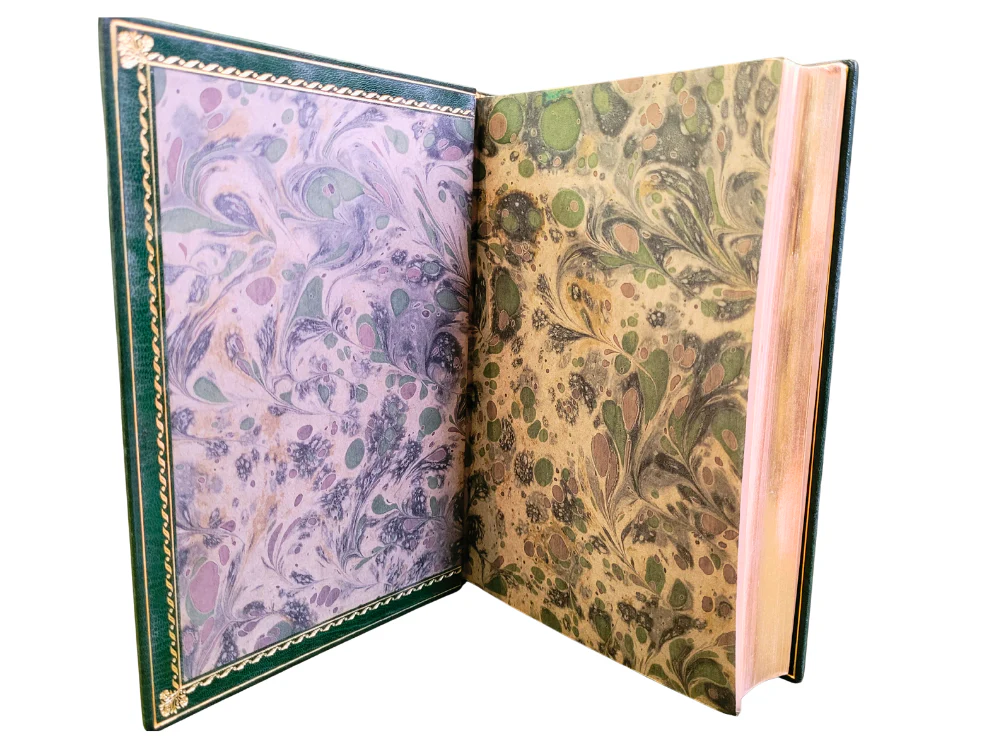
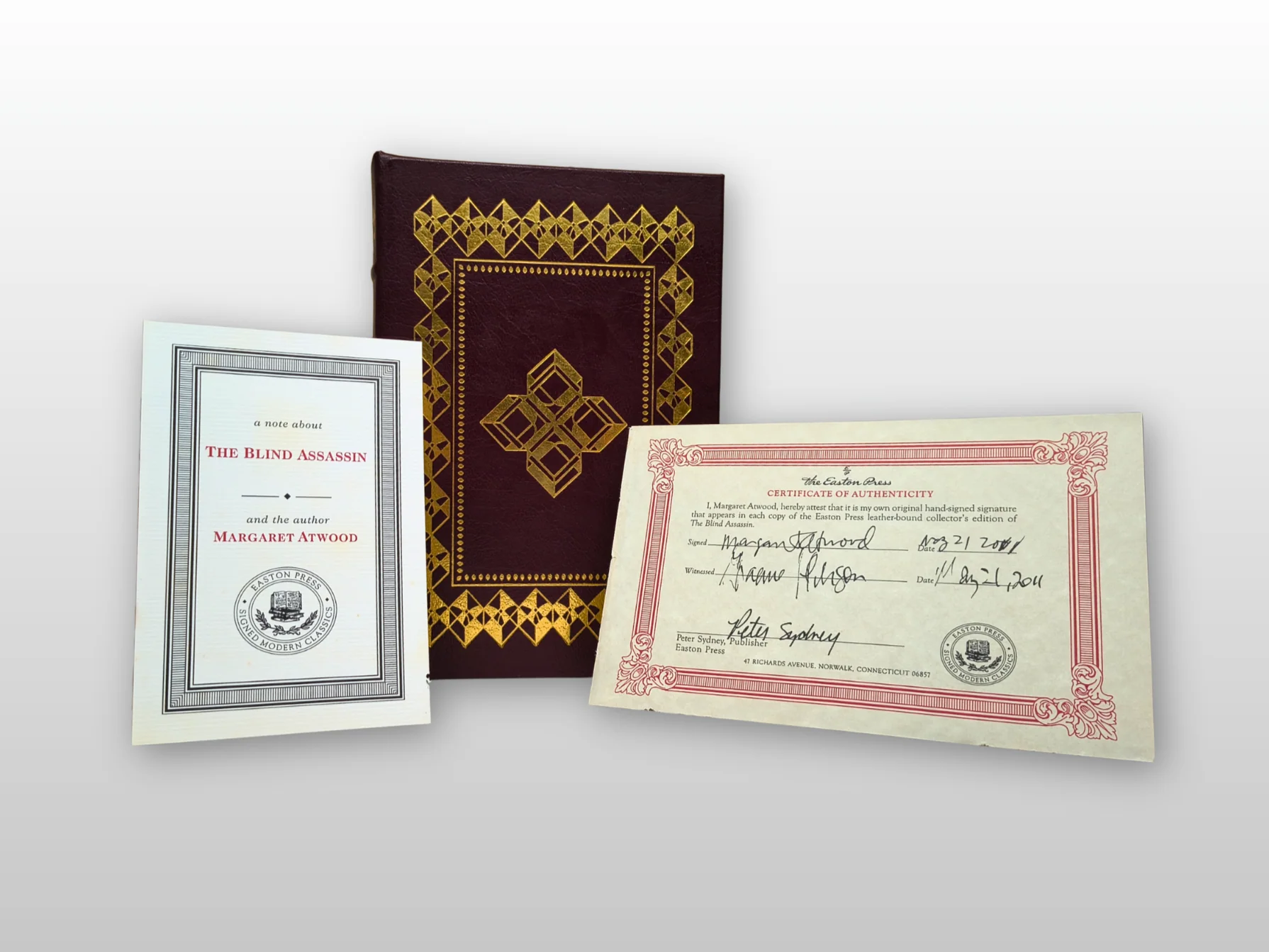
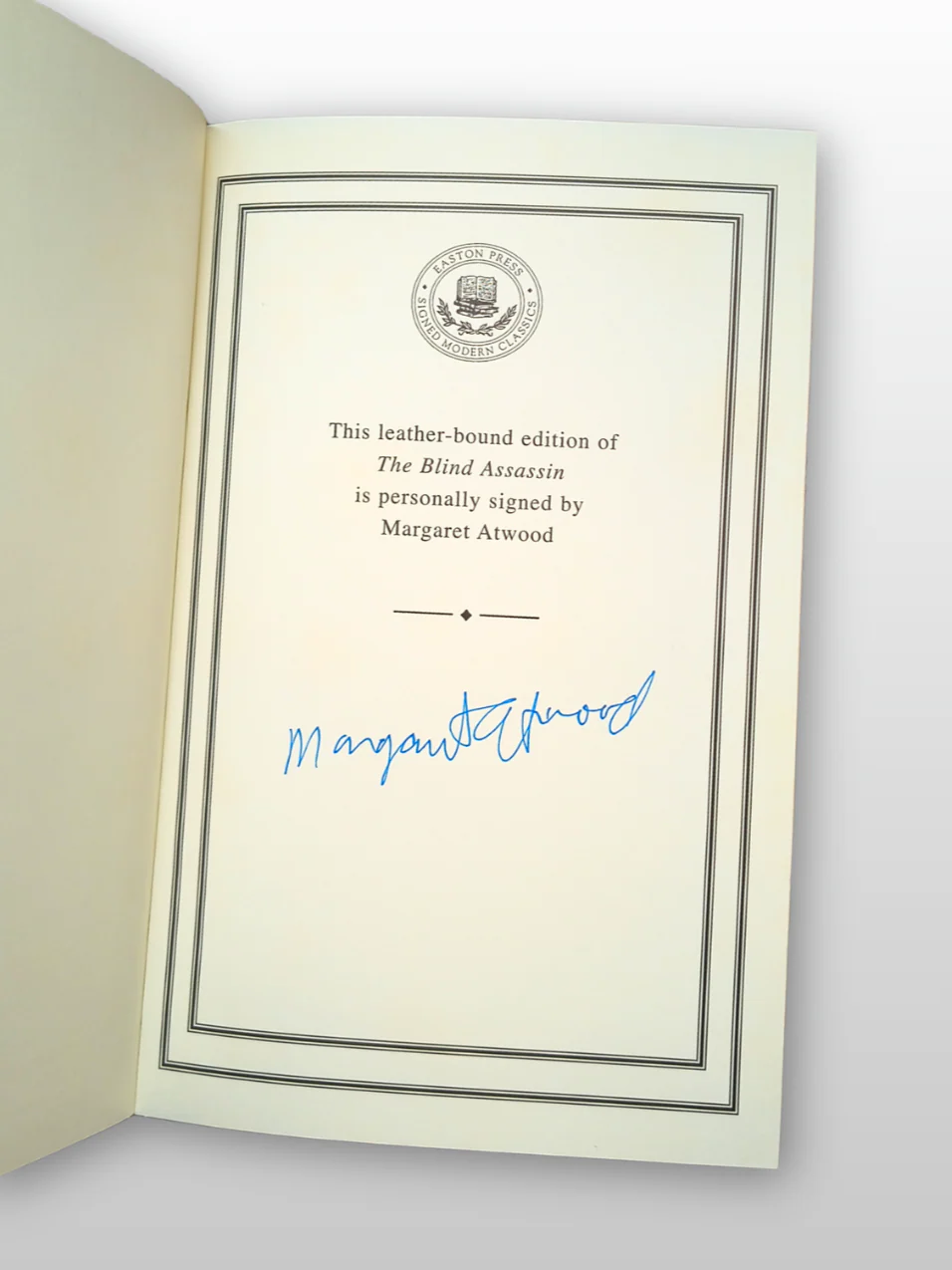
Octavo. Full burgundy leather. Spine with raised bands, 22-carat gilt accents. All edges gilt. Moiré silk endpapers. Satin ribbon page marker. xiii, 521, [ii]pp. Signed Collector's Edition. Signed by the author on the special title page. Includes signed Certificate of Authenticity, edition card, and bookplate adhered to front endpaper. Originally published Toronto: McClelland & Stewart; New York: Nan A. Talese/Doubleday, 2000.
Margaret Atwood (b. 1939) has produced one of the most sustained and distinguished bodies of work in contemporary literature: novels, poetry, short fiction, and criticism spanning six decades and encompassing an extraordinary range of form and subject, from the dystopian speculative fiction of The Handmaid's Tale to the Victorian pastiche of Alias Grace to the ecological trilogy of MaddAddam. She is the recipient of the Booker Prize, the Arthur C. Clarke Award, the National Book Critics Circle Award, and the PEN Pinter Prize, among many others, and is widely regarded as one of the essential writers of her generation.
The Blind Assassin won the Booker Prize in 2000, and it opens with one of the great first sentences in modern fiction: "Ten days after the war ended, my sister Laura drove a car off a bridge." What follows is a novel of extraordinary structural ingenuity, built from four interlocking narrative layers. In the outermost frame, Iris Chase Griffin — eighty-two years old, in deteriorating health, living in a decaying Ontario town — writes her memoirs, working backwards through a long and far from exemplary life. Within her account is a novel called The Blind Assassin, published after Laura Chase's death under Laura's name and subsequently the subject of a devoted cult following. Within that novel, two unnamed lovers — a woman and a man on the run, meeting in dingy rented rooms — construct a pulp science fiction story about a blind assassin on a distant planet. And woven through all of it are newspaper clippings from the 1930s and 1940s, tracking the public surface of the Chase family's history while the memoirs reveal its private substance.
The architecture is immaculate, and it serves a purpose beyond formal display: the nested structure enacts the novel's central concerns, which are the relationship between public and private versions of a life, the ways in which women's stories have been told by others or not told at all, and the specific cruelties that affluent Canadian society visited on women of Iris's generation. The disclosure that the novel works towards arrives with the force of something that has been visible throughout and only now becomes entirely legible. It is Atwood's finest novel, and in a career of remarkable consistency, that is a considerable statement.
Near fine. Some minor markings along gilt edges; otherwise fine throughout.
This book is currently not on display in store. If you would like more information or to arrange a viewing, please contact: [email protected]
Catalogue Number: HH000496
Product Information
Product Information
Shipping & Returns
Shipping & Returns

The Blind Assassin (Easton Press Signed Collector's Edition)
The Blind Assassin (Easton Press Signed Collector's Edition)
ATWOOD, Margaret. The Blind Assassin. Norwalk, Connecticut: The Easton Press, 2011.
Octavo. Full burgundy leather. Spine with raised bands, 22-carat gilt accents. All edges gilt. Moiré silk endpapers. Satin ribbon page marker. xiii, 521, [ii]pp. Signed Collector's Edition. Signed by the author on the special title page. Includes signed Certificate of Authenticity, edition card, and bookplate adhered to front endpaper. Originally published Toronto: McClelland & Stewart; New York: Nan A. Talese/Doubleday, 2000.
Margaret Atwood (b. 1939) has produced one of the most sustained and distinguished bodies of work in contemporary literature: novels, poetry, short fiction, and criticism spanning six decades and encompassing an extraordinary range of form and subject, from the dystopian speculative fiction of The Handmaid's Tale to the Victorian pastiche of Alias Grace to the ecological trilogy of MaddAddam. She is the recipient of the Booker Prize, the Arthur C. Clarke Award, the National Book Critics Circle Award, and the PEN Pinter Prize, among many others, and is widely regarded as one of the essential writers of her generation.
The Blind Assassin won the Booker Prize in 2000, and it opens with one of the great first sentences in modern fiction: "Ten days after the war ended, my sister Laura drove a car off a bridge." What follows is a novel of extraordinary structural ingenuity, built from four interlocking narrative layers. In the outermost frame, Iris Chase Griffin — eighty-two years old, in deteriorating health, living in a decaying Ontario town — writes her memoirs, working backwards through a long and far from exemplary life. Within her account is a novel called The Blind Assassin, published after Laura Chase's death under Laura's name and subsequently the subject of a devoted cult following. Within that novel, two unnamed lovers — a woman and a man on the run, meeting in dingy rented rooms — construct a pulp science fiction story about a blind assassin on a distant planet. And woven through all of it are newspaper clippings from the 1930s and 1940s, tracking the public surface of the Chase family's history while the memoirs reveal its private substance.
The architecture is immaculate, and it serves a purpose beyond formal display: the nested structure enacts the novel's central concerns, which are the relationship between public and private versions of a life, the ways in which women's stories have been told by others or not told at all, and the specific cruelties that affluent Canadian society visited on women of Iris's generation. The disclosure that the novel works towards arrives with the force of something that has been visible throughout and only now becomes entirely legible. It is Atwood's finest novel, and in a career of remarkable consistency, that is a considerable statement.
Near fine. Some minor markings along gilt edges; otherwise fine throughout.
This book is currently not on display in store. If you would like more information or to arrange a viewing, please contact: [email protected]
Catalogue Number: HH000496
Original: $83.57
-65%$83.57
$29.25Product Information
Product Information
Shipping & Returns
Shipping & Returns
Description
ATWOOD, Margaret. The Blind Assassin. Norwalk, Connecticut: The Easton Press, 2011.
Octavo. Full burgundy leather. Spine with raised bands, 22-carat gilt accents. All edges gilt. Moiré silk endpapers. Satin ribbon page marker. xiii, 521, [ii]pp. Signed Collector's Edition. Signed by the author on the special title page. Includes signed Certificate of Authenticity, edition card, and bookplate adhered to front endpaper. Originally published Toronto: McClelland & Stewart; New York: Nan A. Talese/Doubleday, 2000.
Margaret Atwood (b. 1939) has produced one of the most sustained and distinguished bodies of work in contemporary literature: novels, poetry, short fiction, and criticism spanning six decades and encompassing an extraordinary range of form and subject, from the dystopian speculative fiction of The Handmaid's Tale to the Victorian pastiche of Alias Grace to the ecological trilogy of MaddAddam. She is the recipient of the Booker Prize, the Arthur C. Clarke Award, the National Book Critics Circle Award, and the PEN Pinter Prize, among many others, and is widely regarded as one of the essential writers of her generation.
The Blind Assassin won the Booker Prize in 2000, and it opens with one of the great first sentences in modern fiction: "Ten days after the war ended, my sister Laura drove a car off a bridge." What follows is a novel of extraordinary structural ingenuity, built from four interlocking narrative layers. In the outermost frame, Iris Chase Griffin — eighty-two years old, in deteriorating health, living in a decaying Ontario town — writes her memoirs, working backwards through a long and far from exemplary life. Within her account is a novel called The Blind Assassin, published after Laura Chase's death under Laura's name and subsequently the subject of a devoted cult following. Within that novel, two unnamed lovers — a woman and a man on the run, meeting in dingy rented rooms — construct a pulp science fiction story about a blind assassin on a distant planet. And woven through all of it are newspaper clippings from the 1930s and 1940s, tracking the public surface of the Chase family's history while the memoirs reveal its private substance.
The architecture is immaculate, and it serves a purpose beyond formal display: the nested structure enacts the novel's central concerns, which are the relationship between public and private versions of a life, the ways in which women's stories have been told by others or not told at all, and the specific cruelties that affluent Canadian society visited on women of Iris's generation. The disclosure that the novel works towards arrives with the force of something that has been visible throughout and only now becomes entirely legible. It is Atwood's finest novel, and in a career of remarkable consistency, that is a considerable statement.
Near fine. Some minor markings along gilt edges; otherwise fine throughout.
This book is currently not on display in store. If you would like more information or to arrange a viewing, please contact: [email protected]
Catalogue Number: HH000496