The Confessions of Nat Turner (Easton Press Signed Collector's Edition)
STYRON, William. The Confessions of Nat Turner. Norwalk, Connecticut: The Easton Press, 2000.
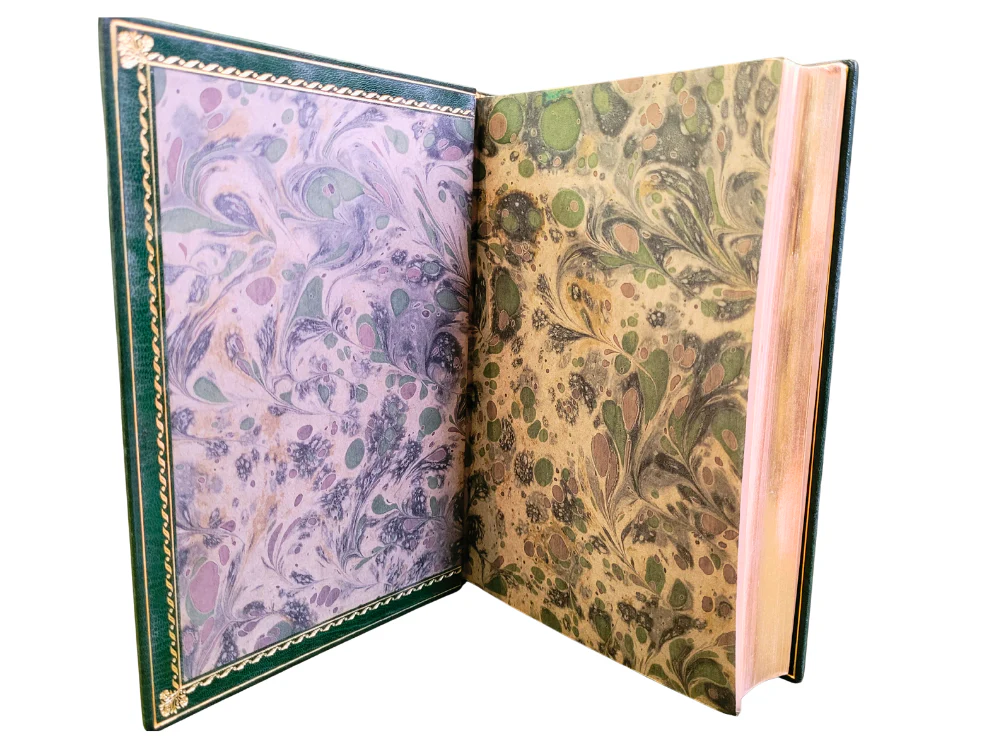
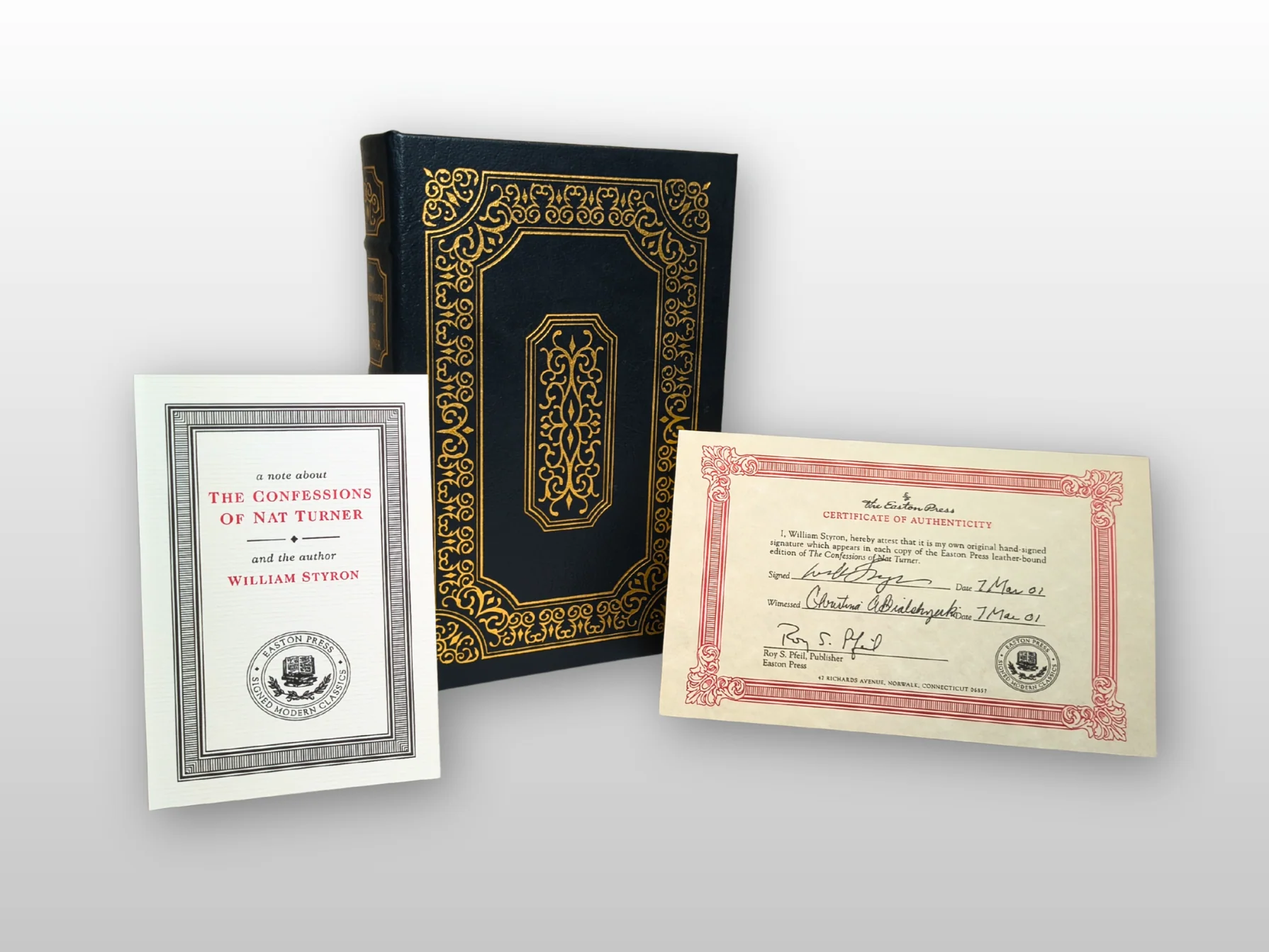
Octavo. Full deep blue leather. Spine with raised bands, 22-carat gilt accents. All edges gilt. Moiré silk endpapers. Satin ribbon page marker. 428 pp. Signed Collector's Edition. Signed by the author on the signature page. Includes signed Certificate of Authenticity, edition card, and bookplate adhered to front endpaper. Originally published New York: Random House, 1967.
William Styron (1925–2006) was born in Newport News, Virginia, and spent his career as one of the major novelists of his generation — a southerner in the tradition of Faulkner who had absorbed that influence without being overwhelmed by it, and whose work ranged across the full spectrum of twentieth-century American catastrophe: slavery, the Holocaust, the civil rights movement, and the internal catastrophe of severe depression. The Confessions of Nat Turner, published in 1967, won the Pulitzer Prize for Fiction in 1968 and the William Dean Howells Medal, and immediately became one of the most debated novels in American literary history.
Nat Turner (1800–1831) was an enslaved man in Southampton County, Virginia, who in August 1831 led the most sustained and deadly slave revolt in American history, killing approximately fifty-five white men, women, and children before being captured and hanged. The historical record available to Styron was sparse: a pamphlet dictated by Turner to his lawyer Thomas Ruffin Gray in the weeks before his execution, known as The Confessions of Nat Turner, and the fragmentary documentary traces left by a man whose interior life his society had no interest in recording. From this material Styron constructed a first-person novel, narrated by Turner in the weeks between capture and execution, that attempted to render from the inside the consciousness of a man who had organised and carried out an act of extraordinary violence in the name of liberation.
The novel was immediately acclaimed by mainstream literary culture — the Pulitzer Prize was announced almost simultaneously with its publication — and immediately attacked by Black critics, writers, and historians who argued that a white Virginian had no right to appropriate Turner's voice, and that the version of Turner Styron produced distorted the historical record in ways that served the assumptions of white liberal culture rather than the truth of Black experience. Ten Black writers published a collective response, William Styron's Nat Turner: Ten Black Writers Respond (1968), that remains among the most significant acts of literary-political critique in American letters. The argument it initiated has not been resolved and shows no sign of being resolved; the novel remains one of the most contested works of American fiction, and also one of the most formally ambitious. Signed copies carry the additional significance of a posthumous signature, Styron having died in 2006.
Fine. Presenting as new.
This book is currently not on display in store. If you would like more information or to arrange a viewing, please contact: [email protected]
Catalogue Number: HH000504
Product Information
Product Information
Shipping & Returns
Shipping & Returns


The Confessions of Nat Turner (Easton Press Signed Collector's Edition)
The Confessions of Nat Turner (Easton Press Signed Collector's Edition)
STYRON, William. The Confessions of Nat Turner. Norwalk, Connecticut: The Easton Press, 2000.
Octavo. Full deep blue leather. Spine with raised bands, 22-carat gilt accents. All edges gilt. Moiré silk endpapers. Satin ribbon page marker. 428 pp. Signed Collector's Edition. Signed by the author on the signature page. Includes signed Certificate of Authenticity, edition card, and bookplate adhered to front endpaper. Originally published New York: Random House, 1967.
William Styron (1925–2006) was born in Newport News, Virginia, and spent his career as one of the major novelists of his generation — a southerner in the tradition of Faulkner who had absorbed that influence without being overwhelmed by it, and whose work ranged across the full spectrum of twentieth-century American catastrophe: slavery, the Holocaust, the civil rights movement, and the internal catastrophe of severe depression. The Confessions of Nat Turner, published in 1967, won the Pulitzer Prize for Fiction in 1968 and the William Dean Howells Medal, and immediately became one of the most debated novels in American literary history.
Nat Turner (1800–1831) was an enslaved man in Southampton County, Virginia, who in August 1831 led the most sustained and deadly slave revolt in American history, killing approximately fifty-five white men, women, and children before being captured and hanged. The historical record available to Styron was sparse: a pamphlet dictated by Turner to his lawyer Thomas Ruffin Gray in the weeks before his execution, known as The Confessions of Nat Turner, and the fragmentary documentary traces left by a man whose interior life his society had no interest in recording. From this material Styron constructed a first-person novel, narrated by Turner in the weeks between capture and execution, that attempted to render from the inside the consciousness of a man who had organised and carried out an act of extraordinary violence in the name of liberation.
The novel was immediately acclaimed by mainstream literary culture — the Pulitzer Prize was announced almost simultaneously with its publication — and immediately attacked by Black critics, writers, and historians who argued that a white Virginian had no right to appropriate Turner's voice, and that the version of Turner Styron produced distorted the historical record in ways that served the assumptions of white liberal culture rather than the truth of Black experience. Ten Black writers published a collective response, William Styron's Nat Turner: Ten Black Writers Respond (1968), that remains among the most significant acts of literary-political critique in American letters. The argument it initiated has not been resolved and shows no sign of being resolved; the novel remains one of the most contested works of American fiction, and also one of the most formally ambitious. Signed copies carry the additional significance of a posthumous signature, Styron having died in 2006.
Fine. Presenting as new.
This book is currently not on display in store. If you would like more information or to arrange a viewing, please contact: [email protected]
Catalogue Number: HH000504
Original: $62.85
-65%$62.85
$22.00Product Information
Product Information
Shipping & Returns
Shipping & Returns
Description
STYRON, William. The Confessions of Nat Turner. Norwalk, Connecticut: The Easton Press, 2000.
Octavo. Full deep blue leather. Spine with raised bands, 22-carat gilt accents. All edges gilt. Moiré silk endpapers. Satin ribbon page marker. 428 pp. Signed Collector's Edition. Signed by the author on the signature page. Includes signed Certificate of Authenticity, edition card, and bookplate adhered to front endpaper. Originally published New York: Random House, 1967.
William Styron (1925–2006) was born in Newport News, Virginia, and spent his career as one of the major novelists of his generation — a southerner in the tradition of Faulkner who had absorbed that influence without being overwhelmed by it, and whose work ranged across the full spectrum of twentieth-century American catastrophe: slavery, the Holocaust, the civil rights movement, and the internal catastrophe of severe depression. The Confessions of Nat Turner, published in 1967, won the Pulitzer Prize for Fiction in 1968 and the William Dean Howells Medal, and immediately became one of the most debated novels in American literary history.
Nat Turner (1800–1831) was an enslaved man in Southampton County, Virginia, who in August 1831 led the most sustained and deadly slave revolt in American history, killing approximately fifty-five white men, women, and children before being captured and hanged. The historical record available to Styron was sparse: a pamphlet dictated by Turner to his lawyer Thomas Ruffin Gray in the weeks before his execution, known as The Confessions of Nat Turner, and the fragmentary documentary traces left by a man whose interior life his society had no interest in recording. From this material Styron constructed a first-person novel, narrated by Turner in the weeks between capture and execution, that attempted to render from the inside the consciousness of a man who had organised and carried out an act of extraordinary violence in the name of liberation.
The novel was immediately acclaimed by mainstream literary culture — the Pulitzer Prize was announced almost simultaneously with its publication — and immediately attacked by Black critics, writers, and historians who argued that a white Virginian had no right to appropriate Turner's voice, and that the version of Turner Styron produced distorted the historical record in ways that served the assumptions of white liberal culture rather than the truth of Black experience. Ten Black writers published a collective response, William Styron's Nat Turner: Ten Black Writers Respond (1968), that remains among the most significant acts of literary-political critique in American letters. The argument it initiated has not been resolved and shows no sign of being resolved; the novel remains one of the most contested works of American fiction, and also one of the most formally ambitious. Signed copies carry the additional significance of a posthumous signature, Styron having died in 2006.
Fine. Presenting as new.
This book is currently not on display in store. If you would like more information or to arrange a viewing, please contact: [email protected]
Catalogue Number: HH000504