The Corrections (Easton Press Signed Collector's Edition)
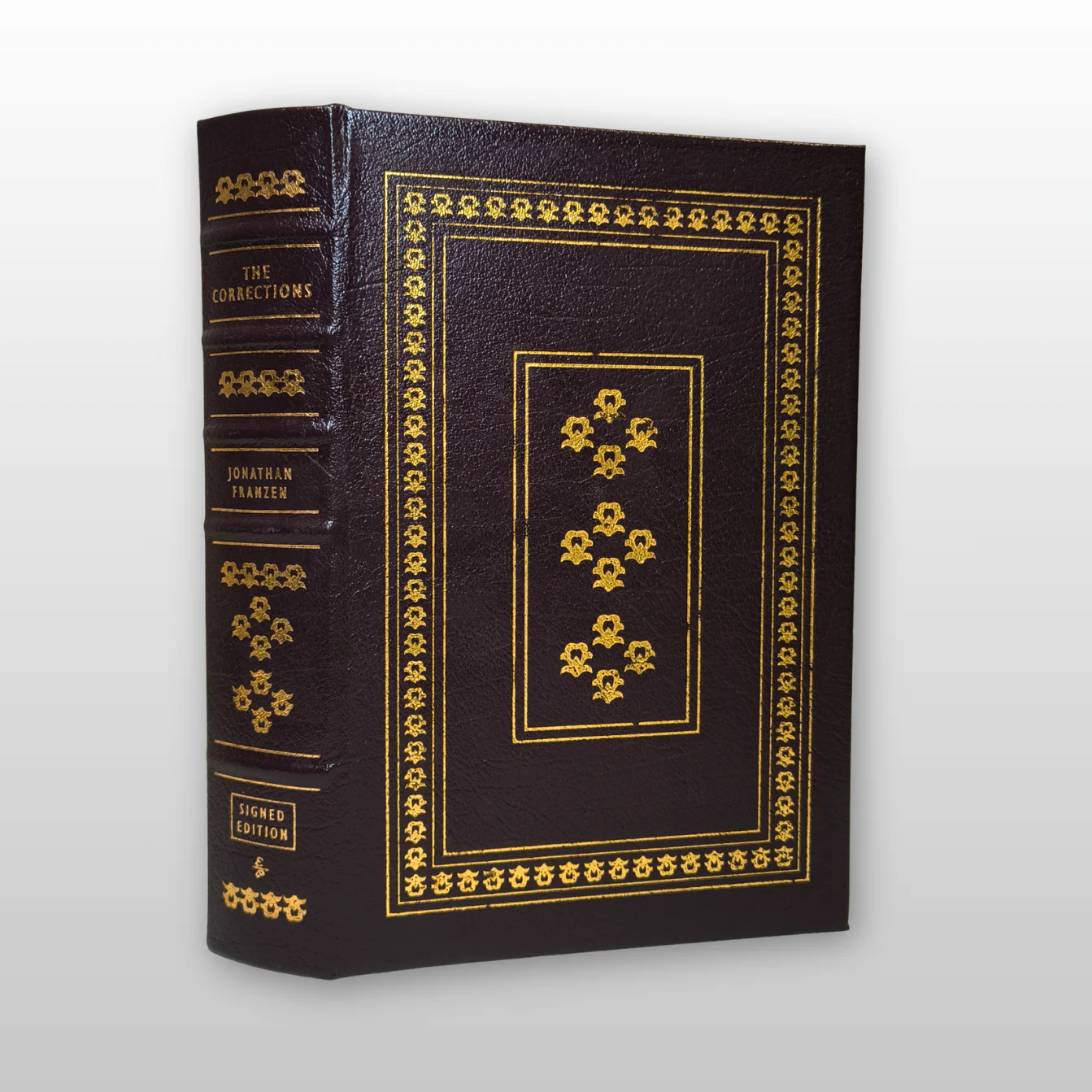
FRANZEN, Jonathan. The Corrections. Norwalk, Connecticut: The Easton Press, 2008.
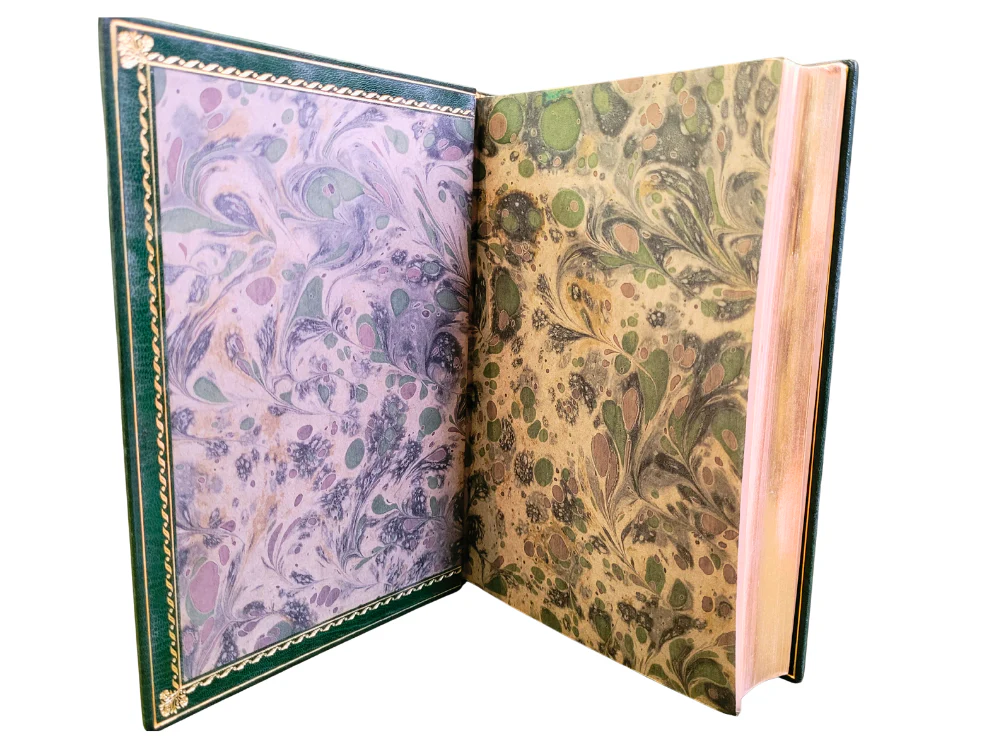
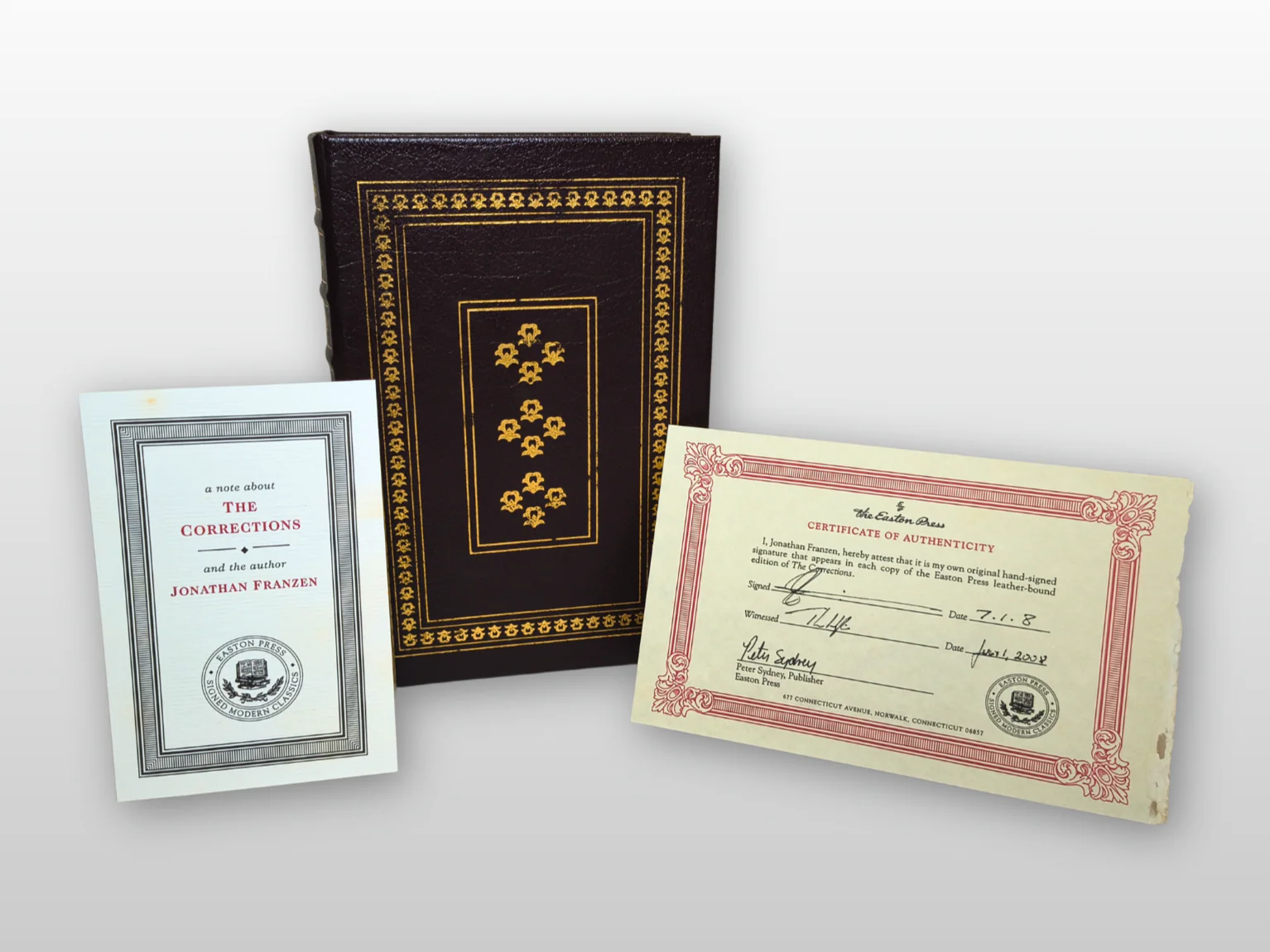
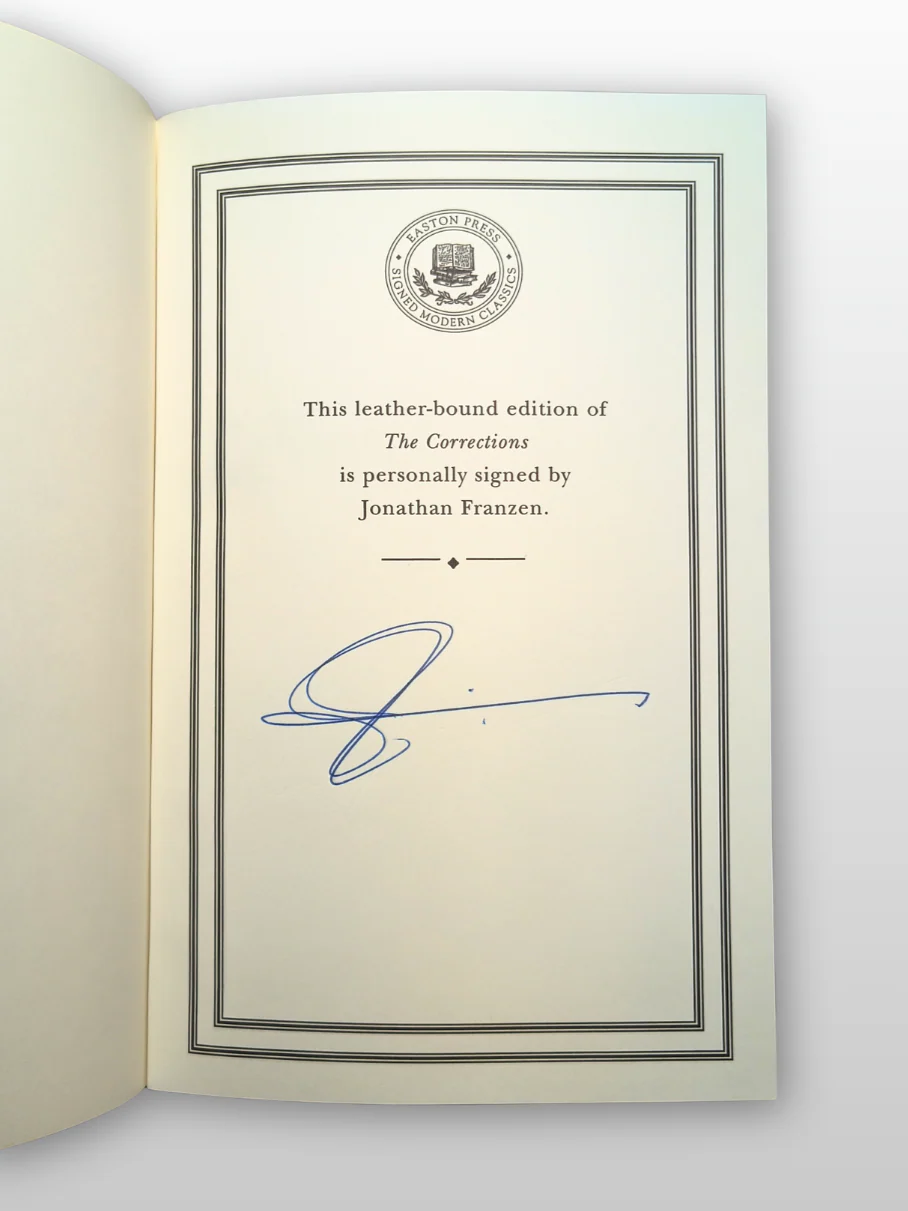
Octavo. Full brown leather. Spine with five raised bands, 22-carat gilt accents. Gilt design, lettering and fore-edges. All edges gilt. Moiré silk endpapers. Satin ribbon page marker. 566 pp. Signed Collector's Edition. Part of the Easton Press Signed Modern Classics series. Limited to 1,200 numbered copies. Signed by the author on the special signature page. Includes signed Certificate of Authenticity, edition card, and bookplate adhered to front endpaper. Originally published New York: Farrar, Straus and Giroux, 2001.
Jonathan Franzen (b. 1959) spent most of the 1990s writing The Corrections and being largely silent as a novelist, having announced in a 1996 Harper's essay that he intended to write a work of sufficient ambition and popular appeal to revive the tradition of the socially engaged American novel. The announcement attracted more scepticism than anticipation. The novel, when it arrived in September 2001, attracted something considerably more difficult to manage: the full apparatus of American literary celebrity, which descended upon it with a force that Franzen, constitutionally ambivalent about all such machinery, found genuinely disconcerting.
The novel won the 2001 National Book Award for Fiction and the 2002 James Tait Black Memorial Prize, was shortlisted for the Pulitzer Prize and the PEN/Faulkner Award, and was selected for Oprah Winfrey's Book Club — the selection that generated the most discussed literary controversy of its decade. Franzen expressed reservations about the Oprah imprimatur, the Book Club sticker, and what he called the association with schmaltzy, one-dimensional fiction. Winfrey rescinded the invitation. Franzen subsequently thanked her in his National Book Award acceptance speech and has been diplomatically reticent about the episode ever since. The novel's reputation survived all of it intact.
The Lambert family of St. Jude, Missouri, are the centre of the novel: Alfred, the patriarch, a retired railroad executive and man of rigid principle who is losing his mind to Parkinson's disease; Enid, his wife, who has spent a lifetime accommodating Alfred's rigidities and wants, before it is too late, one last Christmas with all three children at home; and the children themselves — Gary, the eldest, a Philadelphia banker managing his own depression; Chip, the middle child, a disgraced academic turned Lithuanian internet fraudster; and Denise, the youngest, an acclaimed chef whose personal life is in ruins. The novel moves between their stories with a structural intelligence and a comic precision that together constitute the fullest portrait of the American family at the end of the twentieth century that fiction has yet produced.
Near fine. Some markings along gilt edges; otherwise fine throughout.
This book is currently not on display in store. If you would like more information or to arrange a viewing, please contact: [email protected]
Catalogue Number: HH000559
Product Information
Product Information
Shipping & Returns
Shipping & Returns
The Corrections (Easton Press Signed Collector's Edition)
The Corrections (Easton Press Signed Collector's Edition)
FRANZEN, Jonathan. The Corrections. Norwalk, Connecticut: The Easton Press, 2008.
Octavo. Full brown leather. Spine with five raised bands, 22-carat gilt accents. Gilt design, lettering and fore-edges. All edges gilt. Moiré silk endpapers. Satin ribbon page marker. 566 pp. Signed Collector's Edition. Part of the Easton Press Signed Modern Classics series. Limited to 1,200 numbered copies. Signed by the author on the special signature page. Includes signed Certificate of Authenticity, edition card, and bookplate adhered to front endpaper. Originally published New York: Farrar, Straus and Giroux, 2001.
Jonathan Franzen (b. 1959) spent most of the 1990s writing The Corrections and being largely silent as a novelist, having announced in a 1996 Harper's essay that he intended to write a work of sufficient ambition and popular appeal to revive the tradition of the socially engaged American novel. The announcement attracted more scepticism than anticipation. The novel, when it arrived in September 2001, attracted something considerably more difficult to manage: the full apparatus of American literary celebrity, which descended upon it with a force that Franzen, constitutionally ambivalent about all such machinery, found genuinely disconcerting.
The novel won the 2001 National Book Award for Fiction and the 2002 James Tait Black Memorial Prize, was shortlisted for the Pulitzer Prize and the PEN/Faulkner Award, and was selected for Oprah Winfrey's Book Club — the selection that generated the most discussed literary controversy of its decade. Franzen expressed reservations about the Oprah imprimatur, the Book Club sticker, and what he called the association with schmaltzy, one-dimensional fiction. Winfrey rescinded the invitation. Franzen subsequently thanked her in his National Book Award acceptance speech and has been diplomatically reticent about the episode ever since. The novel's reputation survived all of it intact.
The Lambert family of St. Jude, Missouri, are the centre of the novel: Alfred, the patriarch, a retired railroad executive and man of rigid principle who is losing his mind to Parkinson's disease; Enid, his wife, who has spent a lifetime accommodating Alfred's rigidities and wants, before it is too late, one last Christmas with all three children at home; and the children themselves — Gary, the eldest, a Philadelphia banker managing his own depression; Chip, the middle child, a disgraced academic turned Lithuanian internet fraudster; and Denise, the youngest, an acclaimed chef whose personal life is in ruins. The novel moves between their stories with a structural intelligence and a comic precision that together constitute the fullest portrait of the American family at the end of the twentieth century that fiction has yet produced.
Near fine. Some markings along gilt edges; otherwise fine throughout.
This book is currently not on display in store. If you would like more information or to arrange a viewing, please contact: [email protected]
Catalogue Number: HH000559
Original: $62.85
-65%$62.85
$22.00Product Information
Product Information
Shipping & Returns
Shipping & Returns
Description
FRANZEN, Jonathan. The Corrections. Norwalk, Connecticut: The Easton Press, 2008.
Octavo. Full brown leather. Spine with five raised bands, 22-carat gilt accents. Gilt design, lettering and fore-edges. All edges gilt. Moiré silk endpapers. Satin ribbon page marker. 566 pp. Signed Collector's Edition. Part of the Easton Press Signed Modern Classics series. Limited to 1,200 numbered copies. Signed by the author on the special signature page. Includes signed Certificate of Authenticity, edition card, and bookplate adhered to front endpaper. Originally published New York: Farrar, Straus and Giroux, 2001.
Jonathan Franzen (b. 1959) spent most of the 1990s writing The Corrections and being largely silent as a novelist, having announced in a 1996 Harper's essay that he intended to write a work of sufficient ambition and popular appeal to revive the tradition of the socially engaged American novel. The announcement attracted more scepticism than anticipation. The novel, when it arrived in September 2001, attracted something considerably more difficult to manage: the full apparatus of American literary celebrity, which descended upon it with a force that Franzen, constitutionally ambivalent about all such machinery, found genuinely disconcerting.
The novel won the 2001 National Book Award for Fiction and the 2002 James Tait Black Memorial Prize, was shortlisted for the Pulitzer Prize and the PEN/Faulkner Award, and was selected for Oprah Winfrey's Book Club — the selection that generated the most discussed literary controversy of its decade. Franzen expressed reservations about the Oprah imprimatur, the Book Club sticker, and what he called the association with schmaltzy, one-dimensional fiction. Winfrey rescinded the invitation. Franzen subsequently thanked her in his National Book Award acceptance speech and has been diplomatically reticent about the episode ever since. The novel's reputation survived all of it intact.
The Lambert family of St. Jude, Missouri, are the centre of the novel: Alfred, the patriarch, a retired railroad executive and man of rigid principle who is losing his mind to Parkinson's disease; Enid, his wife, who has spent a lifetime accommodating Alfred's rigidities and wants, before it is too late, one last Christmas with all three children at home; and the children themselves — Gary, the eldest, a Philadelphia banker managing his own depression; Chip, the middle child, a disgraced academic turned Lithuanian internet fraudster; and Denise, the youngest, an acclaimed chef whose personal life is in ruins. The novel moves between their stories with a structural intelligence and a comic precision that together constitute the fullest portrait of the American family at the end of the twentieth century that fiction has yet produced.
Near fine. Some markings along gilt edges; otherwise fine throughout.
This book is currently not on display in store. If you would like more information or to arrange a viewing, please contact: [email protected]
Catalogue Number: HH000559