The Emperor of all Maladies (Easton Press Signed Collector's Edition)
MUKHERJEE, Siddhartha. The Emperor of All Maladies: A Biography of Cancer. Norwalk, Connecticut: The Easton Press, 2011.
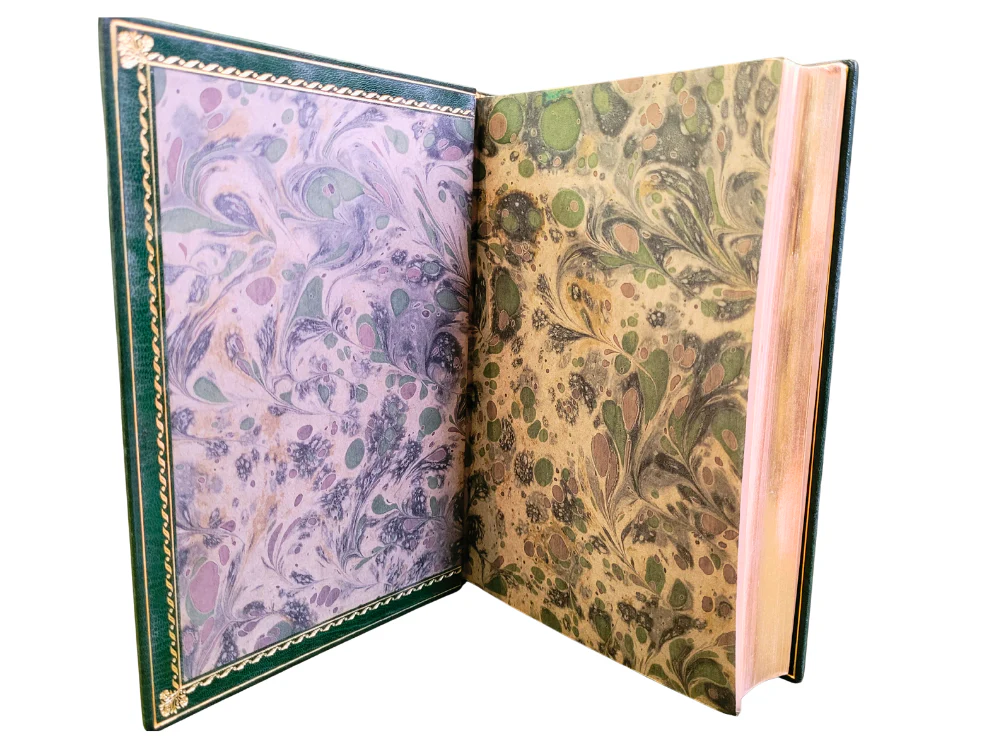
8vo. Full green-grey leather. Spine with four raised bands, 22-carat gilt accents. All edges gilt. Moiré silk endpapers. Satin ribbon page marker. Signed Collector's Edition. Signed by the author on the special signature page. Includes signed Certificate of Authenticity, edition card, and bookplate adhered to front endpaper. Originally published New York: Scribner, 2010.
Siddhartha Mukherjee (b. 1970) was born in New Delhi, studied at Stanford, took his DPhil at Oxford researching cancer-causing viruses, and completed his MD at Harvard Medical School. He has practised as an oncologist at Columbia University and the Massachusetts General Hospital, published extensively in Nature, the New England Journal of Medicine, and the New York Times, and has since The Emperor of All Maladies written The Laws of Medicine (2015), The Gene: An Intimate History (2016), and The Song of the Cell (2022), establishing himself as the most distinguished writer working at the intersection of oncology, genetics, and literary nonfiction.
The Emperor of All Maladies began, Mukherjee has said, as a response to a patient's demand: "I'm willing to go on fighting, but I need to know what it is that I'm battling." The book he wrote in answer is one of the great works of American nonfiction of the twenty-first century: a biography not of a person but of a disease, tracing the history of cancer from its first documented identification by the Egyptian physician Imhotep more than four thousand years ago through the epic and often brutal interventions of twentieth-century medicine — radical mastectomy, high-dose chemotherapy, radiation — to the molecular biology that finally began to reveal the nature of what cancer actually is.
Mukherjee examines cancer with a cellular biologist's precision, a historian's perspective, and a biographer's passion, and the combination produces writing of unusual power. The history he tells is not only a history of science but of the human beings who made and suffered from that science: the oncologist Sidney Farber, whose obsession with curing childhood leukaemia launched the era of chemotherapy; Mary Lasker, the socialite and lobbyist who turned cancer research into a national political cause; the patients whose testimonies frame the contemporary sections of the book. The Guardian noted that it "takes some nerve to echo the first line of Anna Karenina and infer that the story of a disease is capable of bearing a Tolstoyan treatment — but that is, breathtakingly, what Mukherjee pulls off."
The book won the 2011 Pulitzer Prize for General Nonfiction and the inaugural PEN/E. O. Wilson Literary Science Writing Award. It was adapted as a documentary by Ken Burns for PBS, selected as one of the best books of the 21st century by the New York Times, and included on Time magazine's list of the hundred most influential books of the last hundred years.
Near fine. Some spotting along fore-edge gilt; otherwise fine throughout.
This book is currently not on display in store. If you would like more information or to arrange a viewing, please contact: [email protected]
Catalogue Number: HH000507
Product Information
Product Information
Shipping & Returns
Shipping & Returns


The Emperor of all Maladies (Easton Press Signed Collector's Edition)
The Emperor of all Maladies (Easton Press Signed Collector's Edition)
MUKHERJEE, Siddhartha. The Emperor of All Maladies: A Biography of Cancer. Norwalk, Connecticut: The Easton Press, 2011.
8vo. Full green-grey leather. Spine with four raised bands, 22-carat gilt accents. All edges gilt. Moiré silk endpapers. Satin ribbon page marker. Signed Collector's Edition. Signed by the author on the special signature page. Includes signed Certificate of Authenticity, edition card, and bookplate adhered to front endpaper. Originally published New York: Scribner, 2010.
Siddhartha Mukherjee (b. 1970) was born in New Delhi, studied at Stanford, took his DPhil at Oxford researching cancer-causing viruses, and completed his MD at Harvard Medical School. He has practised as an oncologist at Columbia University and the Massachusetts General Hospital, published extensively in Nature, the New England Journal of Medicine, and the New York Times, and has since The Emperor of All Maladies written The Laws of Medicine (2015), The Gene: An Intimate History (2016), and The Song of the Cell (2022), establishing himself as the most distinguished writer working at the intersection of oncology, genetics, and literary nonfiction.
The Emperor of All Maladies began, Mukherjee has said, as a response to a patient's demand: "I'm willing to go on fighting, but I need to know what it is that I'm battling." The book he wrote in answer is one of the great works of American nonfiction of the twenty-first century: a biography not of a person but of a disease, tracing the history of cancer from its first documented identification by the Egyptian physician Imhotep more than four thousand years ago through the epic and often brutal interventions of twentieth-century medicine — radical mastectomy, high-dose chemotherapy, radiation — to the molecular biology that finally began to reveal the nature of what cancer actually is.
Mukherjee examines cancer with a cellular biologist's precision, a historian's perspective, and a biographer's passion, and the combination produces writing of unusual power. The history he tells is not only a history of science but of the human beings who made and suffered from that science: the oncologist Sidney Farber, whose obsession with curing childhood leukaemia launched the era of chemotherapy; Mary Lasker, the socialite and lobbyist who turned cancer research into a national political cause; the patients whose testimonies frame the contemporary sections of the book. The Guardian noted that it "takes some nerve to echo the first line of Anna Karenina and infer that the story of a disease is capable of bearing a Tolstoyan treatment — but that is, breathtakingly, what Mukherjee pulls off."
The book won the 2011 Pulitzer Prize for General Nonfiction and the inaugural PEN/E. O. Wilson Literary Science Writing Award. It was adapted as a documentary by Ken Burns for PBS, selected as one of the best books of the 21st century by the New York Times, and included on Time magazine's list of the hundred most influential books of the last hundred years.
Near fine. Some spotting along fore-edge gilt; otherwise fine throughout.
This book is currently not on display in store. If you would like more information or to arrange a viewing, please contact: [email protected]
Catalogue Number: HH000507
Original: $114.28
-65%$114.28
$40.00Product Information
Product Information
Shipping & Returns
Shipping & Returns
Description
MUKHERJEE, Siddhartha. The Emperor of All Maladies: A Biography of Cancer. Norwalk, Connecticut: The Easton Press, 2011.
8vo. Full green-grey leather. Spine with four raised bands, 22-carat gilt accents. All edges gilt. Moiré silk endpapers. Satin ribbon page marker. Signed Collector's Edition. Signed by the author on the special signature page. Includes signed Certificate of Authenticity, edition card, and bookplate adhered to front endpaper. Originally published New York: Scribner, 2010.
Siddhartha Mukherjee (b. 1970) was born in New Delhi, studied at Stanford, took his DPhil at Oxford researching cancer-causing viruses, and completed his MD at Harvard Medical School. He has practised as an oncologist at Columbia University and the Massachusetts General Hospital, published extensively in Nature, the New England Journal of Medicine, and the New York Times, and has since The Emperor of All Maladies written The Laws of Medicine (2015), The Gene: An Intimate History (2016), and The Song of the Cell (2022), establishing himself as the most distinguished writer working at the intersection of oncology, genetics, and literary nonfiction.
The Emperor of All Maladies began, Mukherjee has said, as a response to a patient's demand: "I'm willing to go on fighting, but I need to know what it is that I'm battling." The book he wrote in answer is one of the great works of American nonfiction of the twenty-first century: a biography not of a person but of a disease, tracing the history of cancer from its first documented identification by the Egyptian physician Imhotep more than four thousand years ago through the epic and often brutal interventions of twentieth-century medicine — radical mastectomy, high-dose chemotherapy, radiation — to the molecular biology that finally began to reveal the nature of what cancer actually is.
Mukherjee examines cancer with a cellular biologist's precision, a historian's perspective, and a biographer's passion, and the combination produces writing of unusual power. The history he tells is not only a history of science but of the human beings who made and suffered from that science: the oncologist Sidney Farber, whose obsession with curing childhood leukaemia launched the era of chemotherapy; Mary Lasker, the socialite and lobbyist who turned cancer research into a national political cause; the patients whose testimonies frame the contemporary sections of the book. The Guardian noted that it "takes some nerve to echo the first line of Anna Karenina and infer that the story of a disease is capable of bearing a Tolstoyan treatment — but that is, breathtakingly, what Mukherjee pulls off."
The book won the 2011 Pulitzer Prize for General Nonfiction and the inaugural PEN/E. O. Wilson Literary Science Writing Award. It was adapted as a documentary by Ken Burns for PBS, selected as one of the best books of the 21st century by the New York Times, and included on Time magazine's list of the hundred most influential books of the last hundred years.
Near fine. Some spotting along fore-edge gilt; otherwise fine throughout.
This book is currently not on display in store. If you would like more information or to arrange a viewing, please contact: [email protected]
Catalogue Number: HH000507