The Inheritance of Loss (Easton Press Signed Collector's Edition)
DESAI, Kiran. The Inheritance of Loss. Norwalk, Connecticut: The Easton Press, 2010.
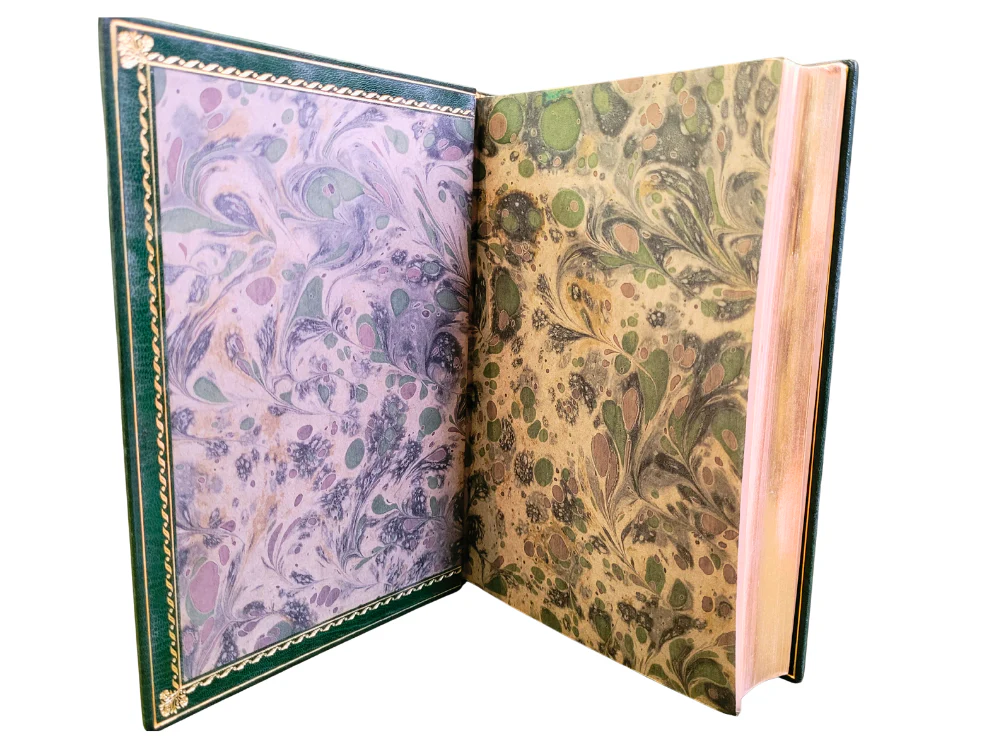
Octavo. Full red leather. Spine with four raised bands, 22-carat gilt accents. Elaborate gilt stamping to covers. All edges gilt. Moiré silk endpapers. Satin ribbon page marker. 358 pp. Signed Collector's Edition. Signed by the author on the special signature page. Includes signed Certificate of Authenticity, edition card, and bookplate adhered to front endpaper. Originally published New York: Atlantic Monthly Press, 2006.
Kiran Desai (b. 1971) was born in New Delhi, the daughter of Anita Desai, one of the most distinguished Indian novelists of the twentieth century. She grew up between India, England, and the United States — a biography that maps directly onto the concerns of her fiction — and published her debut novel, Hullabaloo in the Guava Orchard, to widespread acclaim in 1998. The Inheritance of Loss, her second novel, took seven years to write, and when it was published in 2006 it won the Man Booker Prize and the National Book Critics Circle Award. At thirty-five, Desai became the youngest woman ever to win the Booker.
The novel is set in 1986 in Kalimpong, a hill town in northeastern India near the borders with Sikkim and Nepal, beneath the vast presence of Mount Kanchenjunga. At its centre is the retired judge Jemubhai Patel — a man who left India for England in the 1940s to study law, was systematically humiliated by the society he sought to enter, and returned home with a lasting contempt for everything Indian, including himself. He lives in a crumbling house with his cook and his dog Mutt, attempting to retreat from history, when his orphaned granddaughter Sai arrives on his doorstep. The cook's son Biju runs in parallel: an undocumented immigrant in New York, moving through the underclass of restaurant kitchens, trying to stay ahead of immigration enforcement while his father tries to stay ahead of a Nepali insurgency that is about to engulf the hill station.
The novel moves between these two worlds — the claustrophobic beauty of the Himalayas and the anonymous labour of urban America — with a structural precision that makes the parallels feel genuinely illuminating rather than schematic. Both Biju and Sai's grandfather are caught between worlds they cannot fully inhabit: one excluded from the country he tried to join, the other excluded from the country he returned to. Pankaj Mishra, writing in the New York Times, described Desai as managing to explore "with intimacy and insight, just about every contemporary international issue: globalization, multiculturalism, economic inequality, fundamentalism and terrorist violence." The novel is also, beneath its political intelligence, a book about the particular loneliness of people who have been formed by more than one culture and belong entirely to neither.
Near fine. Some very mild markings along gilt edges; otherwise fine throughout.
This book is currently not on display in store. If you would like more information or to arrange a viewing, please contact: [email protected]
Catalogue Number: HH000556
Product Information
Product Information
Shipping & Returns
Shipping & Returns



The Inheritance of Loss (Easton Press Signed Collector's Edition)
The Inheritance of Loss (Easton Press Signed Collector's Edition)
DESAI, Kiran. The Inheritance of Loss. Norwalk, Connecticut: The Easton Press, 2010.
Octavo. Full red leather. Spine with four raised bands, 22-carat gilt accents. Elaborate gilt stamping to covers. All edges gilt. Moiré silk endpapers. Satin ribbon page marker. 358 pp. Signed Collector's Edition. Signed by the author on the special signature page. Includes signed Certificate of Authenticity, edition card, and bookplate adhered to front endpaper. Originally published New York: Atlantic Monthly Press, 2006.
Kiran Desai (b. 1971) was born in New Delhi, the daughter of Anita Desai, one of the most distinguished Indian novelists of the twentieth century. She grew up between India, England, and the United States — a biography that maps directly onto the concerns of her fiction — and published her debut novel, Hullabaloo in the Guava Orchard, to widespread acclaim in 1998. The Inheritance of Loss, her second novel, took seven years to write, and when it was published in 2006 it won the Man Booker Prize and the National Book Critics Circle Award. At thirty-five, Desai became the youngest woman ever to win the Booker.
The novel is set in 1986 in Kalimpong, a hill town in northeastern India near the borders with Sikkim and Nepal, beneath the vast presence of Mount Kanchenjunga. At its centre is the retired judge Jemubhai Patel — a man who left India for England in the 1940s to study law, was systematically humiliated by the society he sought to enter, and returned home with a lasting contempt for everything Indian, including himself. He lives in a crumbling house with his cook and his dog Mutt, attempting to retreat from history, when his orphaned granddaughter Sai arrives on his doorstep. The cook's son Biju runs in parallel: an undocumented immigrant in New York, moving through the underclass of restaurant kitchens, trying to stay ahead of immigration enforcement while his father tries to stay ahead of a Nepali insurgency that is about to engulf the hill station.
The novel moves between these two worlds — the claustrophobic beauty of the Himalayas and the anonymous labour of urban America — with a structural precision that makes the parallels feel genuinely illuminating rather than schematic. Both Biju and Sai's grandfather are caught between worlds they cannot fully inhabit: one excluded from the country he tried to join, the other excluded from the country he returned to. Pankaj Mishra, writing in the New York Times, described Desai as managing to explore "with intimacy and insight, just about every contemporary international issue: globalization, multiculturalism, economic inequality, fundamentalism and terrorist violence." The novel is also, beneath its political intelligence, a book about the particular loneliness of people who have been formed by more than one culture and belong entirely to neither.
Near fine. Some very mild markings along gilt edges; otherwise fine throughout.
This book is currently not on display in store. If you would like more information or to arrange a viewing, please contact: [email protected]
Catalogue Number: HH000556
Original: $62.85
-65%$62.85
$22.00Product Information
Product Information
Shipping & Returns
Shipping & Returns
Description
DESAI, Kiran. The Inheritance of Loss. Norwalk, Connecticut: The Easton Press, 2010.
Octavo. Full red leather. Spine with four raised bands, 22-carat gilt accents. Elaborate gilt stamping to covers. All edges gilt. Moiré silk endpapers. Satin ribbon page marker. 358 pp. Signed Collector's Edition. Signed by the author on the special signature page. Includes signed Certificate of Authenticity, edition card, and bookplate adhered to front endpaper. Originally published New York: Atlantic Monthly Press, 2006.
Kiran Desai (b. 1971) was born in New Delhi, the daughter of Anita Desai, one of the most distinguished Indian novelists of the twentieth century. She grew up between India, England, and the United States — a biography that maps directly onto the concerns of her fiction — and published her debut novel, Hullabaloo in the Guava Orchard, to widespread acclaim in 1998. The Inheritance of Loss, her second novel, took seven years to write, and when it was published in 2006 it won the Man Booker Prize and the National Book Critics Circle Award. At thirty-five, Desai became the youngest woman ever to win the Booker.
The novel is set in 1986 in Kalimpong, a hill town in northeastern India near the borders with Sikkim and Nepal, beneath the vast presence of Mount Kanchenjunga. At its centre is the retired judge Jemubhai Patel — a man who left India for England in the 1940s to study law, was systematically humiliated by the society he sought to enter, and returned home with a lasting contempt for everything Indian, including himself. He lives in a crumbling house with his cook and his dog Mutt, attempting to retreat from history, when his orphaned granddaughter Sai arrives on his doorstep. The cook's son Biju runs in parallel: an undocumented immigrant in New York, moving through the underclass of restaurant kitchens, trying to stay ahead of immigration enforcement while his father tries to stay ahead of a Nepali insurgency that is about to engulf the hill station.
The novel moves between these two worlds — the claustrophobic beauty of the Himalayas and the anonymous labour of urban America — with a structural precision that makes the parallels feel genuinely illuminating rather than schematic. Both Biju and Sai's grandfather are caught between worlds they cannot fully inhabit: one excluded from the country he tried to join, the other excluded from the country he returned to. Pankaj Mishra, writing in the New York Times, described Desai as managing to explore "with intimacy and insight, just about every contemporary international issue: globalization, multiculturalism, economic inequality, fundamentalism and terrorist violence." The novel is also, beneath its political intelligence, a book about the particular loneliness of people who have been formed by more than one culture and belong entirely to neither.
Near fine. Some very mild markings along gilt edges; otherwise fine throughout.
This book is currently not on display in store. If you would like more information or to arrange a viewing, please contact: [email protected]
Catalogue Number: HH000556