The Tomb of Tut-Ankh-Amun, 3 Volumes (Easton Press Collector's Edition)
CARTER, Howard (with A. C. Mace, Vol. I; illus. Harry Burton). The Tomb of Tut-Ankh-Amen: Discovered by the Late Earl of Carnarvon and Howard Carter. Norwalk, Connecticut: The Easton Press, 2009. 3 vols.
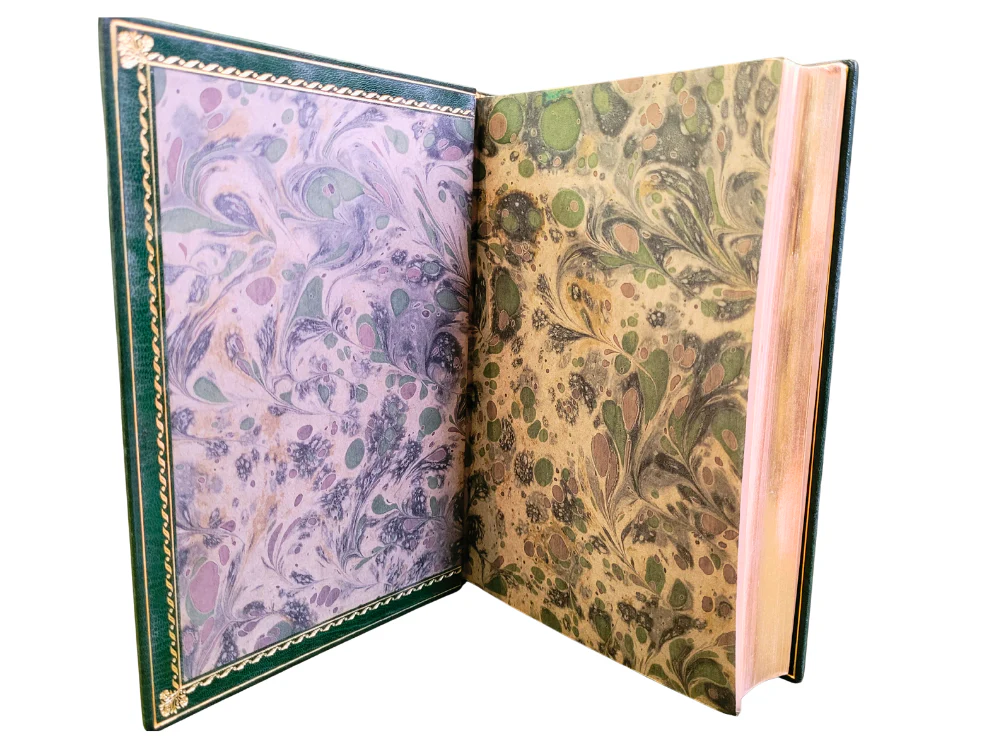
Octavo. All three volumes in full tan leather. Spines with raised bands, 22-carat gilt accents, titles and decorations stamped in black and gold. All edges gilt. Moiré silk endpapers. Satin ribbon page markers. Vol. I: 231 pp; Vol. II: 277 pp; Vol. III: 248 pp. 413 photographic plate illustrations by Harry Burton (Metropolitan Museum of Art, New York) throughout all three volumes. Three-volume Collector's Edition. Now out of print. Originally published London: Cassell & Company, 1923 (Vol. I), 1927 (Vol. II), 1933 (Vol. III).
On the morning of 4 November 1922, one of Howard Carter's Egyptian workmen uncovered a stone step in the floor of the Valley of the Kings. By the following afternoon, the stairway leading down from it had been cleared, and Carter was looking at a sealed doorway bearing the cartouche of a royal tomb. He filled the stairway in again and sent a telegram to his patron, George Herbert, fifth Earl of Carnarvon, who was at Highclere Castle in Hampshire. Carnarvon and his daughter Lady Evelyn arrived three weeks later. On 26 November 1922, Carter made a small hole in the inner door and held a candle to it. When Carnarvon asked if he could see anything, Carter replied — in what became the most famous sentence in the history of archaeology — that he could see wonderful things.
Howard Carter (1874–1939) spent the next ten years documenting, conserving, and removing the contents of the tomb of Tutankhamun — a task of extraordinary complexity, conducted under the scrutiny of the international press, the Egyptian government, and the scholarly world simultaneously. The tomb contained over 5,000 objects, many of them in a state of fragile deterioration that required painstaking conservation before they could be moved. Carter handled the technical processes with an exemplary combination of archaeological rigour and practical ingenuity that is, in retrospect, as impressive as the discovery itself.
The three volumes of The Tomb of Tut-Ankh-Amen, published between 1923 and 1933 as the work proceeded, constitute his contemporaneous account: the discovery, the opening of the antechamber, the clearing of the burial chamber, the opening of the sarcophagus and the three nested coffins, the examination of the royal mummy, the contents of the treasury, and the final clearance of the annexe. The first volume was substantially co-written with Arthur Cruttenden Mace (1874–1928), the Tasmanian-born British Egyptologist who served as Carter's principal assistant from the Metropolitan Museum of Art until ill health forced him to leave Egypt in 1924. The photographs throughout — all 413 of them — were taken by Harry Burton of the Metropolitan Museum, whose documentation of the excavation remains one of the great bodies of archaeological photography.
The Easton Press three-volume Collector's Edition of 2009, now out of print, reproduces Carter's complete text with the full photographic record, bound in uniform tan leather with gilt decoration.
Near fine. Some loss to titling gilt on all three volumes; otherwise fine throughout.
Please note: This item is a three-volume set and may require additional postage costs. If so, we will contact you after purchase.
This book is currently not on display in store. If you would like more information or to arrange a viewing, please contact: [email protected]
Catalogue Number: HH000568
Product Information
Product Information
Shipping & Returns
Shipping & Returns
The Tomb of Tut-Ankh-Amun, 3 Volumes (Easton Press Collector's Edition)
The Tomb of Tut-Ankh-Amun, 3 Volumes (Easton Press Collector's Edition)
CARTER, Howard (with A. C. Mace, Vol. I; illus. Harry Burton). The Tomb of Tut-Ankh-Amen: Discovered by the Late Earl of Carnarvon and Howard Carter. Norwalk, Connecticut: The Easton Press, 2009. 3 vols.
Octavo. All three volumes in full tan leather. Spines with raised bands, 22-carat gilt accents, titles and decorations stamped in black and gold. All edges gilt. Moiré silk endpapers. Satin ribbon page markers. Vol. I: 231 pp; Vol. II: 277 pp; Vol. III: 248 pp. 413 photographic plate illustrations by Harry Burton (Metropolitan Museum of Art, New York) throughout all three volumes. Three-volume Collector's Edition. Now out of print. Originally published London: Cassell & Company, 1923 (Vol. I), 1927 (Vol. II), 1933 (Vol. III).
On the morning of 4 November 1922, one of Howard Carter's Egyptian workmen uncovered a stone step in the floor of the Valley of the Kings. By the following afternoon, the stairway leading down from it had been cleared, and Carter was looking at a sealed doorway bearing the cartouche of a royal tomb. He filled the stairway in again and sent a telegram to his patron, George Herbert, fifth Earl of Carnarvon, who was at Highclere Castle in Hampshire. Carnarvon and his daughter Lady Evelyn arrived three weeks later. On 26 November 1922, Carter made a small hole in the inner door and held a candle to it. When Carnarvon asked if he could see anything, Carter replied — in what became the most famous sentence in the history of archaeology — that he could see wonderful things.
Howard Carter (1874–1939) spent the next ten years documenting, conserving, and removing the contents of the tomb of Tutankhamun — a task of extraordinary complexity, conducted under the scrutiny of the international press, the Egyptian government, and the scholarly world simultaneously. The tomb contained over 5,000 objects, many of them in a state of fragile deterioration that required painstaking conservation before they could be moved. Carter handled the technical processes with an exemplary combination of archaeological rigour and practical ingenuity that is, in retrospect, as impressive as the discovery itself.
The three volumes of The Tomb of Tut-Ankh-Amen, published between 1923 and 1933 as the work proceeded, constitute his contemporaneous account: the discovery, the opening of the antechamber, the clearing of the burial chamber, the opening of the sarcophagus and the three nested coffins, the examination of the royal mummy, the contents of the treasury, and the final clearance of the annexe. The first volume was substantially co-written with Arthur Cruttenden Mace (1874–1928), the Tasmanian-born British Egyptologist who served as Carter's principal assistant from the Metropolitan Museum of Art until ill health forced him to leave Egypt in 1924. The photographs throughout — all 413 of them — were taken by Harry Burton of the Metropolitan Museum, whose documentation of the excavation remains one of the great bodies of archaeological photography.
The Easton Press three-volume Collector's Edition of 2009, now out of print, reproduces Carter's complete text with the full photographic record, bound in uniform tan leather with gilt decoration.
Near fine. Some loss to titling gilt on all three volumes; otherwise fine throughout.
Please note: This item is a three-volume set and may require additional postage costs. If so, we will contact you after purchase.
This book is currently not on display in store. If you would like more information or to arrange a viewing, please contact: [email protected]
Catalogue Number: HH000568
Original: $217.84
-65%$217.84
$76.24Product Information
Product Information
Shipping & Returns
Shipping & Returns
Description
CARTER, Howard (with A. C. Mace, Vol. I; illus. Harry Burton). The Tomb of Tut-Ankh-Amen: Discovered by the Late Earl of Carnarvon and Howard Carter. Norwalk, Connecticut: The Easton Press, 2009. 3 vols.
Octavo. All three volumes in full tan leather. Spines with raised bands, 22-carat gilt accents, titles and decorations stamped in black and gold. All edges gilt. Moiré silk endpapers. Satin ribbon page markers. Vol. I: 231 pp; Vol. II: 277 pp; Vol. III: 248 pp. 413 photographic plate illustrations by Harry Burton (Metropolitan Museum of Art, New York) throughout all three volumes. Three-volume Collector's Edition. Now out of print. Originally published London: Cassell & Company, 1923 (Vol. I), 1927 (Vol. II), 1933 (Vol. III).
On the morning of 4 November 1922, one of Howard Carter's Egyptian workmen uncovered a stone step in the floor of the Valley of the Kings. By the following afternoon, the stairway leading down from it had been cleared, and Carter was looking at a sealed doorway bearing the cartouche of a royal tomb. He filled the stairway in again and sent a telegram to his patron, George Herbert, fifth Earl of Carnarvon, who was at Highclere Castle in Hampshire. Carnarvon and his daughter Lady Evelyn arrived three weeks later. On 26 November 1922, Carter made a small hole in the inner door and held a candle to it. When Carnarvon asked if he could see anything, Carter replied — in what became the most famous sentence in the history of archaeology — that he could see wonderful things.
Howard Carter (1874–1939) spent the next ten years documenting, conserving, and removing the contents of the tomb of Tutankhamun — a task of extraordinary complexity, conducted under the scrutiny of the international press, the Egyptian government, and the scholarly world simultaneously. The tomb contained over 5,000 objects, many of them in a state of fragile deterioration that required painstaking conservation before they could be moved. Carter handled the technical processes with an exemplary combination of archaeological rigour and practical ingenuity that is, in retrospect, as impressive as the discovery itself.
The three volumes of The Tomb of Tut-Ankh-Amen, published between 1923 and 1933 as the work proceeded, constitute his contemporaneous account: the discovery, the opening of the antechamber, the clearing of the burial chamber, the opening of the sarcophagus and the three nested coffins, the examination of the royal mummy, the contents of the treasury, and the final clearance of the annexe. The first volume was substantially co-written with Arthur Cruttenden Mace (1874–1928), the Tasmanian-born British Egyptologist who served as Carter's principal assistant from the Metropolitan Museum of Art until ill health forced him to leave Egypt in 1924. The photographs throughout — all 413 of them — were taken by Harry Burton of the Metropolitan Museum, whose documentation of the excavation remains one of the great bodies of archaeological photography.
The Easton Press three-volume Collector's Edition of 2009, now out of print, reproduces Carter's complete text with the full photographic record, bound in uniform tan leather with gilt decoration.
Near fine. Some loss to titling gilt on all three volumes; otherwise fine throughout.
Please note: This item is a three-volume set and may require additional postage costs. If so, we will contact you after purchase.
This book is currently not on display in store. If you would like more information or to arrange a viewing, please contact: [email protected]
Catalogue Number: HH000568