Time's Arrow (Easton Press Signed Collector's Edition)
AMIS, Martin. Time's Arrow; or, The Nature of the Offence. Norwalk, Connecticut: The Easton Press, 2011.
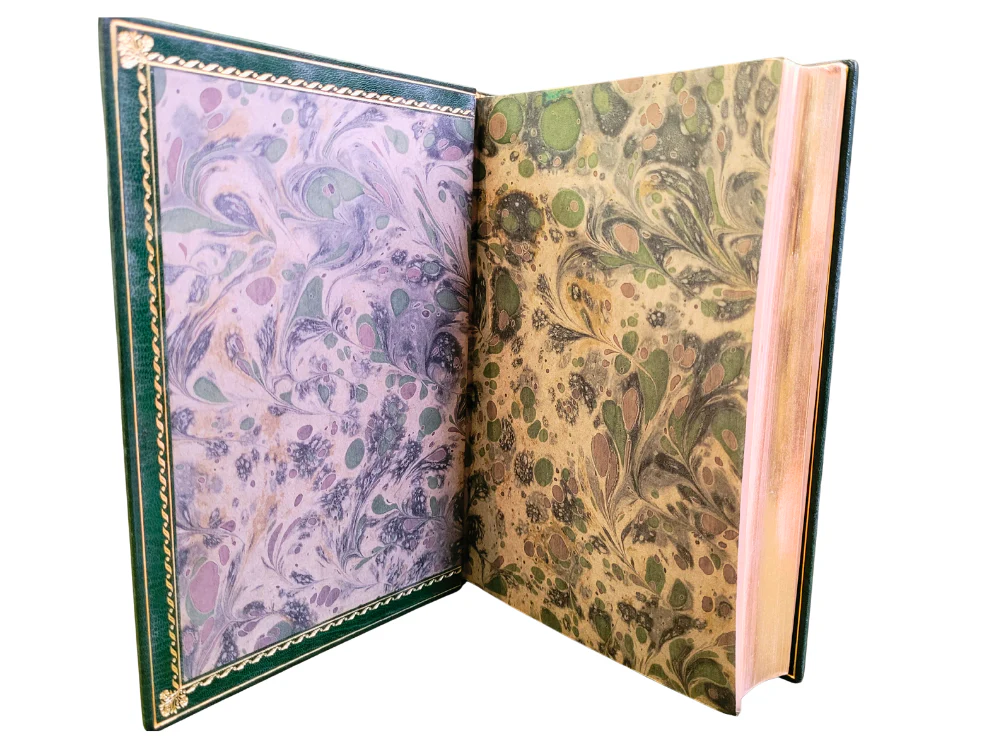
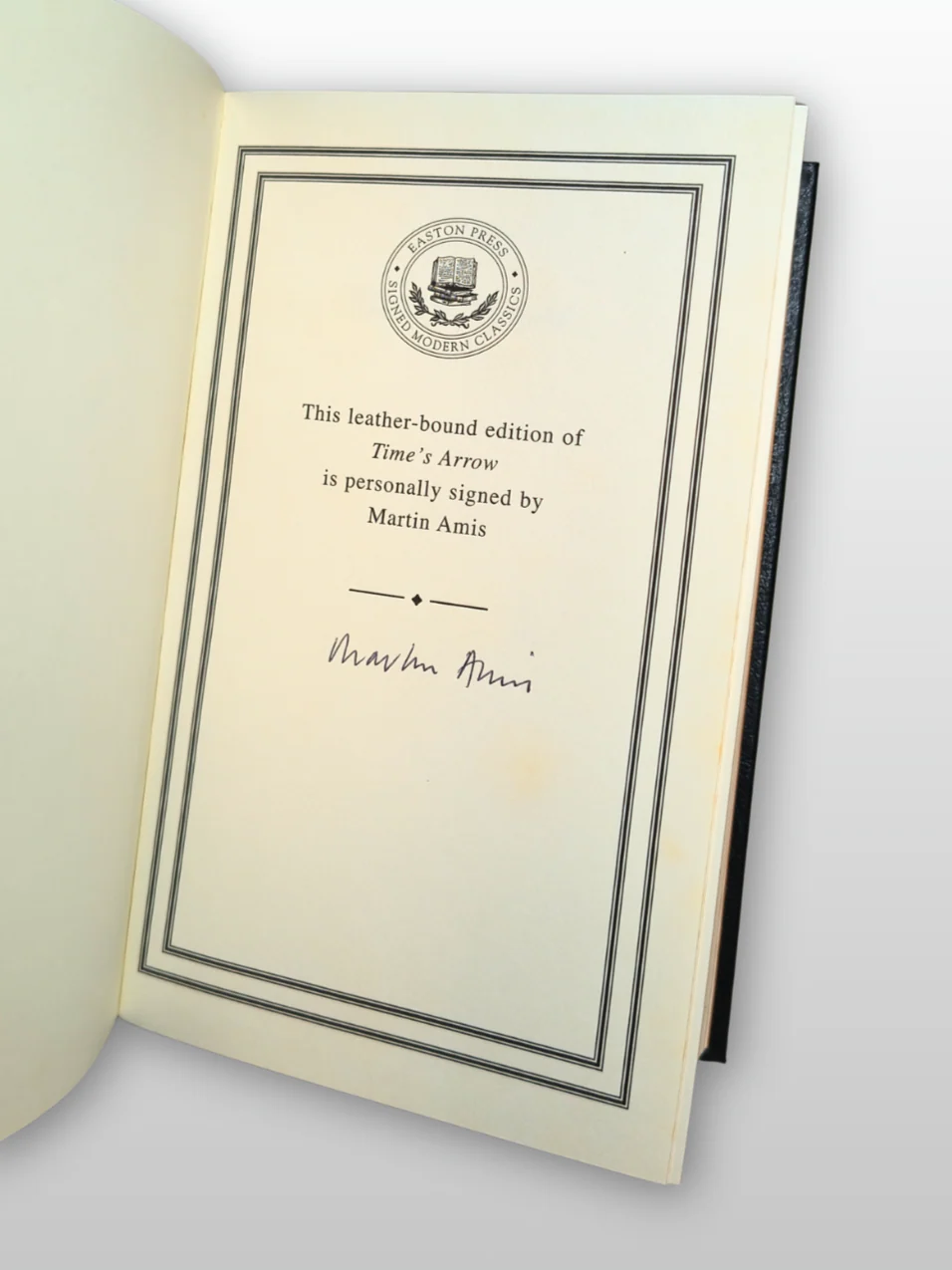
Octavo. Full black leather. Spine with five raised bands, 22-carat gilt accents. Gilt design, lettering and fore-edges. All edges gilt. Moiré silk endpapers. Satin ribbon page marker. 168 pp. Signed Collector's Edition. Part of the Easton Press Signed Modern Classics series. Signed by the author on the special signature page. Includes signed Certificate of Authenticity, Collector's Notes, and bookplate adhered to front endpaper. Originally published London: Jonathan Cape, 1991.
Martin Amis (1949–2023) was born in Oxford, the son of Kingsley Amis, and established himself across a career of forty years as one of the central figures in postwar British fiction — a novelist of formidable technical invention, satirical range, and stylistic ambition whose influence on the generation that followed him is difficult to overstate. Money (1984) and London Fields (1989) are the novels on which his popular reputation rests; Time's Arrow, published in 1991 and shortlisted for the Booker Prize, is the one that best demonstrates what his intelligence could do when given a subject of commensurate magnitude. The Times named him one of the fifty greatest British writers since 1945. He died in May 2023; signed copies of his work carry the significance of a posthumous signature from one of the most important British novelists of his generation.
The novel is 168 pages long. Its subject is the Holocaust. Its formal conceit is that the entire narrative runs backwards — from death to birth, from post-war suburban America back to the death camps of occupied Poland — and is narrated by a consciousness that has no agency, only perception, riding inside the body of a Nazi doctor called Tod T. Friendly as his life reverses toward its origins.
The effect of the reversed narrative on the reader's experience of the Holocaust material is the novel's central and most disturbing achievement. A life experienced backwards is a life in which consequences precede causes, in which food emerges from mouths and returns to plates, in which injuries heal as the doctor approaches rather than withdraws. Within this logic, Auschwitz becomes, as experienced by the narrator moving backwards through it, a place of miraculous creation: the dead are restored to life, families are reunited, the smoke and ash of the crematoria reconstitute themselves into living human beings. The horror of this inversion — the recognition that the formal beauty of the reversal enacts an annihilation of meaning, that what it depicts as creation was in reality destruction — is the "nature of the offence" of the subtitle. It is one of the most formally daring responses to the question of whether and how the Holocaust can be represented in fiction, and one of the most successful.
Fine. Presenting as new.
This book is currently not on display in store. If you would like more information or to arrange a viewing, please contact: [email protected]
Catalogue Number: HH000563
Product Information
Product Information
Shipping & Returns
Shipping & Returns


Time's Arrow (Easton Press Signed Collector's Edition)
Time's Arrow (Easton Press Signed Collector's Edition)
AMIS, Martin. Time's Arrow; or, The Nature of the Offence. Norwalk, Connecticut: The Easton Press, 2011.
Octavo. Full black leather. Spine with five raised bands, 22-carat gilt accents. Gilt design, lettering and fore-edges. All edges gilt. Moiré silk endpapers. Satin ribbon page marker. 168 pp. Signed Collector's Edition. Part of the Easton Press Signed Modern Classics series. Signed by the author on the special signature page. Includes signed Certificate of Authenticity, Collector's Notes, and bookplate adhered to front endpaper. Originally published London: Jonathan Cape, 1991.
Martin Amis (1949–2023) was born in Oxford, the son of Kingsley Amis, and established himself across a career of forty years as one of the central figures in postwar British fiction — a novelist of formidable technical invention, satirical range, and stylistic ambition whose influence on the generation that followed him is difficult to overstate. Money (1984) and London Fields (1989) are the novels on which his popular reputation rests; Time's Arrow, published in 1991 and shortlisted for the Booker Prize, is the one that best demonstrates what his intelligence could do when given a subject of commensurate magnitude. The Times named him one of the fifty greatest British writers since 1945. He died in May 2023; signed copies of his work carry the significance of a posthumous signature from one of the most important British novelists of his generation.
The novel is 168 pages long. Its subject is the Holocaust. Its formal conceit is that the entire narrative runs backwards — from death to birth, from post-war suburban America back to the death camps of occupied Poland — and is narrated by a consciousness that has no agency, only perception, riding inside the body of a Nazi doctor called Tod T. Friendly as his life reverses toward its origins.
The effect of the reversed narrative on the reader's experience of the Holocaust material is the novel's central and most disturbing achievement. A life experienced backwards is a life in which consequences precede causes, in which food emerges from mouths and returns to plates, in which injuries heal as the doctor approaches rather than withdraws. Within this logic, Auschwitz becomes, as experienced by the narrator moving backwards through it, a place of miraculous creation: the dead are restored to life, families are reunited, the smoke and ash of the crematoria reconstitute themselves into living human beings. The horror of this inversion — the recognition that the formal beauty of the reversal enacts an annihilation of meaning, that what it depicts as creation was in reality destruction — is the "nature of the offence" of the subtitle. It is one of the most formally daring responses to the question of whether and how the Holocaust can be represented in fiction, and one of the most successful.
Fine. Presenting as new.
This book is currently not on display in store. If you would like more information or to arrange a viewing, please contact: [email protected]
Catalogue Number: HH000563
Original: $67.85
-65%$67.85
$23.75Product Information
Product Information
Shipping & Returns
Shipping & Returns
Description
AMIS, Martin. Time's Arrow; or, The Nature of the Offence. Norwalk, Connecticut: The Easton Press, 2011.
Octavo. Full black leather. Spine with five raised bands, 22-carat gilt accents. Gilt design, lettering and fore-edges. All edges gilt. Moiré silk endpapers. Satin ribbon page marker. 168 pp. Signed Collector's Edition. Part of the Easton Press Signed Modern Classics series. Signed by the author on the special signature page. Includes signed Certificate of Authenticity, Collector's Notes, and bookplate adhered to front endpaper. Originally published London: Jonathan Cape, 1991.
Martin Amis (1949–2023) was born in Oxford, the son of Kingsley Amis, and established himself across a career of forty years as one of the central figures in postwar British fiction — a novelist of formidable technical invention, satirical range, and stylistic ambition whose influence on the generation that followed him is difficult to overstate. Money (1984) and London Fields (1989) are the novels on which his popular reputation rests; Time's Arrow, published in 1991 and shortlisted for the Booker Prize, is the one that best demonstrates what his intelligence could do when given a subject of commensurate magnitude. The Times named him one of the fifty greatest British writers since 1945. He died in May 2023; signed copies of his work carry the significance of a posthumous signature from one of the most important British novelists of his generation.
The novel is 168 pages long. Its subject is the Holocaust. Its formal conceit is that the entire narrative runs backwards — from death to birth, from post-war suburban America back to the death camps of occupied Poland — and is narrated by a consciousness that has no agency, only perception, riding inside the body of a Nazi doctor called Tod T. Friendly as his life reverses toward its origins.
The effect of the reversed narrative on the reader's experience of the Holocaust material is the novel's central and most disturbing achievement. A life experienced backwards is a life in which consequences precede causes, in which food emerges from mouths and returns to plates, in which injuries heal as the doctor approaches rather than withdraws. Within this logic, Auschwitz becomes, as experienced by the narrator moving backwards through it, a place of miraculous creation: the dead are restored to life, families are reunited, the smoke and ash of the crematoria reconstitute themselves into living human beings. The horror of this inversion — the recognition that the formal beauty of the reversal enacts an annihilation of meaning, that what it depicts as creation was in reality destruction — is the "nature of the offence" of the subtitle. It is one of the most formally daring responses to the question of whether and how the Holocaust can be represented in fiction, and one of the most successful.
Fine. Presenting as new.
This book is currently not on display in store. If you would like more information or to arrange a viewing, please contact: [email protected]
Catalogue Number: HH000563