Webster's Third New International Dictionary of the English Language, Unabridged (Easton Press Collector's Edition)
MERRIAM-WEBSTER, INC. (ed.-in-chief Philip Babcock Gove; founded upon the lexicographical work of Noah Webster). Webster's Third New International Dictionary of the English Language, Unabridged. Norwalk, Connecticut: The Easton Press, 2002.
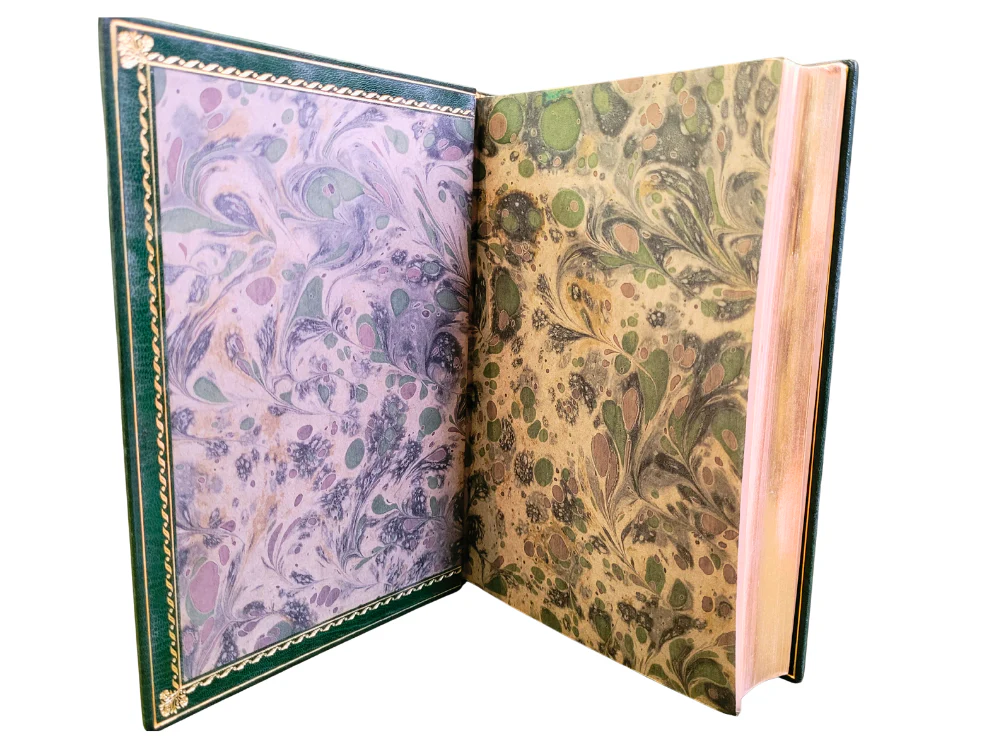
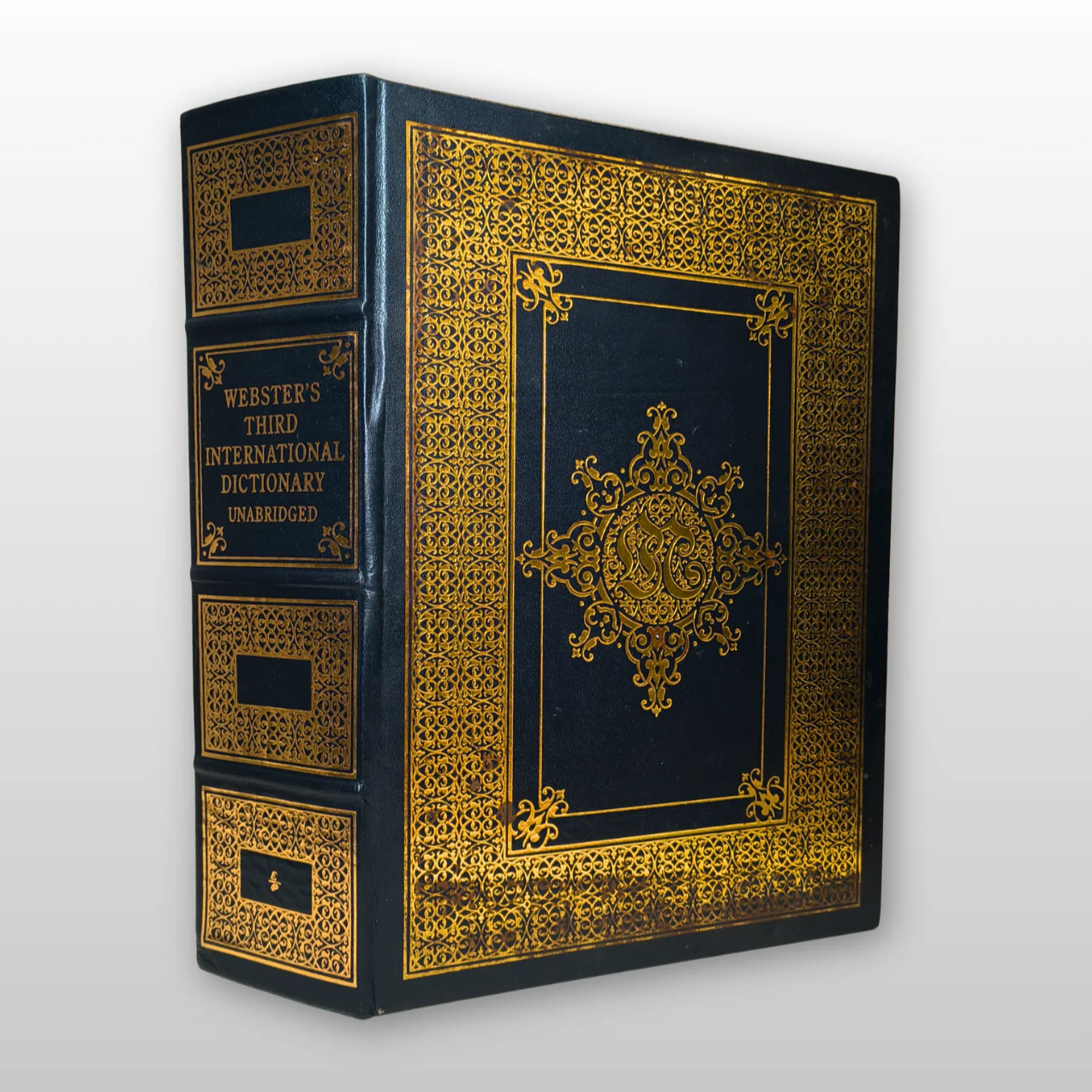
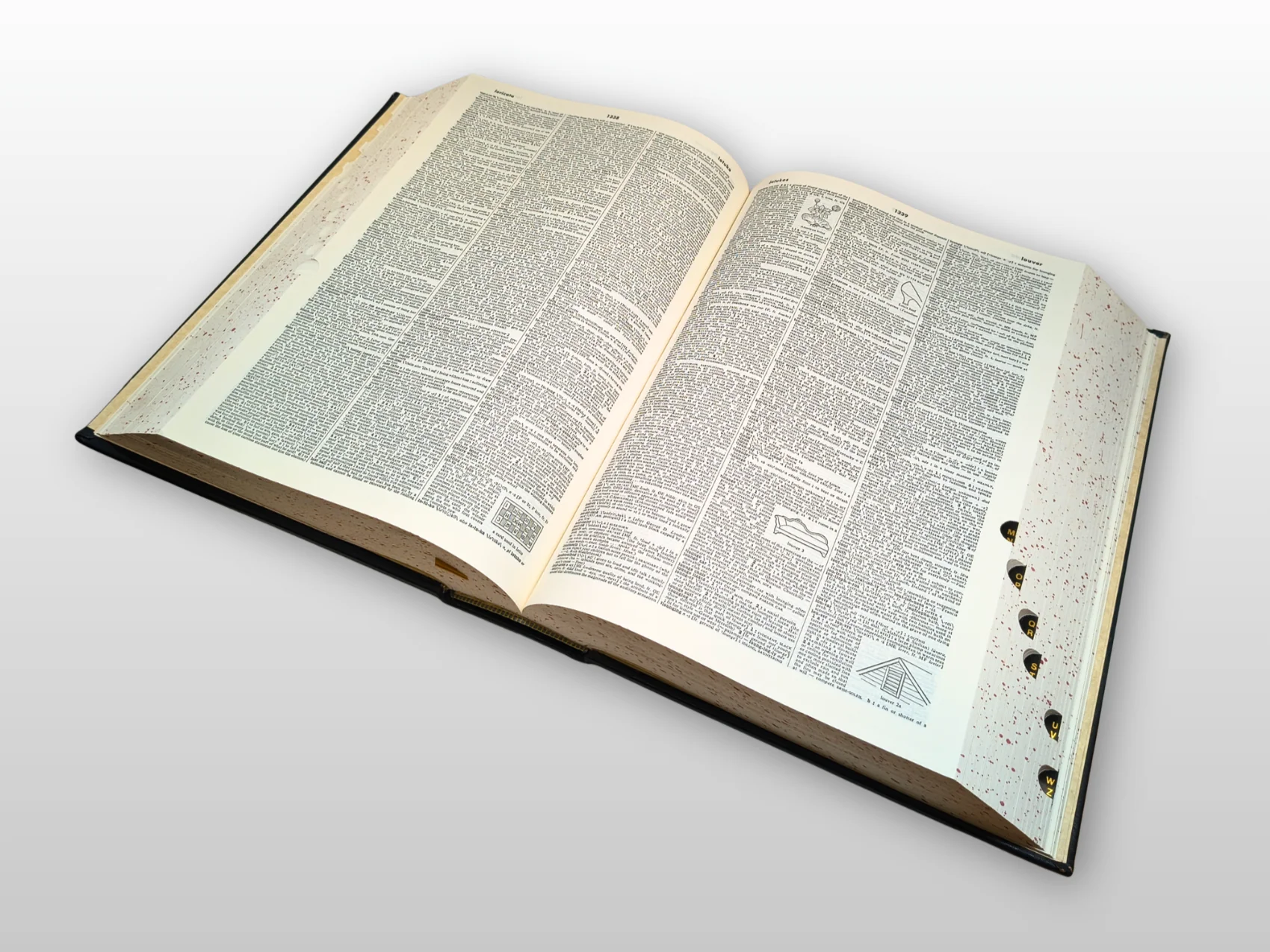
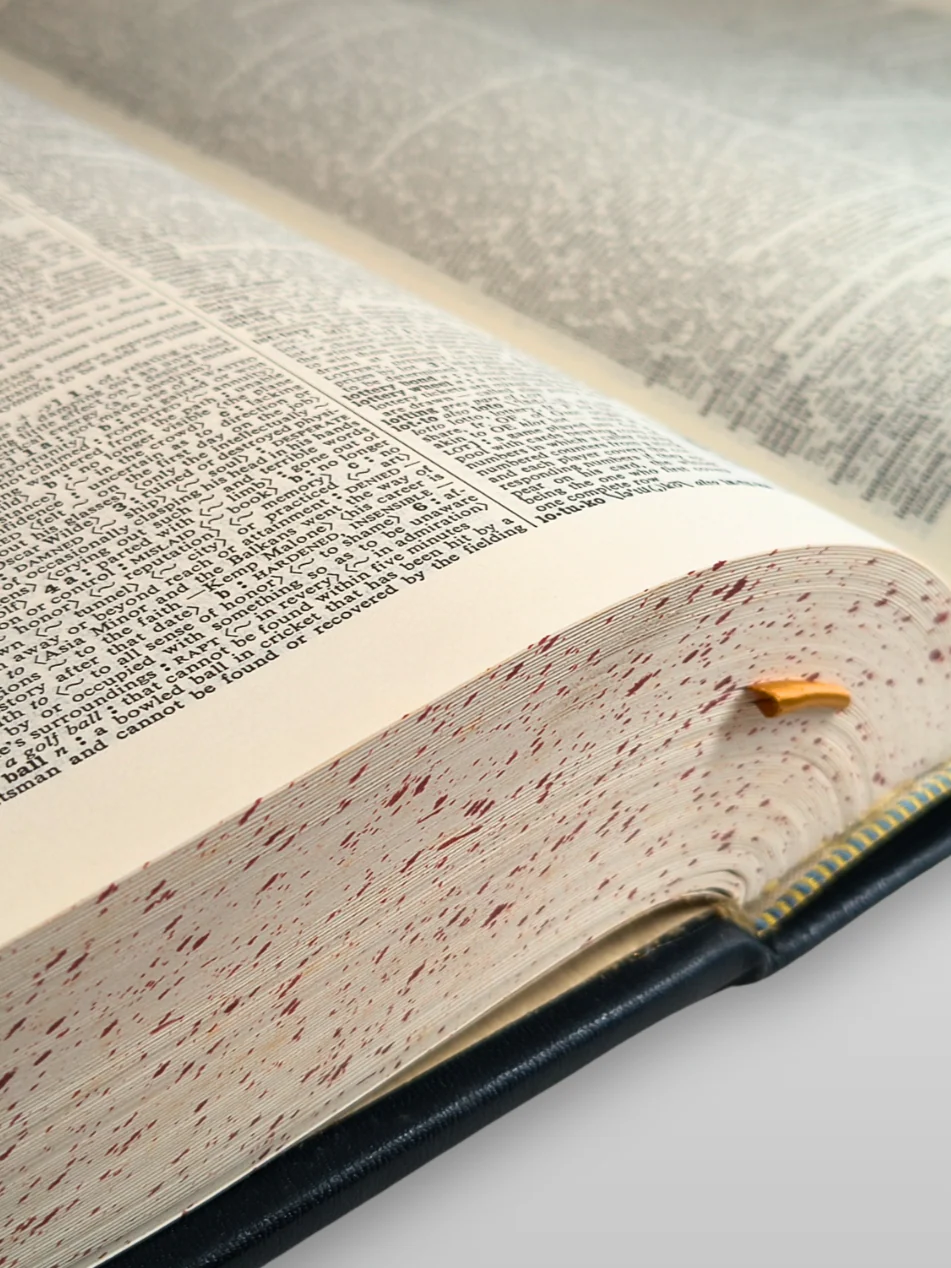
Quarto. Full deep blue leather. Spine with raised bands, 22-carat gilt accents. Gilt design and lettering to covers and spine. All edges decorated with red speckle. Moiré silk endpapers. Satin ribbon page marker. 2,661, [i]pp. Collector's Edition. Originally published Springfield, Massachusetts: G. & C. Merriam Company, 1961.
Noah Webster (1758–1843) published his American Dictionary of the English Language in 1828, the foundational act of American lexicography: a work that deliberately differentiated American English from British English in spelling, pronunciation, and vocabulary, and that made the argument, in its prefatory material, that a democratic republic required its own linguistic identity. Webster's name became synonymous with the dictionary in the United States, and when Merriam-Webster's predecessors acquired the rights to his work after his death and began producing revised and expanded editions, the brand was established that has carried his name through every subsequent iteration of the enterprise.
The Third New International Dictionary, published by G. & C. Merriam in 1961 under the editorship of Philip Babcock Gove (1902–1972), was the most comprehensive and the most controversial dictionary ever published in the English language. With over 470,000 entries and more than 100,000 illustrative quotations drawn from actual usage across an enormous range of sources, it represented the fullest realisation of the descriptive approach to lexicography: the view that a dictionary's function is to record how language is actually used, not to prescribe how it ought to be used. The distinction was not merely academic. The Third International's willingness to include terms previously considered too colloquial or too new for dictionary treatment, and its practice of recording usage rather than passing judgment on it, generated a furore of criticism from conservative commentators that reads, in retrospect, as a precise index of the cultural anxieties of its moment. The New York Times editorialised against it. Wilson Follett, writing in the Atlantic, called it "a scandal and a disaster." The dictionary survived the controversy and is now recognised as one of the great scholarly achievements of twentieth-century American publishing.
Very good. Some loss to lower cover gilt and some mild markings. Otherwise, fine throughout.
Please note: This is a large and heavy single-volume quarto reference work and may require additional postage costs. If so, we will contact you after purchase.
This book is currently not on display in store. If you would like more information or to arrange a viewing, please contact: [email protected]
Catalogue Number: HH000590
Product Information
Product Information
Shipping & Returns
Shipping & Returns
Webster's Third New International Dictionary of the English Language, Unabridged (Easton Press Collector's Edition)
Webster's Third New International Dictionary of the English Language, Unabridged (Easton Press Collector's Edition)
MERRIAM-WEBSTER, INC. (ed.-in-chief Philip Babcock Gove; founded upon the lexicographical work of Noah Webster). Webster's Third New International Dictionary of the English Language, Unabridged. Norwalk, Connecticut: The Easton Press, 2002.
Quarto. Full deep blue leather. Spine with raised bands, 22-carat gilt accents. Gilt design and lettering to covers and spine. All edges decorated with red speckle. Moiré silk endpapers. Satin ribbon page marker. 2,661, [i]pp. Collector's Edition. Originally published Springfield, Massachusetts: G. & C. Merriam Company, 1961.
Noah Webster (1758–1843) published his American Dictionary of the English Language in 1828, the foundational act of American lexicography: a work that deliberately differentiated American English from British English in spelling, pronunciation, and vocabulary, and that made the argument, in its prefatory material, that a democratic republic required its own linguistic identity. Webster's name became synonymous with the dictionary in the United States, and when Merriam-Webster's predecessors acquired the rights to his work after his death and began producing revised and expanded editions, the brand was established that has carried his name through every subsequent iteration of the enterprise.
The Third New International Dictionary, published by G. & C. Merriam in 1961 under the editorship of Philip Babcock Gove (1902–1972), was the most comprehensive and the most controversial dictionary ever published in the English language. With over 470,000 entries and more than 100,000 illustrative quotations drawn from actual usage across an enormous range of sources, it represented the fullest realisation of the descriptive approach to lexicography: the view that a dictionary's function is to record how language is actually used, not to prescribe how it ought to be used. The distinction was not merely academic. The Third International's willingness to include terms previously considered too colloquial or too new for dictionary treatment, and its practice of recording usage rather than passing judgment on it, generated a furore of criticism from conservative commentators that reads, in retrospect, as a precise index of the cultural anxieties of its moment. The New York Times editorialised against it. Wilson Follett, writing in the Atlantic, called it "a scandal and a disaster." The dictionary survived the controversy and is now recognised as one of the great scholarly achievements of twentieth-century American publishing.
Very good. Some loss to lower cover gilt and some mild markings. Otherwise, fine throughout.
Please note: This is a large and heavy single-volume quarto reference work and may require additional postage costs. If so, we will contact you after purchase.
This book is currently not on display in store. If you would like more information or to arrange a viewing, please contact: [email protected]
Catalogue Number: HH000590
Original: $52.14
-65%$52.14
$18.25Product Information
Product Information
Shipping & Returns
Shipping & Returns
Description
MERRIAM-WEBSTER, INC. (ed.-in-chief Philip Babcock Gove; founded upon the lexicographical work of Noah Webster). Webster's Third New International Dictionary of the English Language, Unabridged. Norwalk, Connecticut: The Easton Press, 2002.
Quarto. Full deep blue leather. Spine with raised bands, 22-carat gilt accents. Gilt design and lettering to covers and spine. All edges decorated with red speckle. Moiré silk endpapers. Satin ribbon page marker. 2,661, [i]pp. Collector's Edition. Originally published Springfield, Massachusetts: G. & C. Merriam Company, 1961.
Noah Webster (1758–1843) published his American Dictionary of the English Language in 1828, the foundational act of American lexicography: a work that deliberately differentiated American English from British English in spelling, pronunciation, and vocabulary, and that made the argument, in its prefatory material, that a democratic republic required its own linguistic identity. Webster's name became synonymous with the dictionary in the United States, and when Merriam-Webster's predecessors acquired the rights to his work after his death and began producing revised and expanded editions, the brand was established that has carried his name through every subsequent iteration of the enterprise.
The Third New International Dictionary, published by G. & C. Merriam in 1961 under the editorship of Philip Babcock Gove (1902–1972), was the most comprehensive and the most controversial dictionary ever published in the English language. With over 470,000 entries and more than 100,000 illustrative quotations drawn from actual usage across an enormous range of sources, it represented the fullest realisation of the descriptive approach to lexicography: the view that a dictionary's function is to record how language is actually used, not to prescribe how it ought to be used. The distinction was not merely academic. The Third International's willingness to include terms previously considered too colloquial or too new for dictionary treatment, and its practice of recording usage rather than passing judgment on it, generated a furore of criticism from conservative commentators that reads, in retrospect, as a precise index of the cultural anxieties of its moment. The New York Times editorialised against it. Wilson Follett, writing in the Atlantic, called it "a scandal and a disaster." The dictionary survived the controversy and is now recognised as one of the great scholarly achievements of twentieth-century American publishing.
Very good. Some loss to lower cover gilt and some mild markings. Otherwise, fine throughout.
Please note: This is a large and heavy single-volume quarto reference work and may require additional postage costs. If so, we will contact you after purchase.
This book is currently not on display in store. If you would like more information or to arrange a viewing, please contact: [email protected]
Catalogue Number: HH000590